
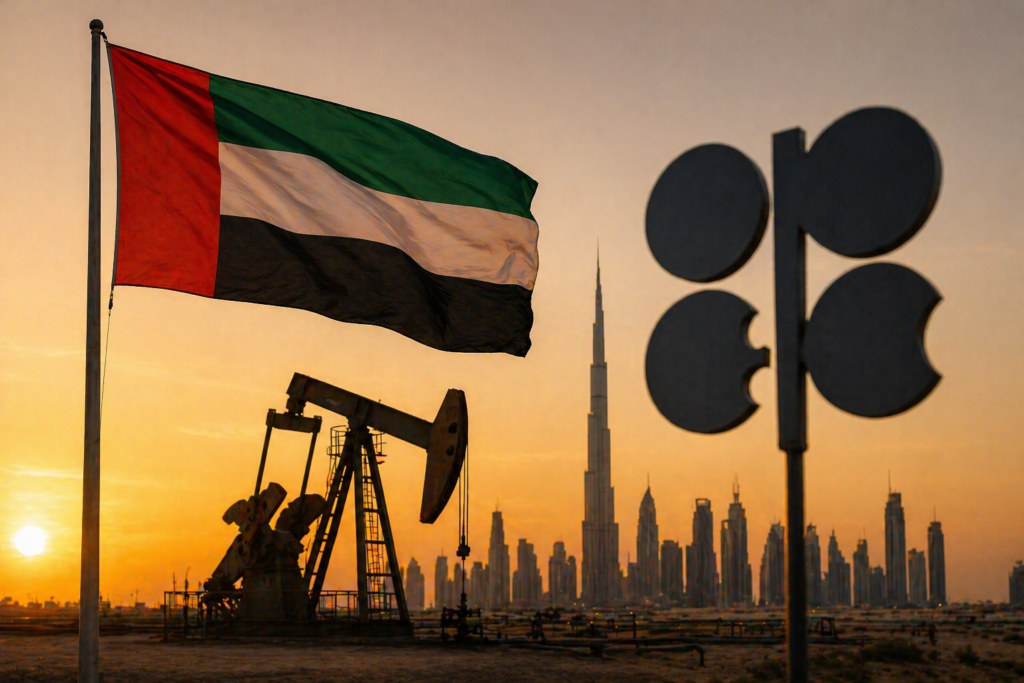
Image Credentials: Image Title: One Year On: UAE to Exit OPEC After Nearly Six Decades, Signaling Shift in Global Oil Dynamics Source: (chatgpt.com) Date: April 2026. Attribution: This image was created using AI-generated imagery (chatgpt.com) by Open Chronicle and does not depict a real-world scene.
By Open Chronicle with Agencies
The United Arab Emirates has announced it will leave OPEC on May 1, ending nearly 60 years of membership in the influential oil producers’ cartel.
In a statement carried by state media, the UAE said the decision reflects its “long-term strategic and economic vision” and an evolving energy profile. The country emphasized its growing focus on expanding domestic production capacity and positioning itself as a flexible and forward-looking player in global energy markets.
The move follows years of tension within OPEC, particularly between the UAE and Saudi Arabia, the group’s dominant force. Disagreements over production quotas have repeatedly strained relations, with Abu Dhabi pushing for higher output levels while Riyadh sought to maintain tighter controls to stabilize prices.
UAE is leaving OPEC after 50+ years. 🚨
One of the cartel’s biggest producers just walked away,
no more quotas, no more coordination.This could reshape global oil markets overnight.pic.twitter.com/sf5JYVp7bd
— SheTrades (@SheTrades_08) April 28, 2026
These disputes have at times delayed key OPEC meetings and highlighted deeper divisions within the alliance. Beyond oil policy, geopolitical differences have also contributed to the rift, including diverging positions in regional conflicts such as Yemen and increasing economic competition between the two Gulf powers.
The UAE’s exit comes at a sensitive moment for global energy markets. The ongoing Iran conflict has disrupted shipping through the Strait of Hormuz, limiting exports for Gulf producers and contributing to price volatility. Despite its ambitions to increase output, the UAE, like its regional counterparts, faces logistical constraints due to reduced maritime traffic in the area.
Analysts warn that the departure of a key producer could weaken OPEC’s ability to manage supply and influence prices. The group’s effectiveness has long depended on member countries’ willingness to limit production collectively, a mechanism that may now face greater strain.
The broader OPEC+ framework, which includes countries such as Russia and Mexico, will likely continue to play a role in coordinating output. However, the UAE’s decision raises questions about the future cohesion of the alliance and the balance of power within it.
Energy experts suggest that Saudi Arabia may now bear a greater burden in maintaining market stability, as one of the cartel’s key “swing producers.” At the same time, the UAE appears to be strengthening ties with Western partners, including the United States and European countries, as part of a broader strategic realignment.
In the long term, the UAE’s exit could mark a turning point for OPEC, potentially reducing its influence over global oil markets at a time of heightened geopolitical uncertainty and shifting energy priorities.