
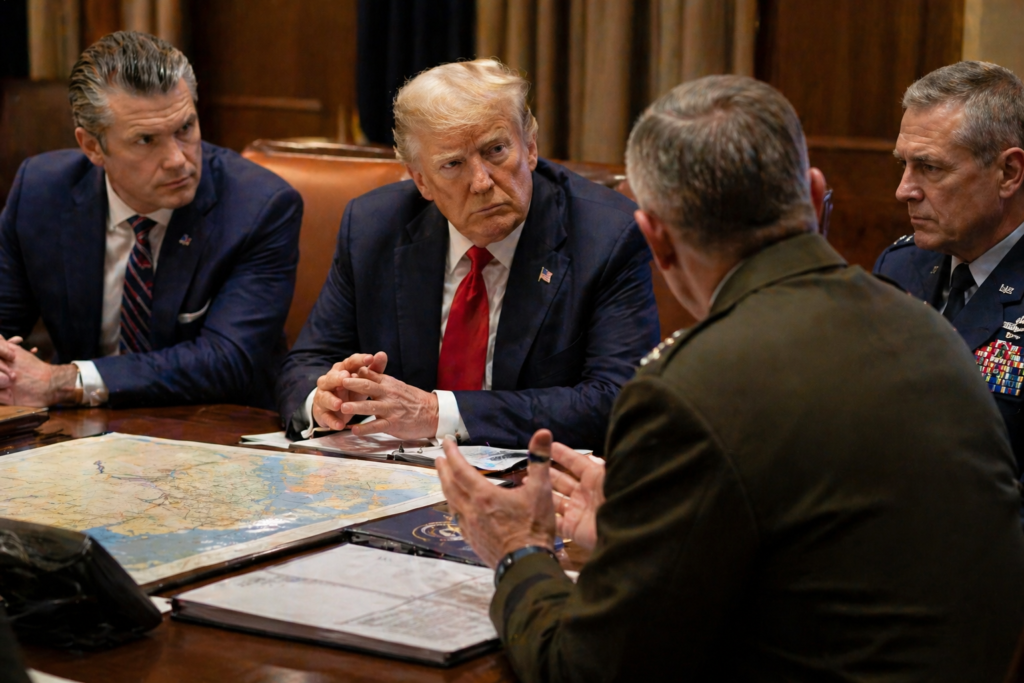
Image Credentials: Image Title: US Military Leaders to Brief Trump on Potential Iran Strike Options Source: (chatgpt.com) Date: April 2026. Attribution: This image was created using AI-generated imagery (chatgpt.com) by Open Chronicle and does not depict a real-world scene.
By Open Chronicle with Agencies
Senior U.S. military officials are set to brief Donald Trump on possible military actions against Iran, as tensions in the Middle East continue to escalate following weeks of conflict.
According to a U.S. official, the briefing will include Brad Cooper, head of U.S. Central Command, alongside Defense Secretary Pete Hegseth and Dan Caine. The discussion is expected to focus on strategies aimed at pressuring Iran into negotiations to end the ongoing war.
While specific operational details have not been disclosed, the options under consideration reportedly include targeted strikes on Iranian infrastructure as well as measures to secure parts of the Strait of Hormuz, a vital global shipping route that has been severely disrupted by the conflict.
The briefing is scheduled to take place after Hegseth and Caine testify before the Senate, where lawmakers are expected to question them about the conflict that began on February 28 with coordinated U.S. and Israeli military actions.
Reports suggest that military planners have prepared scenarios involving a rapid and concentrated wave of strikes designed to deliver a decisive impact in a short timeframe. Another potential course of action could involve direct intervention to reopen the Strait of Hormuz, where shipping traffic has dropped sharply amid ongoing hostilities.
The waterway remains a critical chokepoint for global energy supplies, accounting for roughly 20 percent of the world’s oil and liquefied natural gas shipments. Disruptions there have already contributed to rising energy prices and heightened volatility in global markets.
Despite the strategic considerations, the conflict has proven controversial domestically. Public opinion in the United States has shown significant opposition to deeper military involvement, even as geopolitical pressures mount.
The administration has not publicly commented on the details of the planned briefing, and both the White House and U.S. Central Command have declined to provide further information.
As Washington weighs its next steps, the decisions made in the coming days could have far-reaching implications for regional stability, global energy flows, and the broader trajectory of U.S. foreign policy.