
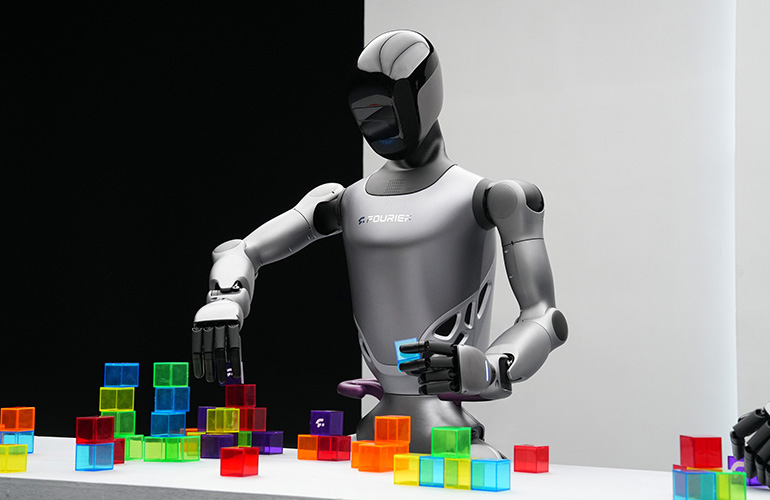
Image: from Ritwik Pavan X @ritwikpavan
By Open Chronicle with Agencies
In a rapidly evolving humanoid robotics landscape, the Fourier GR Series is carving out a distinct position by prioritizing practical, real-world applications over broad, general-purpose ambitions.
Developed by Fourier Intelligence, the GR Series is specifically designed for use in healthcare, rehabilitation, and service environments. This targeted approach sets it apart from many competitors that aim to build versatile humanoids capable of handling a wide range of tasks.
Focus on Real-World Use Cases
The emphasis on medical and assistive applications gives the GR Series a clearer path to near-term deployment. In settings such as physical therapy, elderly care, and hospital support, robots can provide consistent assistance, reduce strain on human staff, and improve patient outcomes.
Industry analysts note that this specialization may offer a more sustainable growth trajectory compared to more experimental humanoid projects that are still searching for viable commercial use cases.
Fourier Intelligence Robotics’ GR-2 introduces 12-DoF dexterous hands—double the dexterity of previous models. It is equipped with seven types of distinct FSA actuators.
It also comes with six array-type tactile sensors. These sensors can sense force, identify object shapes and… pic.twitter.com/sx3y6Y93Dq
— Wevolver (@WevolverApp) March 6, 2026
Lower Visibility, Strong Potential
Despite its practical advantages, the GR Series has not achieved the same level of public attention as some higher-profile robotics platforms. Unlike competitors that generate viral interest through demonstrations and social media exposure, Fourier’s approach has been more understated.
However, experts suggest that long-term success in robotics may depend less on visibility and more on reliability and real-world integration. In that sense, the GR Series could be well positioned to gain traction in sectors where functionality matters more than spectacle.
A Strategic Niche
The growing demand for automation in healthcare, driven by aging populations and workforce shortages, creates a favorable environment for specialized humanoid robots. By focusing on this niche, Fourier Intelligence may be able to establish a strong foothold in a market with immediate needs.
While broader humanoid platforms continue to evolve, the GR Series highlights a different strategy, one centered on solving specific problems today rather than pursuing universal capability tomorrow.
Power Ranking Perspective
From an industry standpoint, the verdict is clear: the Fourier GR Series may not dominate headlines, but its practical design and targeted applications give it meaningful potential.
In a field often driven by hype, its quiet, purpose-driven development could prove to be a significant advantage over time.