
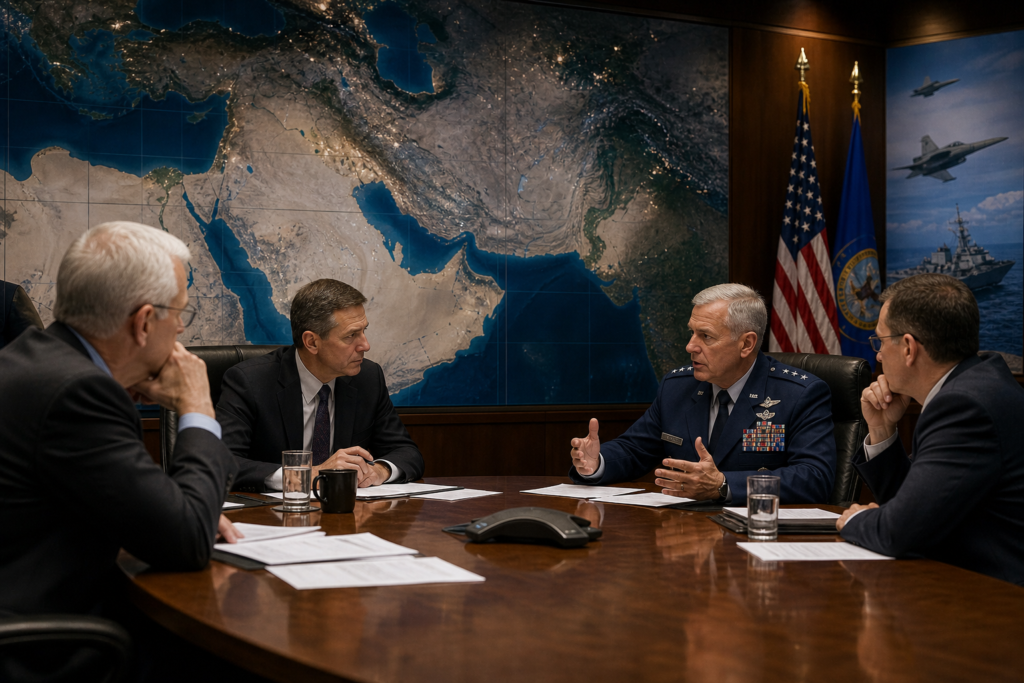
Image Credentials: Image Title: Analysts Warn Airpower Alone Has Not Secured US Goals in Iran War Source: (chatgpt.com) Date: May 2026. Attribution: This image was created using AI-generated imagery (chatgpt.com) by Open Chronicle and does not depict a real-world scene.
By Open Chronicle
Defense analysts and former senior military commanders have warned that the United States has achieved tactical successes in the Iran war but has struggled to translate those gains into strategic results.
In a Council on Foreign Relations discussion led by Rob Danin, experts assessed the military campaign, the fragile ceasefire, the Strait of Hormuz crisis, and the limits of US airpower.
Former US Army Europe commander Ben Hodges said American forces, working with Israel, had inflicted significant damage on Iran’s conventional military capabilities. However, he argued that the broader outcome remains uncertain because Iran still retains the ability to disrupt shipping and launch attacks across the region.
Kelly Grieco of the Stimson Center described the conflict as two separate air wars. She said the United States had performed well in destroying targets, including vessels, launchers, and military facilities, but had struggled in the more decisive battle near the surface, where Iranian drones and missiles have denied Washington full control around the Strait of Hormuz.
Max Boot of the Council on Foreign Relations said the war showed the limits of airpower. He noted that early goals such as regime change and ending Iran’s nuclear program have not been achieved, even as US and Israeli strikes degraded parts of Iran’s military infrastructure.
Panelists also questioned the clarity of Washington’s objectives. Hodges said the administration had not clearly defined why the United States entered the war, with explanations shifting from support for protesters to nuclear concerns and then to reopening the Strait of Hormuz.
Former NATO commander Philip Breedlove said unclear objectives make it harder to choose the right military tools. He argued that strikes may destroy targets successfully while still failing to advance a lasting political end state.
The experts warned that Iran’s use of drones, missiles, speedboats, and maritime pressure has exposed weaknesses in US planning. Boot said Iran has demonstrated an ability to threaten one of the world’s most important energy corridors despite being far weaker than the United States militarily.
The discussion also highlighted concerns over depleted US stockpiles of advanced munitions, including Tomahawk missiles and costly air defense interceptors. Analysts said replacing those weapons could take years and create risks in other theaters, including Europe and the Indo-Pacific.
Several speakers stressed that any major ground operation inside Iran would carry extreme risks. Hodges warned that a land invasion would be far more difficult than Iraq and could become one of the most serious military disasters in modern US history.
The panelists also debated the future of US bases in the Gulf. Grieco argued that Washington should rethink its posture in the Middle East and focus more on the Indo-Pacific, while Breedlove defended forward basing as essential for US global power projection.
Despite differences, the speakers largely agreed that diplomacy will be necessary to resolve the crisis. Boot said the United States may need a face-saving way to end the conflict and reopen Hormuz, while acknowledging that Iran now has significant leverage through its control over the strait.
The discussion concluded with a warning that tactical success should not be confused with strategic victory. Analysts said the Iran war has shown that destroying targets is not enough unless military action is tied to clear political objectives.
The Grand Strategy Institute
Continue Exploring Strategic Analysis
Return to The Grand Strategy Institute for strategic assessments, long-form analysis and research examining geopolitics, military affairs, international security, emerging technologies and the changing international order.
← Back to The Grand Strategy Institute