
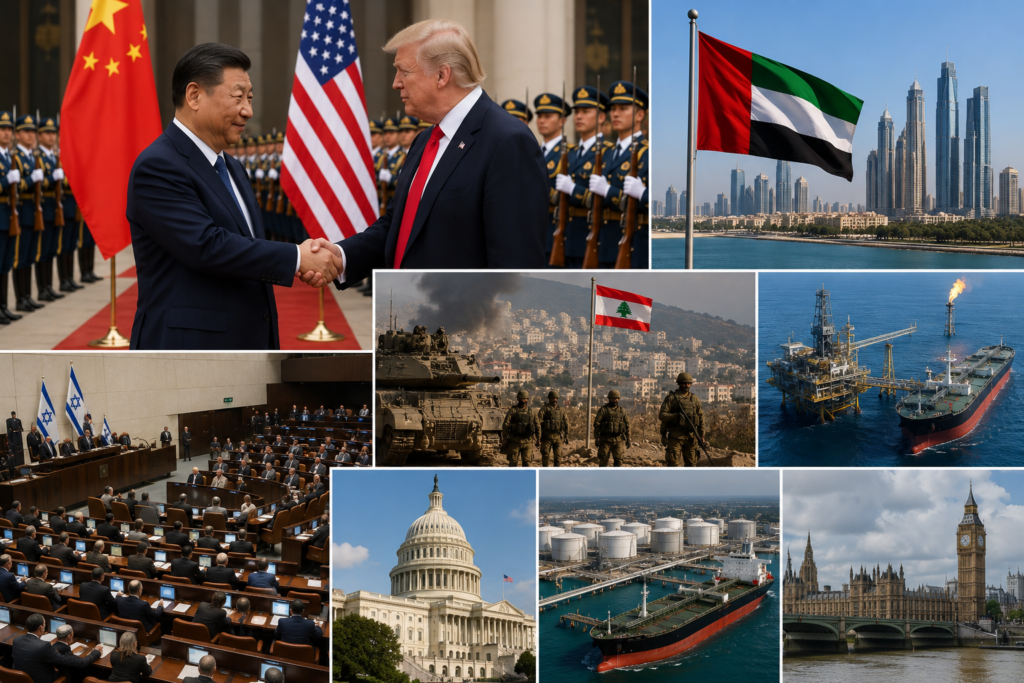
Image Credits: Image Title: Global News Brief: Key Events and Developments for May 14, 2026. Source: (chatgpt.com) Date: May 2026. Attribution: This image was created using AI-generated imagery (chatgpt.com) by Open Chronicle and does not depict a real-world scene.
By Open Chronicle with agencies
Trump and Xi Hold High-Stakes Summit in Beijing Amid Global Tensions
United States President Donald Trump and Chinese President Xi Jinping held high-level talks in Beijing on Wednesday as both countries attempt to stabilize relations amid growing geopolitical and economic tensions.
The summit, taking place at the Great Hall of the People, marked one of the most significant diplomatic meetings between Washington and Beijing in years.
Trump described relations between the two powers as potentially entering a new phase.
“Ties between our countries are poised to become better than ever before,” Trump said during the welcoming ceremony, repeatedly praising Xi’s leadership and China’s economic development.
Xi responded by emphasizing cooperation over confrontation.
“We should help each other succeed, prosper together, and find the right way for major countries to get along in the new era,” the Chinese leader said, adding that Beijing and Washington should remain “partners, not rivals.”
UAE Rejects Reports of Secret Netanyahu Visit
Meanwhile, the United Arab Emirates denied reports claiming Israeli Prime Minister Benjamin Netanyahu made a secret visit to the Gulf state during the recent war involving Iran.
In a statement, the Emirati Foreign Ministry rejected allegations that Netanyahu or any Israeli military delegation had been secretly received on Emirati territory.
The ministry stressed that relations between the UAE and Israel are conducted openly under the framework of the Abraham Accords and are “not based on secrecy or hidden arrangements.”
The denial comes amid continued regional scrutiny over Gulf-Israeli coordination during the conflict involving Iran.
Political Crisis Deepens in Israel
Inside Israel, Prime Minister Netanyahu’s governing coalition submitted legislation aimed at dissolving the Knesset amid growing political tensions over the military conscription of ultra-Orthodox Jewish communities.
The move was widely viewed as an attempt to counter opposition efforts seeking similar parliamentary action.
The political crisis adds further instability to Israel’s domestic landscape at a time of heightened regional uncertainty.
Lebanon and Regional Security Concerns
In Lebanon, officials continued discussions aimed at preventing further escalation between Israeli forces and Hezbollah.
Lebanese officials said the country’s immediate objective in negotiations with Israel is securing a lasting truce, while Israeli officials continue demanding Hezbollah’s disarmament.
The United Nations Interim Force in Lebanon also expressed concern about increased drone activity near peacekeeper positions.
Pressure Mounts on Keir Starmer
In the United Kingdom, Prime Minister Keir Starmer faced renewed political pressure as calls for his resignation continued inside the Labour Party.
During the traditional King’s Speech delivered by King Charles III, Starmer focused on outlining the government’s legislative priorities rather than directly addressing internal criticism.
King Charles warned Britain faces growing threats from an “increasingly dangerous and volatile world,” citing instability in the Middle East among the major concerns.
US Senate Confirms Kevin Warsh as Fed Chair
In Washington, the US Senate confirmed Kevin Warsh as the new chair of the Federal Reserve.
Warsh replaces Jerome Powell at a time when inflation, interest rates and economic uncertainty remain under intense scrutiny.
Markets are closely watching whether the new Fed leadership will align with Trump administration calls for lower interest rates and broader economic deregulation.
Oil Flows Through Hormuz Continue to Decline
Energy markets also remain under pressure as the US Energy Information Administration reported that oil flows through the Strait of Hormuz dropped nearly 30 percent during the first quarter of 2026.
The strategic waterway transported 14.6 million barrels per day between January and March, sharply below levels recorded in late 2025 and the previous year.
Separately, the International Energy Agency reported that global oil production fell by another 1.8 million barrels per day in April, reflecting the ongoing impact of tensions surrounding the Gulf region.
Analysts warn that prolonged instability around the Strait of Hormuz could continue disrupting energy markets and global trade flows throughout the year.