
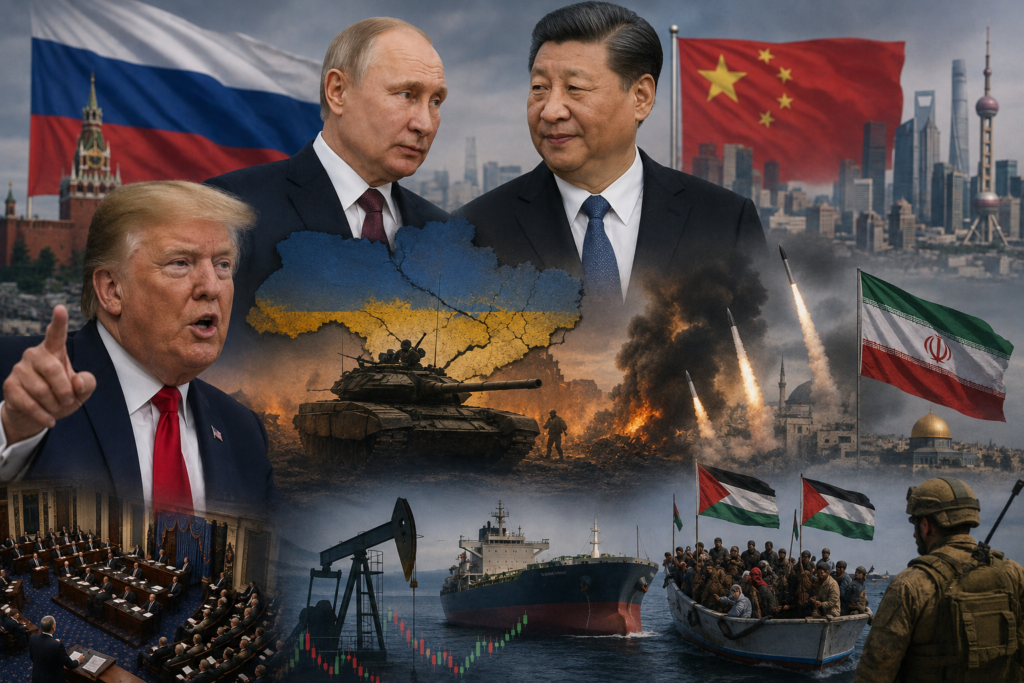
Image Credentials: Image Title: Global News Brief: Key Events and Developments for May 20, 2026. Source: (chatgpt.com) Date: May 2026. Attribution: This image was created using AI-generated imagery (chatgpt.com) by Open Chronicle and does not depict a real-world scene.
Russia, China, and the Middle East Crises Dominate the Global Agenda as New Geopolitical Blocs Emerge
By Open Chronicle with agencies
Russian President Vladimir Putin and Chinese President Xi Jinping used their latest summit in Beijing to showcase what both leaders described as an increasingly powerful strategic partnership, while simultaneous crises involving Iran, Gaza, and the global energy market continued to reshape the international balance of power.
Meeting at the Great Hall of the People, Putin said relations between Moscow and Beijing had reached an “unprecedentedly high level,” describing the partnership as a model for international cooperation during a period of global instability.
The Russian president referred to Xi as a “dear friend” and highlighted the dramatic expansion in economic ties between the two countries over the past 25 years. According to Putin, bilateral trade has increased more than thirtyfold during that period, with China now serving as one of Russia’s most important economic and geopolitical partners.
The summit comes as Russia continues to deepen its dependence on China following years of Western sanctions linked to the war in Ukraine. Moscow increasingly relies on Chinese markets, financial systems, and industrial support as restrictions imposed by the European Union and the United States continue to isolate the Russian economy from much of the Western financial system.
Despite maintaining large military expenditures and wartime industrial production, economic pressure inside Russia is becoming more visible. European officials recently argued that sanctions are beginning to create structural weaknesses in the Russian economy, pointing to slowing growth, inflationary pressure, labor shortages, and a widening budget deficit.
According to Russian government data cited by European officials, the country’s economy contracted by 0.3% during the first quarter of 2026, marking the first quarterly decline since early 2023. The Russian budget deficit has also expanded sharply, while inflation remains elevated despite high interest rates.
European Commission President Ursula von der Leyen recently claimed the sanctions were beginning to have a “biting effect” on the Russian economy, while French Foreign Minister Jean-Noël Barrot said Russia was “sinking into crisis.”
Still, Russia has avoided the economic collapse many Western governments initially predicted after the invasion of Ukraine. Massive military spending, estimated at nearly $190 billion in 2025, has helped sustain industrial production and employment across key sectors.
At the same time, geopolitical tensions across the Middle East continue to influence global diplomacy and energy markets.
US President Donald Trump said Wednesday that Washington was moving rapidly toward ending the conflict with Iran through negotiations, although military pressure against Tehran remains intense.
“We’re going to end that war very quickly,” Trump said at the White House, adding that Iran “wants to make a deal so badly.”
Trump also reiterated that Iran would never be allowed to obtain nuclear weapons and claimed recent American military operations had severely damaged Iranian military capabilities, including naval assets, air defenses, and air force infrastructure.
Meanwhile, reports emerged that the United States had seized an Iran-linked oil tanker in the Indian Ocean as part of ongoing efforts to maintain economic pressure on Tehran.
The conflict has also intensified fears over the security of critical energy infrastructure in the Gulf region. The head of the International Atomic Energy Agency warned that any direct attack on the Barakah nuclear power plant in the United Arab Emirates could trigger severe radioactive consequences.
Diplomatic tensions also escalated over Gaza after organizers of the Global Sumud humanitarian flotilla announced that Israeli authorities had seized all vessels attempting to deliver aid to the Palestinian enclave. The group accused Israel of illegally abducting activists participating in the mission.
Inside the United States, political divisions over foreign policy continued to deepen. The US Senate advanced a war powers resolution that would require congressional authorization for any prolonged military action against Iran, reflecting growing concern among lawmakers over executive military authority.
The Pentagon also confirmed plans to reduce the number of Brigade Combat Teams stationed in Europe from four to three, a move that has raised concern among some NATO allies amid continuing tensions with Russia.
Meanwhile, Kentucky Congressman Thomas Massie lost his Republican primary after facing strong opposition from Trump-aligned political groups and pro-Israel lobbying organizations. Massie had become one of the most visible Republican critics of US military involvement abroad.
Energy markets reacted cautiously to Trump’s decision to delay a planned military strike against Iran following direct appeals from Gulf leaders, including Qatar, Saudi Arabia, and the United Arab Emirates. Oil prices retreated slightly after the announcement, though markets remain volatile due to continued uncertainty surrounding the Strait of Hormuz.
Brent crude fell around 1.3% while the US benchmark West Texas Intermediate also declined modestly following the news.
Iranian President Masoud Pezeshkian defended ongoing negotiations with Washington, acknowledging the severe economic pressure facing Iran due to sanctions and disruptions to oil exports.
“They blocked the route, and we are not exporting oil either,” Pezeshkian said, according to Iranian media.
Analysts say the convergence of these crises, from the Ukraine war and Russia-China alignment to tensions in the Gulf and instability in Gaza, reflects the emergence of a far more fragmented and competitive international order.
As Washington, Moscow, and Beijing continue maneuvering for influence, global energy security, military alliances, and economic resilience are becoming increasingly interconnected.