
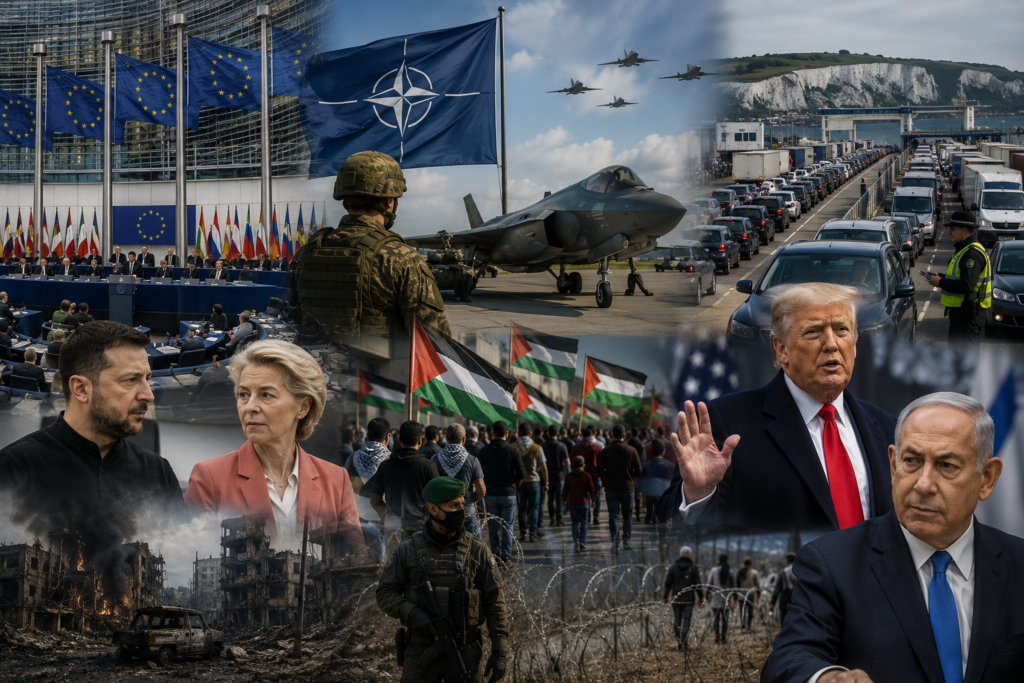
Image Credentials: Image Title: Europe Faces Renewed Security, Political and Border Challenges Amid Mounting Regional Tensions Source: (chatgpt.com) Date: May 2026. Attribution: This image was created using AI-generated imagery (chatgpt.com) by Open Chronicle and does not depict a real-world scene.
By Open Chronicle with agencies
Europe entered the weekend facing a convergence of geopolitical tensions, border disruptions, defense concerns, and political uncertainty, as governments across the continent responded to mounting pressure linked to the war in Ukraine, instability in the Middle East, and growing debate over the future direction of the European Union.
France announced a ban on Israeli National Security Minister Itamar Ben-Gvir from entering the country, following widespread criticism across Europe regarding the treatment of activists linked to the Gaza flotilla movement. The decision came amid increasing pressure from European lawmakers and governments demanding stronger measures against Israeli settler violence and the handling of humanitarian activists.
At the same time, European powers continued to express concern over escalating violence in the Middle East. Germany said it was “deeply worried” by Israeli strikes affecting health workers in southern Lebanon, while several EU member states pushed for renewed diplomatic efforts to contain regional instability.
The security situation across Europe also remained closely tied to developments surrounding Ukraine and NATO. The arrival of the first F-35 fighter jets in Poland marked another major step in strengthening NATO’s eastern flank, as Warsaw deepened military cooperation with Washington. The deployment followed U.S. President Donald Trump’s decision to send thousands of additional American troops to Poland after criticism from NATO allies over shifting U.S. military commitments in Europe.
NATO officials acknowledged growing uncertainty among member states regarding Washington’s long-term military posture on the continent. Several European governments voiced concern that the United States may gradually reduce its presence in Europe, forcing EU nations to accelerate defense coordination and strategic autonomy initiatives.
Meanwhile, Ukraine continued to press for full European Union membership. President Volodymyr Zelenskyy insisted Kyiv deserves complete accession rather than any form of “associate membership,” warning that partial integration could leave Ukraine in political limbo during a critical phase of the war with Russia.
Russian and Ukrainian attacks also intensified. Ukrainian drone strikes reportedly caused major fires at Russian oil terminals and industrial facilities, while Moscow accused Kyiv of launching attacks that killed civilians, including in a student dormitory. European officials warned that civilian casualties in Ukraine continue to rise sharply in 2026.
Across Western Europe, border management and migration remained politically sensitive topics. Long delays at the Port of Dover forced France to temporarily suspend additional EU border checks after severe congestion and hours-long queues disrupted travel during the bank holiday period. British officials and transport authorities faced criticism over the handling of post-Brexit border arrangements.
Brexit itself returned to the center of political debate after reports suggested that the EU could potentially fast-track Britain’s membership if the UK chose to reverse Brexit in the future. Several British politicians renewed calls for closer alignment with the European bloc, while others continued to defend the country’s departure from the union.
In Spain, the government unveiled plans to legalize more than 500,000 migrants as part of efforts to address labor shortages and stimulate economic growth. Elsewhere, Ireland reported record-high levels of sexually transmitted infections, contributing to broader European health concerns as public health agencies warned about rising cases of syphilis, gonorrhea, and chlamydia across the continent.
European governments were also confronted by increasing security concerns linked to infrastructure and industrial safety. In Germany, authorities discovered 1.5 tonnes of Soviet-era munitions in a Berlin forest, while Hungary reported a deadly explosion at its largest chemical complex. Britain issued its first amber heat-health alert of 2026 as unusually high temperatures spread across parts of the country.
Political developments across Europe added another layer of uncertainty. Former French Prime Minister Gabriel Attal officially launched his bid for the 2027 French presidential election, while former Prime Minister Édouard Philippe emerged as an early favorite in polling. In Slovenia, Janez Janša returned to power as prime minister, further reinforcing the growing strength of conservative and nationalist movements across parts of Europe.
The Vatican also drew international attention as Pope Leo XIV visited Italy’s “Land of Fires,” condemning environmental exploitation and toxic waste pollution. The Pope warned against what he described as “dizzying profits” driving ecological destruction in vulnerable communities.
As Europe navigates simultaneous crises involving war, migration, energy security, public health, and geopolitical realignment, leaders across the continent face increasing pressure to strengthen coordination while balancing national interests with broader regional stability.