
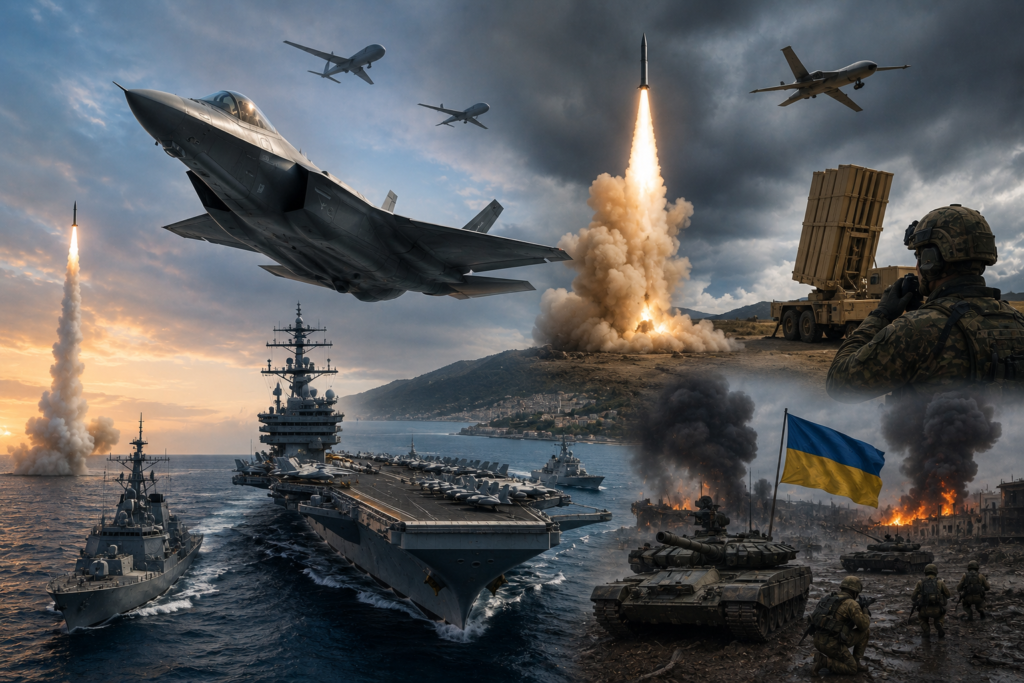
Image Credentials: Image Title: Rising Global Military Tensions Stretch From Europe to the Indo-Pacific. Source: (chatgpt.com) Date: May 2026. Attribution: This image was created using AI-generated imagery (chatgpt.com) by Open Chronicle and does not depict a real-world scene.
By Open Chronicle with agencies
Military tensions intensified across multiple regions on Saturday as NATO allies, Russia, Iran, China and the United States all escalated defense operations, deployments and strategic warnings amid growing instability from Eastern Europe to the Indo-Pacific.
Ukraine and the United States issued fresh alerts over the possibility of a major Russian missile strike involving the nuclear-capable hypersonic “Oreshnik” missile. Ukrainian President Volodymyr Zelensky warned that Moscow may be preparing a significant new assault, while the U.S. Embassy in Kyiv released security advisories urging caution.
The warnings came as fighting between Russia and Ukraine continued to escalate at sea and on land. Ukrainian forces claimed they destroyed the Russian frigate Admiral Essen and a missile hovercraft during a strike on Novorossiysk, one of Russia’s key naval hubs on the Black Sea. Ukrainian drones also reportedly targeted chemical facilities and military supply infrastructure deep inside Russian territory.
At the same time, Russia’s military posture continued to raise concern among Western governments. Reports surrounding Moscow’s alleged secret ocean-floor nuclear missile project triggered renewed alarm among NATO planners, particularly as European officials warned that Russia may be adapting unconventional strategic systems capable of bypassing traditional defenses.
The broader NATO alliance also continued to grapple with uncertainty surrounding the future of U.S. military commitments in Europe. Poland reportedly expressed frustration over poor communication from Washington regarding troop deployments, despite the recent arrival of F-35 fighter jets intended to reinforce NATO’s eastern flank.
French far-right leader Marine Le Pen added to the debate by suggesting France should consider withdrawing from NATO’s integrated military command structure, reviving long-standing questions about Europe’s strategic autonomy.
Meanwhile, the Indo-Pacific region saw a significant expansion of American naval activity. A U.S. Navy supercarrier officially began operations in the Indo-Pacific as Washington continues efforts to strengthen deterrence against China and secure maritime routes in the region. The deployment coincided with growing concerns over Beijing’s naval modernization and reports that China may be developing what could become the world’s largest naval support vessel.
China tensions also extended into Taiwan, where thousands rallied in support of higher defense spending as fears over regional security continued to grow. U.S. military planners remain increasingly focused on preparing for possible conflict scenarios in the Pacific, including space and cyber warfare capabilities.
In the Middle East, diplomatic and military tensions surrounding Iran remained high despite ongoing mediation efforts. Pakistan’s army chief traveled to Tehran for talks aimed at preventing further escalation between Iran, the United States, and Israel. Iranian officials warned Washington against resuming military operations, claiming the country had already rebuilt significant portions of its military capabilities during the current ceasefire period.
The U.S. Central Command said nearly 100 ships had been rerouted due to naval restrictions and operational risks linked to the Strait of Hormuz, one of the world’s most strategically important maritime corridors.
Elsewhere, Syria participated alongside Turkish and NATO forces in the EFES military exercises, highlighting the rapidly shifting diplomatic landscape in the region as Damascus cautiously reopens channels with Western powers.
Defense modernization efforts also accelerated worldwide. Lockheed Martin announced the construction of a new manufacturing facility in the United States that will produce advanced missile defense systems, including THAAD interceptors and next-generation missiles designed to counter Russia’s Sarmat intercontinental ballistic missile systems.
The Pentagon simultaneously continued expanding its next-generation warfare programs. The U.S. Navy’s Project Overmatch, designed to integrate battlefield data across air, land, sea and space assets, drew renewed attention as military analysts described it as a critical component of future American warfare strategy.
The United States also approved additional support packages for Ukraine’s air defense systems, while European nations increased pressure on NATO members to maintain or raise defense spending targets amid fears of prolonged instability.
Across Africa and the Middle East, military operations against extremist groups also continued. Nigerian troops reported killing militants and recovering explosives during operations against Boko Haram and ISWAP fighters in the country’s northeast.
As multiple conflicts and strategic rivalries evolve simultaneously, military planners across the world are increasingly warning that the global security environment is entering one of its most volatile and unpredictable periods in decades.