
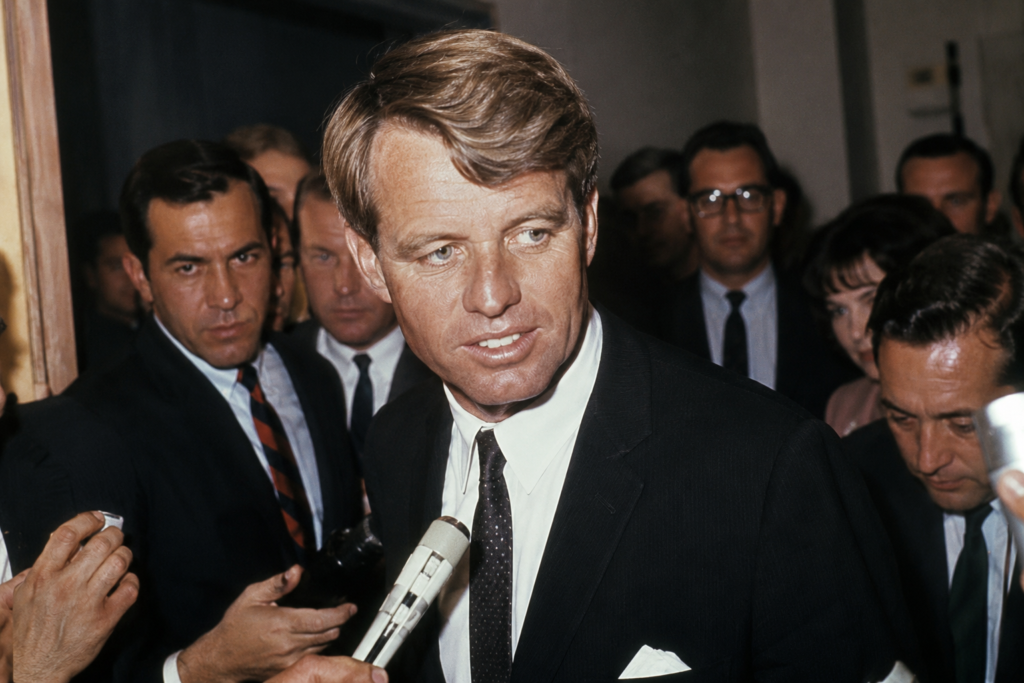
Image Credentials: Image Title: Today in History, June 5: The Assassination of Robert F. Kennedy. Source: (chatgpt.com) Date: May 2026. Attribution: This image was created using AI-generated imagery (chatgpt.com) by Open Chronicle and does not depict a real-world scene.
By Open Chronicle
On June 5, 1968, the United States was shaken by another political tragedy when Senator Robert F. Kennedy was fatally shot moments after celebrating a major victory in California’s Democratic presidential primary. The assassination came less than five years after the murder of his brother, President John F. Kennedy, deepening a sense of national grief and contributing to the enduring idea of a “Kennedy curse.”
Robert F. Kennedy, often known as RFK, had emerged as one of the most influential political figures of the 1960s. A former U.S. Attorney General under the administration of his brother, he later served as a senator from New York and became a leading voice on issues such as civil rights, poverty, social justice, and opposition to the Vietnam War.
The 1968 presidential campaign unfolded during one of the most turbulent periods in American history. The nation was deeply divided by the Vietnam War, racial tensions, and widespread social unrest. Following the assassination of civil rights leader Martin Luther King Jr. in April 1968, many Americans looked to Kennedy as a figure capable of bridging divisions and offering a message of hope.
Late on the night of June 4, Kennedy addressed supporters at the Ambassador Hotel in Los Angeles after winning the California Democratic primary, a crucial step in his campaign for the presidency. After delivering his victory speech, he left the ballroom through a kitchen pantry area, where he was confronted by Sirhan Sirhan, a 24-year-old Palestinian immigrant.
Sirhan opened fire, striking Kennedy and wounding several other people. The senator was rushed to the hospital, where doctors fought to save his life. Despite extensive efforts, Robert F. Kennedy died in the early hours of June 6, 1968, at the age of 42.
The assassination stunned the nation and the world. Millions of Americans watched as Kennedy’s funeral train carried his body from New York City to Washington, D.C., with crowds gathering along the tracks to pay their respects. The images became some of the most memorable scenes of national mourning in modern American history.
Sirhan Sirhan was arrested at the scene and later convicted of murder. His motives have been the subject of debate for decades, though he stated that he was angered by Kennedy’s support for Israel during the 1967 Arab-Israeli War.
Robert F. Kennedy’s death marked the loss of one of the most prominent political leaders of his generation. Many historians continue to speculate about how American history might have unfolded had he survived and secured the presidency.
More than half a century later, Kennedy’s legacy endures through his advocacy for civil rights, economic justice, and national unity. His assassination remains one of the defining moments of 1968, a year marked by upheaval, protest, and profound change across the United States and the wider world.