
OPEN CHRONICLE | WORLD NEWS DESK | POLITICS & GEOPOLITICS
The unprecedented meeting in Shenzhen brings together the leaders of the United States, China and Russia for talks on nuclear arms control, Ukraine, Iran and global trade. Beyond the diplomatic ceremony, the summit raises a fundamental question: can three competing powers cooperate on international security without undermining the interests of other nations?
By Open Chronicle World News Desk | November 18, 2026
SHENZHEN, CHINA | DEVELOPING STORY
Three presidents, one extraordinary diplomatic encounter
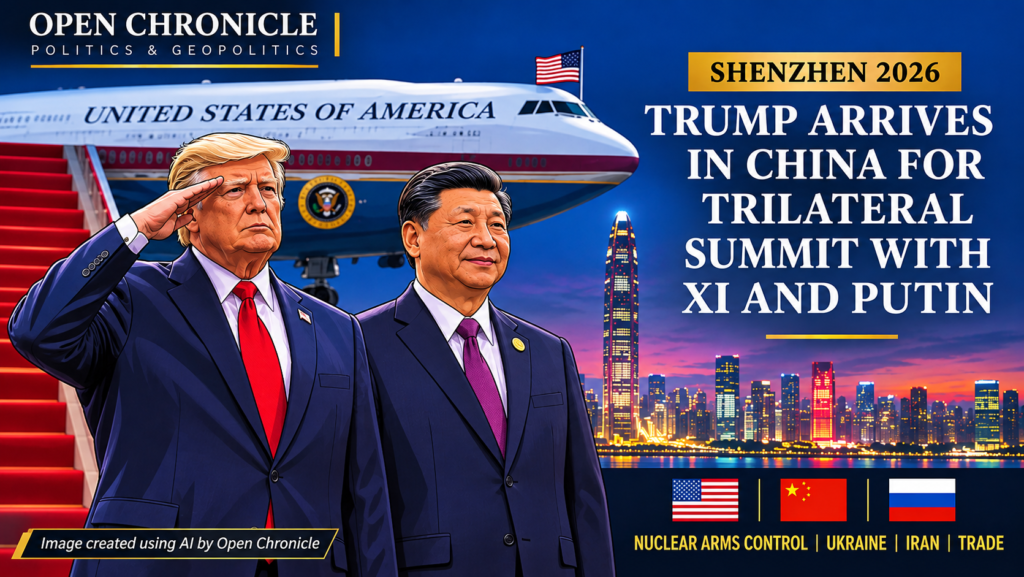
United States President Donald Trump arrived in Shenzhen on Wednesday, November 18, for a closely watched diplomatic gathering that could influence the direction of relations between the world’s three principal nuclear powers.
Chinese President Xi Jinping personally welcomed Trump at Shenzhen Bao’an International Airport, an unusually prominent gesture that highlighted the political importance Beijing attaches to the American president’s visit.
The arrival preceded a planned trilateral meeting on Thursday involving Trump, Xi and Russian President Vladimir Putin, alongside the Asia-Pacific Economic Cooperation (APEC) leaders’ summit.
The meeting is expected to address nuclear disarmament, Russia’s war against Ukraine, the conflict involving Iran, international trade and the wider strategic relationship between Washington, Beijing and Moscow.
It will be the first formal summit bringing together the three leaders in this format.
Although the meeting has generated considerable expectations, no comprehensive agreement has been announced, and the scope of any potential commitments remains uncertain.
The significance of the gathering lies not only in the subjects under discussion, but also in the fact that three governments with competing strategic interests have agreed to discuss some of the world’s most consequential security challenges at the same table.
1. Xi welcomes Trump: The symbolism of a carefully staged arrival
Trump’s arrival at Shenzhen airport was marked by a ceremony designed to project diplomatic warmth.
After descending from Air Force One, the American president was greeted by Xi on a red carpet decorated with Chinese and American national flags.
Participants carrying colourful pom-poms welcomed the delegation as the two leaders exchanged greetings and shook hands.
The presidents also briefly embraced, according to footage and reporting from the scene.
Trump stood at attention and saluted during the ceremonial proceedings, before departing for the summit venue.
The personal reception was significant.
Chinese leaders do not routinely greet visiting heads of state at the aircraft steps, and Xi’s decision to welcome Trump personally carried an unmistakable diplomatic message.
It also reciprocated the reception Trump had given Xi during the Chinese president’s visit to Washington in September.
The gesture suggested that both governments want to preserve direct communication at the highest level, even as they remain divided over trade restrictions, advanced technology, security alliances and the international order.
However, diplomatic symbolism should not be confused with political agreement.
Washington and Beijing continue to compete across multiple strategic sectors, and a cordial reception does not resolve the underlying disagreements.
Xi’s message, as reported by Chinese state media, emphasised his desire for a constructive and strategically stable relationship based on mutual respect and reciprocity.
The central question is whether that language can translate into practical agreements during the summit.
2. The Shenzhen summit: Why this meeting is different
Shenzhen 2026 | Diplomatic Overview
The planned trilateral meeting brings together the leaders of the United States, China and Russia for discussions expected to address nuclear arms control, international security, regional conflicts and global economic relations. The meeting is scheduled for November 19, 2026, and its diplomatic outcomes remain undetermined.
The meeting is scheduled and its agenda remains subject to diplomatic developments. These figures describe the summit’s format, not its outcome.
The Shenzhen meeting is unusual because it brings together three governments that occupy very different positions within the international system.
The United States remains the central military power within NATO and maintains an extensive network of alliances across Europe and the Indo-Pacific.
China is Washington’s principal long-term strategic competitor, with growing military capabilities, major economic influence and ambitions to reshape aspects of international governance.
Russia, meanwhile, remains a major nuclear power whose war against Ukraine has profoundly disrupted European security.
Each government approaches the summit with different priorities.
Washington is seeking to manage competition with China while addressing the conflicts involving Russia and Iran.
Beijing has an interest in reducing economic uncertainty, preserving access to international markets and preventing its rivalry with the United States from escalating into direct confrontation.
Moscow wants to maintain its strategic relevance, challenge Western pressure and strengthen its position in negotiations concerning European security.
The summit therefore brings together overlapping interests and substantial disagreements.
That combination makes diplomacy possible, but also limits the likelihood of sweeping agreements.
3. Nuclear disarmament: The most consequential item on the agenda
One of the most important subjects expected to be discussed is nuclear arms control.
The United States and Russia possess the world’s largest nuclear arsenals, while China has been expanding and modernising its nuclear forces.
This creates a difficult strategic environment.
For decades, nuclear arms control was primarily organised around bilateral agreements between Washington and Moscow.
China’s growing nuclear capabilities have complicated that framework.
The expiration of the New START treaty in February 2026 has intensified concerns about the absence of binding limits on the two largest nuclear arsenals.
Against this background, Trump has indicated that nuclear disarmament will feature in the discussions.
The challenge is considerable.
The United States and Russia possess substantially larger arsenals than China, creating disagreement over whether all three countries should accept comparable restrictions.
Beijing has traditionally argued that the countries with the largest arsenals should make the deepest reductions.
Washington, meanwhile, has increasingly emphasised the need to address China’s expanding nuclear capabilities.
Russia’s strategic calculations are shaped by its confrontation with NATO, the war in Ukraine and its wider relationship with the United States.
These competing priorities make a comprehensive trilateral arms-control treaty difficult to negotiate.
Nevertheless, the summit could provide an opportunity to explore more limited measures.
Such measures might include strategic dialogue, greater transparency, communication mechanisms and discussions intended to reduce the risk of nuclear miscalculation.
These are possible diplomatic avenues, not confirmed summit agreements.
The immediate significance of Shenzhen may therefore be the reopening of a structured conversation rather than the achievement of nuclear disarmament itself.
4. Ukraine: Could the summit reshape European security?
The war in Ukraine is another central issue surrounding the trilateral talks.
Russia’s military campaign has created the most serious European security crisis in decades, while Western governments continue to debate the military, economic and diplomatic measures required to support Ukraine.
The presence of Putin alongside Trump and Xi creates an opportunity for direct discussion about the conflict.
It also raises concerns about the role of Ukraine and its European partners in any negotiations.
European governments have repeatedly argued that decisions concerning Ukraine’s sovereignty, territory and security arrangements cannot legitimately be made without Ukrainian participation.
The Shenzhen summit presents a particular diplomatic challenge because Kyiv is not represented in the trilateral format.
There is a fundamental difference between major powers discussing the war and reaching a settlement accepted by the country directly affected.
China has maintained diplomatic and economic relations with Moscow while presenting itself as a potential contributor to a negotiated resolution.
Washington’s position has involved efforts to influence the course of the conflict while managing its relationship with Russia.
Moscow continues to pursue its own military and political objectives.
These differences mean that even a joint statement on Ukraine would require careful examination.
A declaration supporting peace would not necessarily establish agreement on territorial questions, security guarantees, sanctions or the conditions for a ceasefire.
The greatest diplomatic test would be whether any proposed framework respects Ukraine’s sovereignty and creates conditions for a durable settlement.
The summit’s symbolism has prompted comparisons with historical great-power conferences, particularly the 1945 Yalta meeting.
Such comparisons reflect concerns about powerful states negotiating arrangements affecting smaller countries.
However, Shenzhen and Yalta are different historical situations, and no agreement dividing spheres of influence has been established.
5. Iran and the Middle East: A second conflict on the diplomatic agenda
The conflict involving Iran is expected to feature prominently in Thursday’s discussions.
The United States, China and Russia approach Middle Eastern security from different strategic positions.
Washington’s military involvement has placed the region at the centre of American foreign policy, while China maintains significant economic interests across the Middle East, including energy imports and commercial relationships.
Russia also has longstanding diplomatic, military and strategic interests in the region.
These differences complicate any effort to establish a common position.
For Washington, the discussions could provide an opportunity to explore whether Beijing and Moscow can contribute to reducing regional tensions.
China has an interest in protecting energy supplies and maintaining stability along international shipping routes.
Russia’s calculations are influenced by its relationship with Iran and its wider confrontation with Western governments.
Any agreement would have to address the interests of regional states, rather than treating the Middle East exclusively as a matter for external powers.
The Strait of Hormuz is particularly important because disruptions to maritime traffic can affect energy markets and international commerce.
A prolonged regional conflict could also have consequences for shipping insurance, inflation, supply chains and global economic growth.
However, no jointly agreed peace framework has been announced ahead of the summit.
The immediate question is whether the three leaders can identify limited areas of cooperation despite their opposing positions on regional security.
6. Trade and technology: The economic rivalry behind the diplomatic ceremony
Although nuclear weapons and military conflicts dominate the summit’s security agenda, economic competition may prove equally important.
The United States and China remain deeply interconnected through trade, investment, manufacturing and global supply chains.
Yet both governments have increasingly treated advanced technology and critical industrial capacity as national security priorities.
Semiconductors, artificial intelligence, export controls and access to strategic materials are central to this competition.
At the APEC gathering, Xi called for greater openness in international trade and more equitable economic growth.
His message contrasted with Washington’s emphasis on protecting strategic industries and restricting access to certain advanced technologies.
China’s economy also faces domestic challenges, including weak demand and difficulties in the property sector.
For Beijing, stable international trade relationships remain important to economic performance.
Russia’s position is different.
Facing Western sanctions and restrictions, Moscow has sought to deepen economic relationships with non-Western partners and expand its role in Asian markets.
Putin used the APEC setting to criticise sanctions, tariffs and export restrictions, reinforcing Moscow’s opposition to Western economic pressure.
Why Shenzhen matters
Shenzhen is a particularly symbolic location for these discussions.
Once a relatively small city near Hong Kong, it has become one of China’s most important technology and manufacturing centres.
Its industrial ecosystem includes telecommunications, electronics, advanced manufacturing and innovation-intensive industries.
Holding the summit there allows Beijing to showcase its economic transformation and technological ambitions.
It also places the leaders in a city that embodies many of the sectors now driving strategic competition.
The central economic question is whether Washington and Beijing can preserve commercial cooperation while continuing to restrict technologies considered sensitive to national security.
A possible outcome would be an extension of existing trade understandings or the creation of new channels for negotiations.
Such measures would not eliminate strategic competition, but they could reduce uncertainty for businesses and financial markets.
7. Xi and Putin: A strategic partnership with its own priorities
Before the planned trilateral summit, Xi and Putin held discussions in Shenzhen.
Their relationship has become an important feature of the international political landscape.
China and Russia share opposition to certain aspects of American global influence, but their strategic interests are not identical.
Beijing’s priorities include economic growth, regional stability, technological development and managing competition with Washington.
Moscow places greater emphasis on its confrontation with NATO, its war in Ukraine and the consequences of international sanctions.
The two governments nevertheless maintain substantial diplomatic and economic cooperation.
Their relationship gives both countries additional leverage in dealing with Washington.
For China, maintaining ties with Moscow can strengthen its strategic position, although the war in Ukraine also creates diplomatic difficulties with European governments.
For Russia, cooperation with China provides access to important markets and political engagement at a time of strained relations with Western states.
The planned trilateral meeting therefore creates a delicate diplomatic environment.
Trump will be engaging two leaders whose governments cooperate closely in some areas but have different priorities.
A successful negotiation on one issue would not necessarily produce agreement on others.
The three leaders also exchanged greetings during Wednesday’s APEC events, with Trump and Putin shaking hands as Xi looked on.
The encounter preceded the more substantive discussions scheduled for Thursday.
8. From Manila to Shenzhen: Trump’s Indo-Pacific diplomatic strategy
Trump’s arrival in China followed meetings in Manila with leaders from Japan, Australia, India and Southeast Asia.
The Manila gathering included the Quadrilateral partnership, commonly known as the Quad, bringing together the United States, Japan, India and Australia.
The leaders reaffirmed their commitment to a free and open Indo-Pacific and expressed concern about coercive actions that could destabilise regional security.
Their joint statement also addressed economic coercion, including arbitrary export restrictions.
Although the statement did not explicitly identify China in its central language on coercion, the concerns reflected longstanding regional debates about economic dependence, maritime security and strategic competition.
The Quad announced or welcomed cooperation on maritime surveillance, critical infrastructure, cybersecurity and supply-chain resilience.
These initiatives demonstrate that Washington’s regional strategy involves more than direct relations with Beijing.
The United States is also working through partnerships designed to strengthen regional security and economic resilience.
Trump’s Asia Diplomacy
From regional security discussions in Manila to the planned trilateral summit in Shenzhen, four diplomatic developments illustrate the strategic importance of President Donald Trump’s Asian tour.
Manila | Quad Leaders’ Meeting
Quad leaders meet to discuss regional security, economic coercion and critical supply chains.
Manila | Meeting with Ferdinand Marcos Jr.
Trump meets Philippine President Ferdinand Marcos Jr. before travelling to China.
Shenzhen | Diplomatic Arrival
Xi welcomes Trump. APEC leaders gather, and Trump and Putin exchange greetings.
Shenzhen | Trilateral Summit
The first formal Trump, Xi and Putin trilateral meeting is scheduled to take place.
The diplomatic sequence reflects Washington’s simultaneous engagement with Indo-Pacific partners and its principal strategic competitors. While the Manila meetings focused on regional cooperation and security, the planned Shenzhen summit is expected to address broader questions of nuclear arms control, international conflicts and global economic relations.
The sequence illustrates a central feature of American diplomacy in Asia.
Washington is simultaneously pursuing dialogue with China and strengthening partnerships intended to preserve its regional influence.
These approaches are not necessarily contradictory.
Diplomatic engagement can help manage competition, while alliances and partnerships provide the United States with additional strategic options.
Nevertheless, Beijing may view some American regional initiatives as attempts to constrain China’s influence.
That tension will remain even if the Shenzhen summit produces a more cooperative diplomatic atmosphere.
9. North Korea: Could Kim Jong Un enter the diplomatic picture?
An additional possibility has emerged during Trump’s Asian tour.
The American president has suggested that he could meet North Korean leader Kim Jong Un while visiting China.
However, no meeting has been confirmed.
Secretary of State Marco Rubio said on Wednesday that Trump remained willing to engage with Kim, but emphasised that no summit had been scheduled.
The distinction matters.
A presidential expression of willingness to meet another leader does not establish that negotiations are under way or that the other government has accepted an invitation.
North Korea’s nuclear programme remains a major regional security concern.
A meeting involving Trump and Kim could reopen diplomatic communication, but it would also raise difficult questions about sanctions, nuclear weapons, verification and security guarantees.
China’s relationship with North Korea gives Beijing an important diplomatic role, although that does not mean it can determine Pyongyang’s decisions.
For now, a meeting with Kim remains a possibility rather than a confirmed component of the Shenzhen diplomatic programme.
10. Five developments to watch at Thursday’s summit
Five Developments to Watch at the Shenzhen Summit
Five critical diplomatic questions that could determine the significance of the planned trilateral meeting between Donald Trump, Xi Jinping and Vladimir Putin.
Nuclear arms control
Whether the leaders establish a formal negotiating process, confidence-building measures or a timetable for further talks.
Ukraine and European security
Whether Ukraine is addressed directly, and how any statements account for Kyiv’s sovereignty and the role of European governments.
Iran and regional stability
Whether the three governments identify areas of cooperation on de-escalation, energy security and diplomatic engagement.
Trade and advanced technology
Whether Washington and Beijing announce progress on tariffs, export controls, semiconductors or broader economic relations.
The future of trilateral diplomacy
Whether Shenzhen becomes a one-time diplomatic event or the beginning of a more structured dialogue among the three governments.
The significance of the Shenzhen summit will depend on whether diplomatic discussions produce verifiable commitments, practical confidence-building measures or sustained negotiating mechanisms. Symbolic gestures alone will not resolve the strategic disagreements separating Washington, Beijing and Moscow. Any announced understandings must also be assessed in relation to the sovereignty and security interests of countries directly affected by the conflicts under discussion.
The Big Picture | Can three competing powers negotiate a more stable world?
The Shenzhen summit represents an important moment in contemporary international relations.
For the first time, the leaders of the United States, China and Russia are preparing to meet together in a formal trilateral setting.
The gathering comes at a time of military conflict, nuclear uncertainty, economic competition and growing pressure on international institutions.
Its significance extends beyond the possibility of individual agreements.
The summit raises questions about how international security should be managed in a world where power is increasingly contested.
One possibility is that direct dialogue among major powers could reduce the risk of confrontation.
Regular communication, arms-control discussions and limited economic understandings might help prevent disputes from escalating.
A different concern is that diplomacy conducted primarily among the most powerful states could marginalise countries whose security and sovereignty are directly affected.
Ukraine provides the clearest example.
Any durable settlement of the war would require more than an understanding among Washington, Beijing and Moscow.
The same principle applies to the Middle East and the wider Indo-Pacific.
The interests of regional governments cannot be assumed to coincide with those of the major powers.
There is also a fundamental distinction between diplomatic symbolism and measurable results.
A carefully choreographed welcome, a historic photograph or a joint statement may signal a willingness to engage.
But the value of the summit will ultimately depend on whether it produces credible commitments, reduces uncertainty and establishes mechanisms capable of surviving future disagreements.
For Trump, Shenzhen offers an opportunity to demonstrate that Washington can engage its principal strategic competitors directly.
For Xi, the summit reinforces China’s position as a central venue for international diplomacy.
For Putin, participation provides an opportunity to engage the American president and project Russia’s continuing influence in global affairs.
Their interests overlap, but they do not fully converge.
The central question is whether the three governments can use their diplomatic influence to reduce international instability without attempting to determine the future of other nations in their absence.
Shenzhen may not resolve the conflicts dividing the international system.
It could, however, reveal whether its most powerful participants are prepared to manage those divisions through sustained diplomacy.
Sources and Further Reading
The following sources support the reporting, official summit arrangements and strategic context discussed in this article.
Trump’s arrival, Xi’s reception and trilateral summit preparations.
APEC discussions, trade policy and the positions of Xi and Putin.
Trump’s diplomatic schedule and planned discussions with Putin.
Chinese Ministry of Foreign Affairs
Official APEC meeting dates and Chinese hosting arrangements.
Official Quad statement on regional security, economic coercion and cooperation.
Japanese Ministry of Foreign Affairs
Quad leaders’ meeting and Indo-Pacific security priorities.
Radio Free Europe/Radio Liberty
Nuclear arms control, Iran and differing expectations over Ukraine.
Rubio’s statements concerning a possible meeting with Kim Jong Un.
This article was prepared by Open Chronicle using reporting published on November 18, 2026, official government statements and independent geopolitical analysis. Confirmed diplomatic events are distinguished from scheduled meetings, possible agenda items and prospective agreements. Interpretations concerning strategic competition, nuclear arms control, Ukraine, Iran and the international balance of power represent editorial analysis. No outcome of the November 19 trilateral meeting is presented as established fact.
Explore International Relations
Discover more reporting and analysis on diplomacy, international security, global governance and the changing balance of power.
Return to International Relations →