
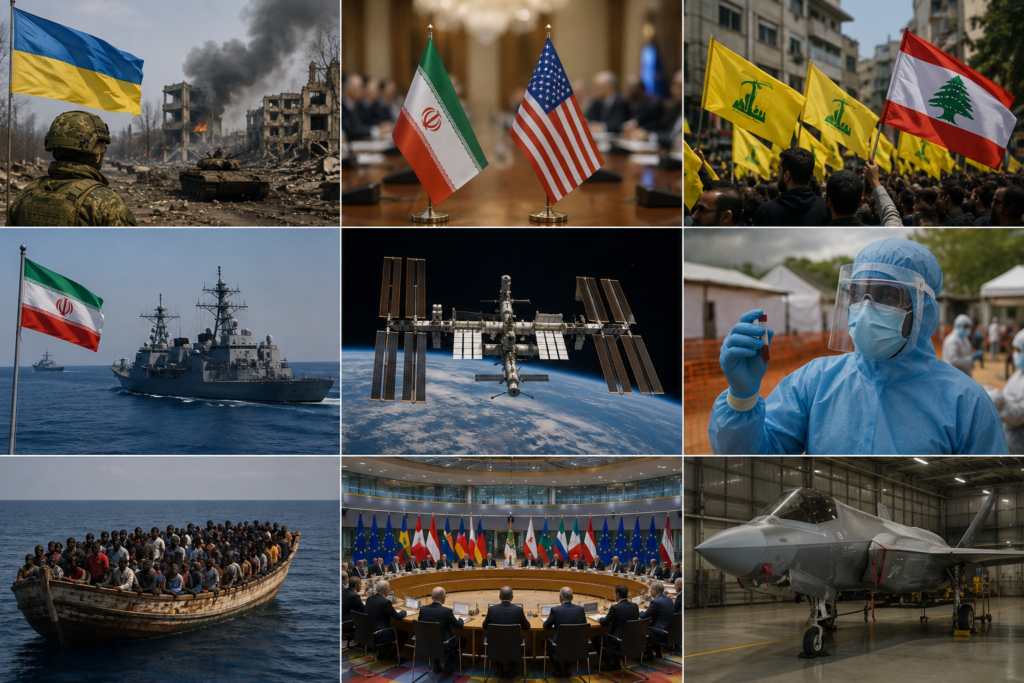
Image Credentials: Image Title: Taiwan Military Hosting Leak Highlights Shifting Balance Across the Taiwan Strait. Source: (chatgpt.com) Date: June 2026. Attribution: This image was created using AI-generated imagery (chatgpt.com) by Open Chronicle and does not depict a real-world scene.
By Open Chronicle with agencies
A series of major international developments unfolded on June 5, ranging from escalating tensions involving Iran, the United States, and Lebanon to new diplomatic initiatives in Europe, humanitarian emergencies in Africa, and renewed efforts to advance peace talks in the war between Russia and Ukraine.
Lebanon Pushes Back Against Iranian Influence
Lebanese leaders delivered some of their strongest criticism of Iran in years amid continuing instability along the Israeli-Lebanese border.
In an interview with CNN, Lebanese President Joseph Aoun declared that Lebanon is not a bargaining tool in Tehran’s negotiations with Washington, criticizing what he described as attempts to use the country as leverage in regional disputes.
Prime Minister Nawaf Salam echoed those concerns, calling on Iran to stop treating southern Lebanon as a strategic card in broader geopolitical negotiations. Meanwhile, Parliament Speaker Nabih Berri indicated he would support the withdrawal of Hezbollah forces from areas south of the Litani River if a stronger and more durable ceasefire arrangement can be secured.
Despite ongoing diplomatic efforts, Israeli strikes and cross-border attacks continued, leaving ceasefire prospects uncertain.
Ukraine Seeks Direct Talks as Fighting Continues
Ukrainian President Volodymyr Zelensky renewed calls for direct negotiations with Russian President Vladimir Putin, inviting him to participate in face-to-face peace talks.
The proposal came as Ukrainian forces intensified long-range operations. Ukrainian maritime drones reportedly struck Russian military assets, including damage to the Russian warship Boykiy, while separate drone incidents affected Romania’s Black Sea coastline after electronic warfare interference allegedly disrupted navigation systems.
Russia continued to reject public pressure while maintaining military operations, even as Western leaders prepared for further consultations with Zelensky. French President Emmanuel Macron, German Chancellor Friedrich Merz, and British Prime Minister Keir Starmer are scheduled to meet the Ukrainian leader in London later this week.
Gulf Tensions Persist Despite Diplomatic Progress
Conflicting reports emerged regarding naval encounters in the Gulf of Oman. Iranian officials claimed their navy fired warning shots toward American destroyers, while U.S. Central Command denied the allegations.
At the same time, Washington announced a new package of sanctions targeting Iran, while diplomats reported progress toward a possible nuclear framework agreement. International Atomic Energy Agency officials suggested both sides may be closer to a breakthrough, although several critical issues remain unresolved.
The United States also confirmed the diversion of 129 commercial vessels under its maritime blockade operations targeting Iranian shipping networks.
NASA Orders ISS Crew to Prepare for Emergency
NASA instructed astronauts aboard the International Space Station to take shelter and prepare for a possible evacuation after engineers detected a worsening air leak within the orbital laboratory.
While officials stressed that the crew remains safe, the alert reflects growing concern over structural integrity and ongoing efforts to isolate the source of the leak. Emergency procedures were activated as a precaution while repair options are evaluated.
WHO Launches Major Ebola Response
The World Health Organization and the Africa Centres for Disease Control and Prevention announced a $518 million emergency response plan to combat a rapidly evolving Ebola outbreak affecting parts of Africa.
Health officials warned that the outbreak remains highly dynamic and emphasized the need for immediate international support to contain transmission, strengthen surveillance, and improve treatment capacity.
Humanitarian Tragedies Across Continents
In Niger, at least 49 migrants died of thirst after a transport truck broke down in a remote desert region. The tragedy highlights the ongoing dangers faced by migrants crossing some of the world’s most unforgiving environments.
Elsewhere, more than 1,000 Nigerian nationals have reportedly requested assistance returning home from South Africa following a wave of attacks targeting foreign nationals.
Europe Debates Expansion and Economic Security
European Union leaders gathered in Montenegro to discuss the bloc’s potential enlargement to as many as 33 member states, reflecting growing interest from candidate countries in the Western Balkans and Eastern Europe.
At the same time, EU trade officials called for new mechanisms to diversify supply chains away from excessive dependence on China, amid increasing concerns about economic security and geopolitical competition.
Russia Expands Defense and Space Ambitions
At the St. Petersburg International Economic Forum, Russia unveiled plans to launch its own satellite communications network next year, described as a domestic alternative to Starlink.
Russian officials also announced progress on the Su-75 Checkmate fighter aircraft program and criticized Western sanctions, arguing they are damaging the broader global economy rather than achieving their intended objectives.
Other Major Developments
Japan agreed to begin discussions with Indonesia regarding a potential naval vessel transfer as both countries deepen defense cooperation.
A dangerous boat carrying approximately 240 Haitian migrants was intercepted near the Turks and Caicos Islands.
The U.S. Senate blocked efforts to extend a key surveillance program following political controversy surrounding intelligence leadership appointments.
The United States unveiled new sanctions against Iran and reportedly seized a sanctioned tanker operating in the Indian Ocean.
Meanwhile, inflation in Iran continued to soar, reaching levels that some economists describe as the highest experienced in the country since the Second World War.
As conflicts, diplomacy, economic competition, and humanitarian emergencies continue to intersect across multiple regions, June 2026 remains one of the most consequential periods for international affairs in recent years.