
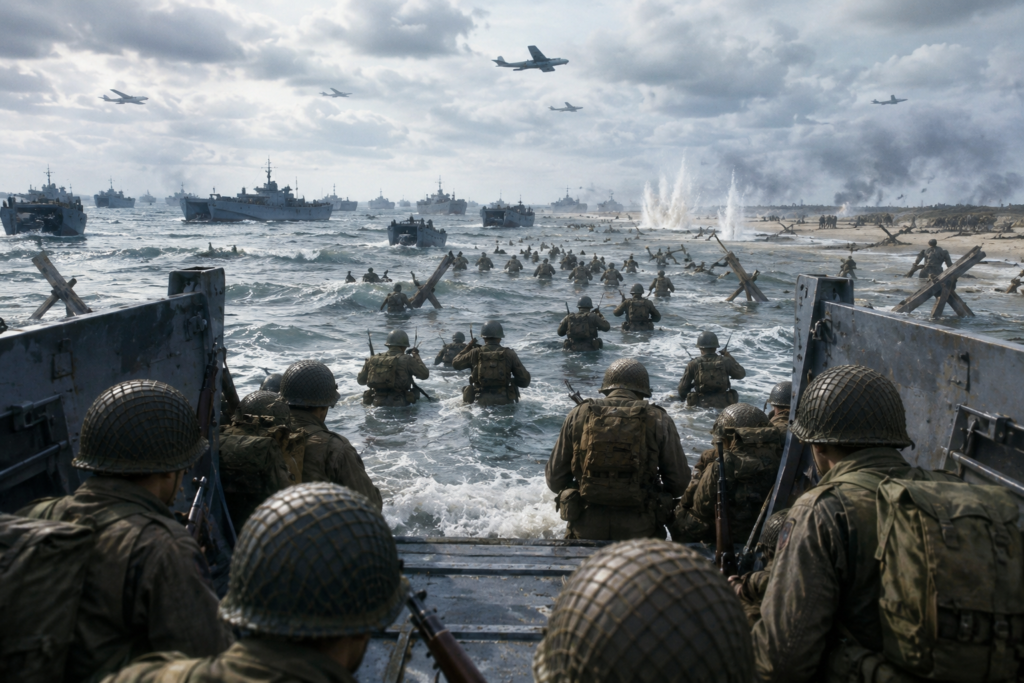
Image Credentials: Image Title: Today in History, June 6: D-Day and the Beginning of the Normandy Invasion. Source: (chatgpt.com) Date: May 2026. Attribution: This image was created using AI-generated imagery (chatgpt.com) by Open Chronicle and does not depict a real-world scene.
By Open Chronicle
On June 6, 1944, one of the most decisive military operations in modern history began as Allied forces launched the invasion of Nazi-occupied France across the beaches of Normandy. Known as D-Day, the operation marked the start of the liberation of Western Europe during World War II and set the stage for the eventual defeat of Nazi Germany.
Led by U.S. General Dwight D. Eisenhower, Supreme Commander of the Allied Expeditionary Force, the invasion brought together troops from the United States, the United Kingdom, Canada, and several other Allied nations. In the early hours of the morning, thousands of paratroopers were dropped behind enemy lines, while a vast armada crossed the English Channel carrying soldiers, vehicles, and supplies toward the French coast.
The scale of the operation was unprecedented. More than 156,000 Allied troops landed in Normandy on the first day alone, supported by nearly 7,000 naval vessels and over 11,000 aircraft. The landings took place across five designated beaches, codenamed Utah, Omaha, Gold, Juno, and Sword.
The fiercest fighting occurred at Omaha Beach, where American forces encountered heavy German defenses and suffered significant casualties. Despite intense resistance, Allied troops gradually secured footholds along the coastline. By the end of the day, all five beaches had been captured, although at a high cost in lives.
D-Day was the culmination of years of planning and deception. Allied commanders sought to convince German forces that the invasion would occur elsewhere, particularly near the Pas-de-Calais region. These efforts helped reduce German preparedness in Normandy and contributed to the operation’s success.
The invasion did not immediately end the war. Weeks of difficult fighting followed as Allied forces pushed inland through the hedgerows and towns of Normandy. However, the successful landings established a permanent Western Front in Europe and accelerated the collapse of Nazi control across the continent.
Today, D-Day is remembered as a symbol of courage, sacrifice, and international cooperation. The beaches of Normandy remain among the most important historical sites of World War II, drawing visitors from around the world who come to honor those who fought and died during the campaign.
More than eighty years later, the Normandy invasion continues to stand as one of history’s most significant military operations, demonstrating the determination of the Allied nations to restore freedom to Europe and bring an end to one of the darkest chapters in human history.