
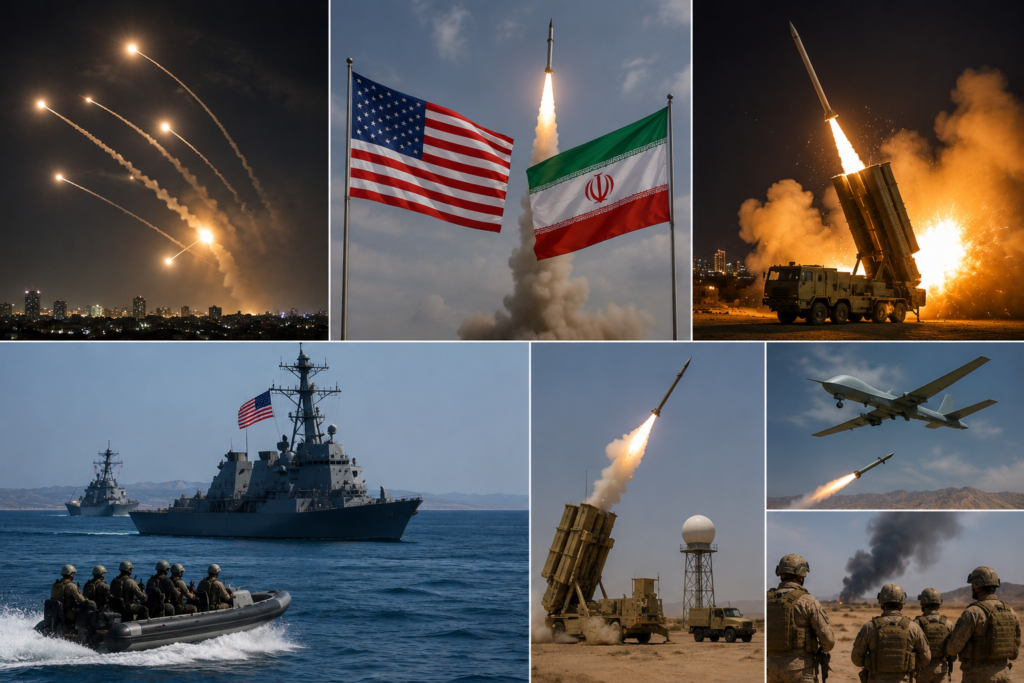
Image Credentials: Image Title: US Intercepts Iranian Missiles and Drones as Gulf Tensions Escalate. Source: (chatgpt.com) Date: June 2026. Attribution: This image was created using AI-generated imagery (chatgpt.com) by Open Chronicle and does not depict a real-world scene.
By Open Chronicle with agencies
The United States military said it intercepted Iranian ballistic missiles and drones aimed at Gulf allies and key maritime routes near the Strait of Hormuz on Friday, marking another dangerous escalation in the ongoing confrontation between Washington and Tehran.
According to U.S. Central Command (CENTCOM), American forces intercepted six of seven ballistic missiles launched by Iran toward Kuwait and Bahrain. The seventh missile reportedly failed before reaching its intended target. U.S. officials said there were no casualties among American personnel.
Earlier in the day, U.S. forces also shot down four Iranian drones that were reportedly heading toward the Strait of Hormuz. CENTCOM described the drones as an immediate threat to commercial shipping and regional maritime security in one of the world’s most strategically important waterways.
The latest exchange comes as the Trump administration increases pressure on Iran to accept a broader agreement aimed at ending months of hostilities and restoring stability to the region.
Gulf States on Alert
Military authorities in Kuwait reported intercepting missiles and drones targeting the country, while Bahrain activated air raid sirens and instructed residents to seek shelter and follow emergency guidance.
Iran’s Revolutionary Guard claimed responsibility for the attacks, stating that it targeted the Ali Al Salem Air Base in Kuwait, which hosts U.S. forces, as well as facilities associated with the U.S. Navy’s Fifth Fleet in Bahrain.
The attacks further raised concerns about the fragile ceasefire that has repeatedly come under strain since being announced earlier this year.
In response, CENTCOM confirmed strikes against several Iranian coastal surveillance radar sites, including installations located on islands near the Strait of Hormuz. The military described the operation as a defensive measure intended to prevent additional attacks on regional shipping and allied nations.
Economic Stakes Continue to Rise
The confrontation is unfolding against the backdrop of a U.S.-led blockade targeting Iranian ports and shipping activity. Washington argues that the measures are necessary to counter Iranian actions affecting navigation through the Strait of Hormuz, a critical route for global oil and natural gas exports.
The resulting disruption has contributed to higher energy prices and increased economic pressure worldwide, while also creating political challenges for the Trump administration ahead of upcoming congressional elections.
Earlier this week, Iranian drone attacks severely damaged part of Kuwait International Airport, killing one person, injuring dozens, and temporarily halting operations.
Trump Pushes for Diplomatic Solution
Despite the renewed violence, President Donald Trump expressed optimism about the prospects for a negotiated settlement.
Speaking at an event in Wisconsin, Trump said that developments with Iran were progressing positively and suggested a resolution could arrive through diplomacy or stronger measures if necessary.
“We’re going to come out of Iran very quickly, and it’s going to be very strong one way or the other,” Trump told reporters.
The president also noted that negotiations remain difficult because Iran is determined to preserve its independence and national interests. According to Trump, Tehran still retains roughly 21 to 22 percent of its missile stockpile following months of military exchanges.
While American and Iranian negotiators reportedly reached a preliminary understanding to extend a ceasefire and begin fresh talks over Iran’s nuclear programme, no final agreement has yet been publicly confirmed.
Lebanon Front Remains Active
Complicating diplomatic efforts are continued clashes in Lebanon.
Although Washington recently helped broker a ceasefire arrangement between Israel and the Lebanese government, the Iran-backed Hezbollah movement has rejected the deal.
On Friday, Israeli forces carried out airstrikes across several locations in southern Lebanon and issued evacuation warnings for multiple villages. Lebanese state media reported that at least nine people were killed in the attacks.
The Israeli military also reported that two soldiers were wounded during combat operations in southern Lebanon.
The situation in Lebanon remains closely linked to broader negotiations with Iran, which has indicated that any lasting regional settlement must address developments along the Israeli-Lebanese border.
Additional Pressure on Tehran
Alongside military operations, the United States continues to expand economic pressure on Iran.
CENTCOM confirmed that U.S. forces boarded a sanctioned oil tanker linked to Iran in the Indian Ocean as part of efforts to restrict Iranian oil revenues.
Washington also announced a new package of sanctions targeting individuals, companies, and vessels connected to Iran’s energy sector.
As military operations continue and diplomatic talks remain uncertain, the latest exchanges highlight the volatility of a conflict that continues to affect regional security, global energy markets and international diplomacy.