
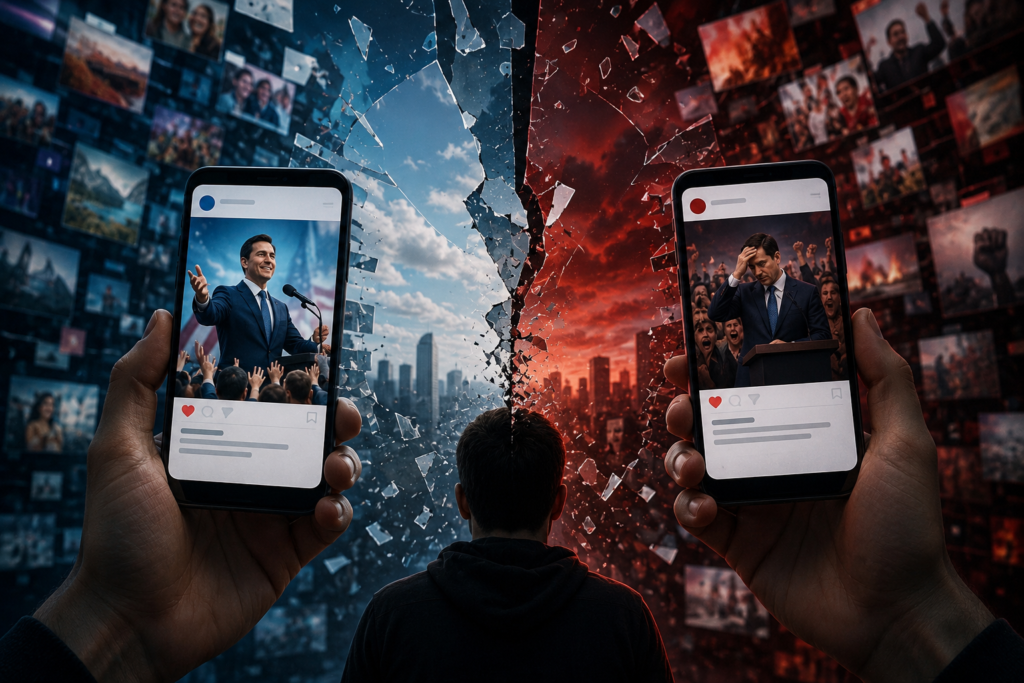
Image Credentials: Image Title: The Death of Shared Reality: How Truth Splintered in the Digital Era. Source: (chatgpt.com) Date: June 2026. Attribution: This image was created using AI-generated imagery (chatgpt.com) by Open Chronicle and does not depict a real-world scene.
By Open Chronicle Culture & Ideas
Imagine scrolling through two news feeds covering the same event.
In one version, a political leader delivers a powerful speech that energizes supporters and demonstrates confident leadership. In the other, the same individual appears confused, ineffective, and disconnected from the audience. The footage is real. The experts are real. The statistics are real. Yet the conclusions are completely incompatible.
What is most striking is that the disagreement no longer concerns interpretation. It concerns reality itself.
For most of modern history, societies argued over what facts meant. Today, increasing numbers of people cannot even agree on what the facts are. The consequences extend far beyond politics. They affect public health, education, justice, personal relationships, and the ability of democratic societies to function.
The digital age promised unprecedented access to information. Instead, it has produced an environment where truth itself is fragmented.
The Collapse of a Shared Information Space
For much of the twentieth century, citizens consumed information from a relatively limited number of sources. Newspapers, radio stations, and television networks certainly carried biases and blind spots, but they created a common informational framework.
Millions of people watched the same evening broadcasts. They read many of the same headlines. They discussed the same events using a largely shared set of facts.
The internet changed that structure forever.
Information is no longer delivered through a common public square. It arrives through personalized streams designed specifically for each individual. Every user receives a unique version of reality, shaped not by civic priorities or journalistic judgment but by algorithms whose primary objective is engagement.
The result is a world where two neighbors can inhabit entirely different informational universes while living on the same street.
The Algorithmic Mirror
The most powerful force behind this transformation is the recommendation algorithm.
Platforms such as TikTok, YouTube, Facebook, Instagram, and X do not simply display information. They actively select, prioritize, and amplify content based on what is most likely to keep users watching, clicking, sharing, and reacting.
The algorithm learns what captures attention and then provides more of it.
If a user shows interest in a particular political viewpoint, the system delivers additional content reinforcing that perspective. If someone engages with conspiracy theories, outrage-driven commentary, or emotionally charged narratives, similar material quickly follows.
Over time, the feed becomes a mirror reflecting existing beliefs to the user with increasing intensity.
This process creates what researchers often describe as “epistemic bubbles” and “echo chambers.” Alternative viewpoints gradually disappear from view. Contradictory information becomes rare. Individuals begin to believe that their perspective is not simply correct but overwhelmingly obvious because everyone they encounter online appears to agree.
In reality, they are seeing a carefully curated version of the world.
The Economics of Outrage
The crisis is not accidental.
Digital platforms operate within an attention economy where engagement is the most valuable currency. Calm, nuanced analysis rarely generates the same level of interaction as anger, fear, outrage, or moral certainty.
Human psychology evolved to pay close attention to threats. Social media systems exploit this tendency at an industrial scale.
Research consistently shows that emotionally provocative content spreads faster than balanced reporting. Falsehoods often travel further than verified information because they are frequently more surprising, shocking, or emotionally satisfying.
The business model rewards intensity rather than accuracy.
As a result, public discourse becomes increasingly dominated by content that generates strong reactions instead of content that promotes understanding.
The Rise of Personalized Truth
Artificial intelligence has accelerated this trend.
Modern AI systems can generate convincing text, images, audio, and video at extraordinary speed. Deepfakes can place words in a person’s mouth. Synthetic content can simulate events that never occurred.
The challenge is no longer identifying false information. Increasingly, it is determining whether any piece of information can be trusted at all.
The old assumption that seeing is believing has become dangerously outdated.
As synthetic media becomes more sophisticated, societies risk entering an era where evidence itself loses persuasive power. Every video can be dismissed as fake. Every recording can be questioned. Every photograph can be challenged.
The result is not merely misinformation. There is uncertainty about reality itself.
When Institutions Lose Authority
Historically, societies relied on trusted institutions to help establish factual consensus.
Universities, scientific organizations, courts, newsrooms, and public agencies served as imperfect but generally accepted arbiters of evidence.
Today, trust in many of these institutions is declining across the political spectrum.
Some citizens view traditional media as biased. Others see scientific expertise as politically motivated. Governments are frequently accused of manipulation. Technology companies face criticism for shaping information flows without accountability.
As confidence erodes, individuals increasingly turn to ideological communities, influencers, and alternative information networks that confirm preexisting beliefs.
Authority becomes decentralized.
Truth becomes tribal.
The Human Cost
The consequences reach beyond politics.
Families fracture over competing realities. Friendships dissolve. Communities become polarized. Public health campaigns face resistance. Elections become battlegrounds not only over policy but over basic facts.
A society cannot solve problems it cannot collectively define.
If citizens cannot agree on whether a crisis exists, discussions about solutions become impossible.
The erosion of shared reality threatens the foundations of democratic governance because democracy depends upon a common understanding of the world, even when people disagree about what should be done.
Can Shared Reality Be Rebuilt?
The challenge is immense, but not hopeless.
Rebuilding a common reality requires more than fact-checking. It requires strengthening media literacy, increasing transparency in algorithmic systems, supporting independent journalism, and fostering institutions capable of earning public trust.
Citizens must also develop new habits of intellectual humility.
The future may depend on our willingness to tolerate uncertainty, question our assumptions, and engage with perspectives that challenge our worldview.
The digital revolution connected billions of people across the globe. Yet connection alone does not create understanding.
The central question of the twenty-first century may not be whether humanity can access more information.
It may be whether humanity can still agree on what is real.
When a shared reality disappears, disagreement becomes permanent, compromise becomes impossible, and society itself begins to fragment.
The death of shared reality is not merely a technological problem.
It is a civilizational one.