
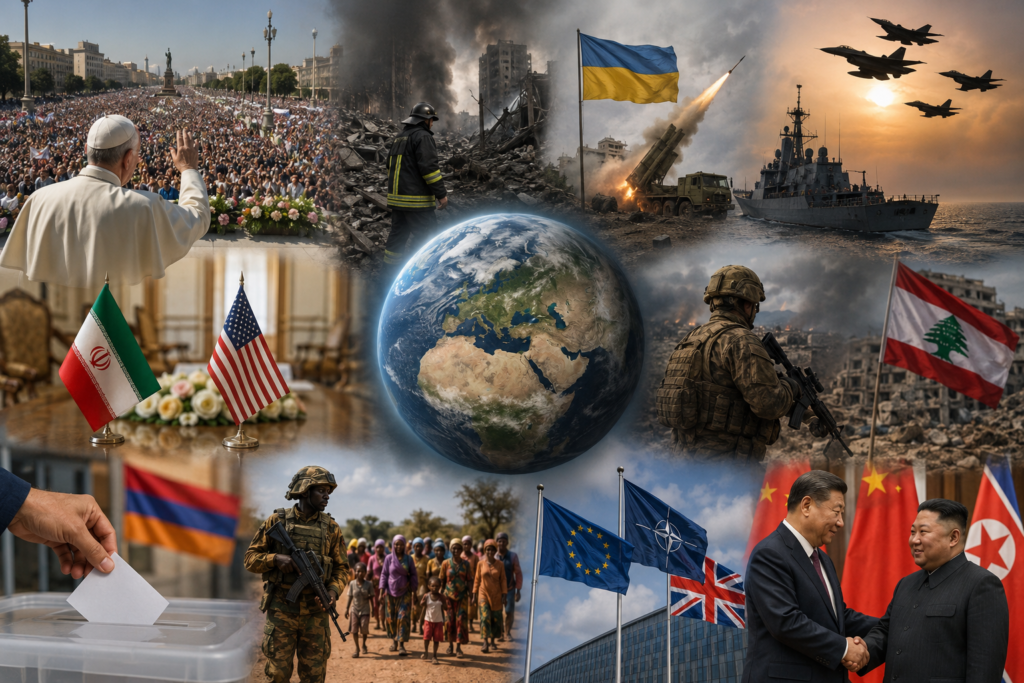
Image Credentials: Image Title: Global News Brief: Key Events and Developments for June 7, 2026. Source: (chatgpt.com) Date: June 2026. Attribution: This image was created using AI-generated imagery (chatgpt.com) by Open Chronicle and does not depict a real-world scene.
By Open Chronicle with agencies
A series of major international developments unfolded across several continents on Saturday, highlighting ongoing conflicts, political transitions, humanitarian challenges, and diplomatic tensions. From renewed violence in the Middle East and Ukraine to historic religious gatherings in Spain and crucial elections in Armenia, the day reflected a world navigating uncertainty on multiple fronts.
Middle East Tensions Continue
The fragile ceasefire between the United States and Iran remained under strain after Washington announced it had intercepted Iranian ballistic missiles and drones aimed at Gulf allies and shipping routes near the Strait of Hormuz. According to U.S. military officials, American forces also conducted strikes against Iranian coastal radar installations following what they described as threats to maritime traffic.
At the same time, reports indicated that Washington is exploring legal mechanisms to use frozen Iranian assets to help fund reconstruction efforts in Gulf states affected by the conflict.
In Lebanon, violence persisted despite diplomatic efforts to reduce tensions. Israeli airstrikes reportedly killed several people, including military personnel and a senior Lebanese officer. The European Union called for accountability following the death of another United Nations peacekeeper in southern Lebanon, while Lebanese leaders continued to criticize external interference in the country’s affairs.
Iranian and Pakistani officials held talks in Tehran aimed at reviving diplomatic channels between Iran and the United States, though prospects for a breakthrough remain uncertain.
Ukraine and Russia Exchange Attacks
Fighting between Russia and Ukraine showed no signs of easing. Ukrainian officials reported that Russian drone strikes targeted facilities near the Chornobyl nuclear zone, including a site connected to nuclear fuel storage. Kyiv condemned the attacks and called for an international response.
Meanwhile, Ukrainian drone operations continued deep inside Russian territory, while Moscow reported ongoing attacks on infrastructure and military assets. The conflict remains one of the central security challenges facing Europe.
British Prime Minister Keir Starmer is set to host Ukrainian President Volodymyr Zelenskyy, French President Emmanuel Macron, and German Chancellor Friedrich Merz in London for high-level discussions on continued support for Ukraine and broader European security.
Pope Draws Massive Crowds in Spain
Pope Leo XIV continued his historic visit to Spain, attracting extraordinary crowds. More than one million people filled the streets of Madrid to witness a flower-carpeted procession and attend a massive open-air Mass.
During his address, the pontiff called for peace, unity, and solidarity with the poor, while criticizing the use of military force as a solution to international disputes. The visit has become one of the largest public religious gatherings in Europe in recent years.
Key Elections Shape Political Futures
Armenians headed to the polls in what many analysts described as a pivotal parliamentary election that could determine the country’s future orientation between Russia and Western institutions. Voter turnout was reported to be strong throughout the day.
In Kosovo, citizens voted in yet another snap election amid growing frustration with political instability and repeated government crises.
In Peru, voters are prepared to choose between a conservative candidate aligned with pro-market policies and a left-wing challenger in a closely watched presidential runoff that could shape the country’s direction for years to come.
North Korea Rejects Denuclearization Calls
North Korea once again dismissed international demands for denuclearization, calling such expectations an “anachronistic dream.” The statement came ahead of a rare visit by Chinese President Xi Jinping, highlighting the strategic importance of relations between Beijing and Pyongyang.
North Korean officials reaffirmed that the country’s nuclear program is irreversible and non-negotiable, underscoring continued tensions on the Korean Peninsula.
Humanitarian and Security Concerns
In Ohio, authorities continued searching for suspects after at least 12 people were shot during a community festival. The incident sparked a large-scale law enforcement response, though details regarding the motive remain unclear.
Nigeria announced the rescue of hundreds of women and children previously abducted by Boko Haram militants, marking a significant operation against one of Africa’s most notorious extremist groups.
Elsewhere, a fatal shark attack off the coast of Western Australia claimed the life of a swimmer. At the same time, emergency responders monitored earthquake activity near Athens following tremors that shook parts of Greece.
Europe Faces Strategic Questions
European defense and security remained a major topic of discussion. Pentagon officials warned that Europe faces growing challenges from ideological extremism and security threats, while NATO’s eastern members continued efforts to strengthen military capabilities amid concerns over Russia.
Debates also intensified regarding Europe’s long-term reliance on American security guarantees, with analysts noting that European armies collectively possess significant manpower but still depend heavily on U.S. military support and strategic leadership.
As conflicts, elections and diplomatic initiatives continue to unfold simultaneously across the globe, June 6 highlighted the interconnected nature of modern international affairs and the growing complexity facing policymakers worldwide.