
Image: from CGTN Frontline X @Frontlinestory
By Open Chronicle with agencies
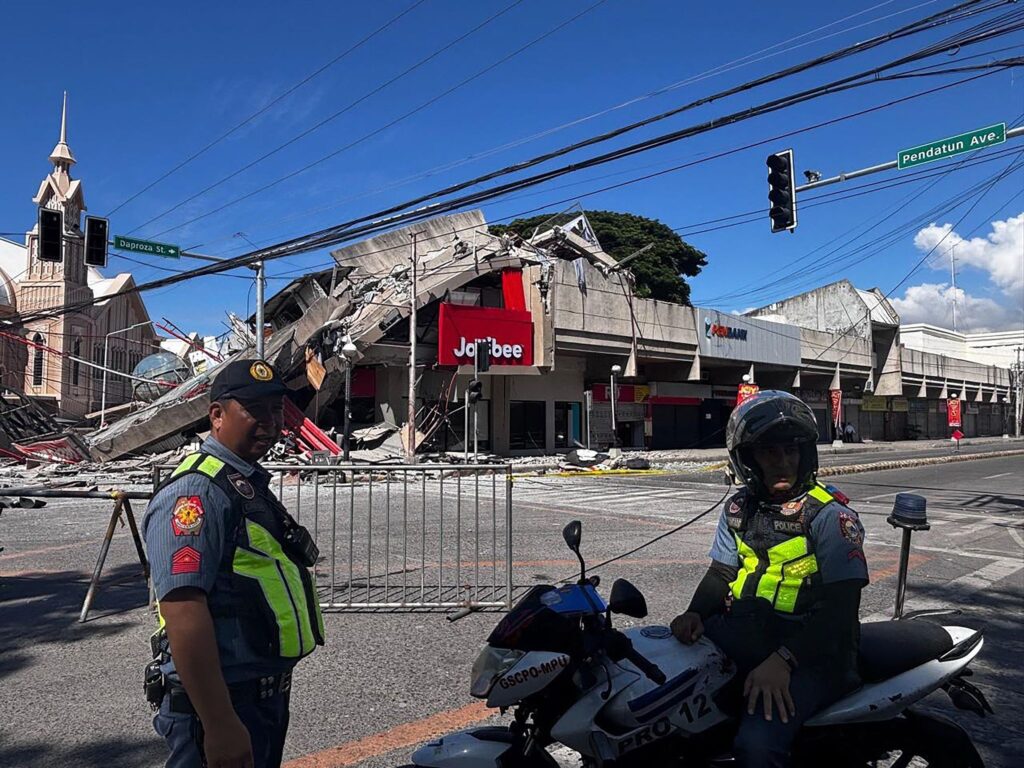
A powerful 7.8 magnitude earthquake struck off the southern coast of the Philippines early Monday, leaving at least four people dead, injuring more than 200 others, damaging critical infrastructure, and triggering tsunami warnings across parts of Southeast Asia.
🚨 BREAKING
A powerful 7.8-magnitude earthquake struck during a Monday morning flag ceremony at Mahayahay Elementary School in Davao Occidental, Philippines.
but no injuries were reported, according to school officials pic.twitter.com/FDjMkdBGeB
— Xtrafrica (@xtr_africa) June 8, 2026
The earthquake, one of the strongest to hit the country this year, occurred at approximately 7:37 a.m. local time. According to Philippine authorities, the epicenter was located offshore about 13 kilometers southwest of General Santos City, a major commercial hub in the southern Mindanao region known for its tuna industry and maritime trade.
The tremor caused widespread panic as residents rushed into the streets while buildings shook violently across several provinces.
A 7.8 magnitude earthquake that rocked the southern Philippines on Monday morning killed at least eight people, the country’s national disaster agency said.
Earlier, the death toll stood at three.
📌 READ MORE: https://t.co/WTQCColjXy#philippines #earthquake pic.twitter.com/jqxm5t2ADA
— The Advertiser (@theTiser) June 8, 2026
Deaths and Widespread Damage Reported
Authorities confirmed that at least three people were killed in General Santos City, while another fatality was reported in Davao Oriental province.
More than 200 people sustained injuries, many during emergency evacuations or due to falling debris. Officials reported that over 100 students suffered bruises and panic-related injuries during morning flag ceremonies at schools throughout the region.
Several buildings sustained structural damage, with some partially collapsing. A key access bridge in General Santos developed significant cracks, raising concerns about transportation and emergency response capabilities.
The city’s international airport was temporarily closed for inspections, resulting in the cancellation of 17 domestic flights.
Rod Sosmeña, regional director of the Office of Civil Defence, described the moment the earthquake struck as sudden and violent.
“Our pickup truck suddenly jerked, and I thought we had a flat tire,” he said, recalling the experience as the ground shook beneath the city.
Tsunami Warning Issued
The earthquake generated tsunami waves that reached approximately one meter in height along parts of the southern Philippine coastline.
Monitoring stations recorded waves in the provinces of Sultan Kudarat and Sarangani, while smaller sea level fluctuations were observed elsewhere.
President Ferdinand Marcos Jr. urged residents in vulnerable coastal communities to move immediately to higher ground and follow evacuation orders.
“Please heed the tsunami warning. Move to higher ground now. Do not wait. Your life is more important than anything left behind,” the president said.
Neighboring countries also responded to the threat. Malaysia issued tsunami warnings for coastal areas in Sabah, while Indonesia reported tsunami waves measuring approximately 83 centimeters near Sulawesi Island.
Several hours after the quake, the Pacific Tsunami Warning Center announced that the primary tsunami threat had largely passed. However, authorities continued to warn residents about possible sea-level fluctuations and dangerous currents.
Emergency Response Underway
The Philippine government placed disaster response agencies on full alert following the earthquake.
President Marcos assured residents that national authorities were mobilizing resources to assist affected communities.
“The national government is moving, and we will not leave Mindanao behind,” he stated.
Emergency teams have been conducting damage assessments across the region while engineers inspect bridges, public buildings, schools, and transportation facilities.
Authorities have not reported any individuals trapped beneath collapsed structures, although search and inspection operations remain ongoing.
Ring of Fire Vulnerability
The Philippine Institute of Volcanology and Seismology said the earthquake was caused by movement along the Cotabato Trench, a major tectonic feature located beneath the sea southwest of Mindanao.
The Philippines lies along the Pacific Ring of Fire, a vast zone of seismic and volcanic activity that stretches around the Pacific Ocean. As a result, the country regularly experiences earthquakes, volcanic eruptions, and other geological hazards.
In addition to seismic threats, the archipelago faces frequent tropical storms and typhoons, making it one of the most disaster-prone nations in the world.
Seismologists have warned that aftershocks are likely to continue in the coming days. Several strong aftershocks, including some exceeding magnitude 6.0, have already been recorded following the initial quake.
While the immediate tsunami threat has diminished, authorities continue to monitor coastal conditions and urge residents to remain vigilant as recovery efforts begin.