
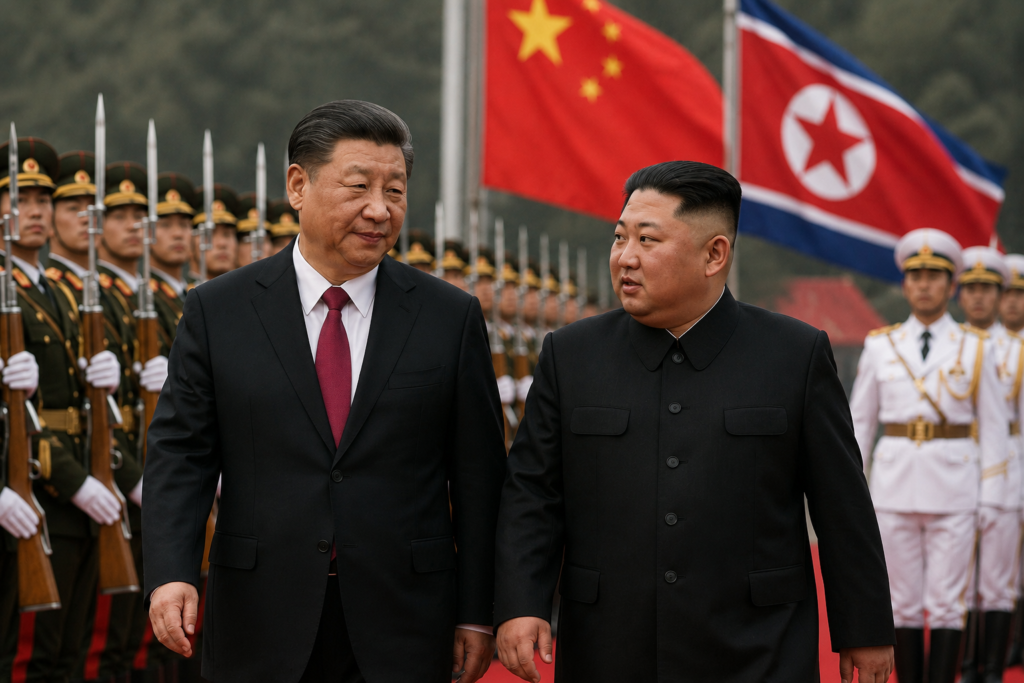
Image Credentials: Image Title: Why Xi Jinping Is Seeking Closer Military Ties With North Korea. Source: (chatgpt.com) Date: June 2026. Attribution: This image was created using AI-generated imagery (chatgpt.com) by Open Chronicle and does not depict a real-world scene.
By Cameron Quinn | Open Chronicle Senior Editor
Chinese President Xi Jinping is placing renewed emphasis on strengthening military and strategic cooperation with North Korea, a move that analysts believe is driven by growing concerns over regional security and the possibility of a future crisis in the Taiwan Strait.
While Beijing and Pyongyang have long maintained a formal alliance, recent diplomatic and military exchanges suggest China is looking to deepen that relationship as geopolitical tensions with the United States and its allies continue to intensify.
A Strategic Partnership With New Importance
Experts argue that North Korea could play a significant supporting role in any future conflict involving Taiwan, although not through the kind of direct military intervention it has reportedly provided to Russia during the war in Ukraine.
Instead, Pyongyang’s value to Beijing lies in its ability to divert American and allied resources. In the event of a Taiwan crisis, heightened military activity or instability on the Korean Peninsula could force the United States, South Korea, and Japan to split their attention between two major theatres.
This would complicate military planning for Washington and potentially reduce the concentration of forces available for operations around Taiwan.
The Taiwan Factor
China continues to view Taiwan as a core national interest and has increased military pressure on the self-governed island in recent years through large-scale exercises, air patrols, and naval operations.
Analysts suggest that closer coordination with North Korea could provide Beijing with strategic depth, creating uncertainty for U.S. planners and reinforcing China’s broader deterrence posture in East Asia.
However, specialists note that Beijing is unlikely to encourage direct North Korean involvement in a Taiwan conflict. Unlike the situation in Ukraine, where North Korea has reportedly provided military assistance to Russia, China’s preference would be for Pyongyang to maintain pressure on the Korean Peninsula without triggering a wider, uncontrollable war.
Strengthening Regional Influence
Beyond military considerations, deeper ties with North Korea also help China maintain its influence over a key regional partner at a time when global alliances are shifting.
The growing cooperation reflects Beijing’s desire to counter the expanding security partnerships between the United States, South Korea, and Japan, which have increased joint military exercises and intelligence sharing in response to both Chinese and North Korean activities.
By reinforcing its relationship with Pyongyang, China signals that it retains leverage in one of the world’s most volatile regions and can shape the security environment on the Korean Peninsula.
A Delicate Balance
Despite the strategic benefits, Beijing also faces challenges in managing its relationship with North Korea. Chinese leaders have historically sought stability above all else, fearing that excessive confrontation or the collapse of the North Korean regime could create a humanitarian crisis and a direct security threat along China’s border.
For this reason, experts believe Xi Jinping’s approach is aimed at strengthening military and political coordination while avoiding actions that could provoke an uncontrollable escalation with the United States and its regional allies.
As competition between major powers increasingly defines global politics, the evolving partnership between China and North Korea is likely to become an even more important factor in the security calculations surrounding Taiwan and the broader Indo-Pacific region.
The Grand Strategy Institute
Continue Exploring Strategic Analysis
Return to The Grand Strategy Institute for strategic assessments, long-form analysis and research examining geopolitics, military affairs, international security, emerging technologies and the changing international order.
← Back to The Grand Strategy Institute