
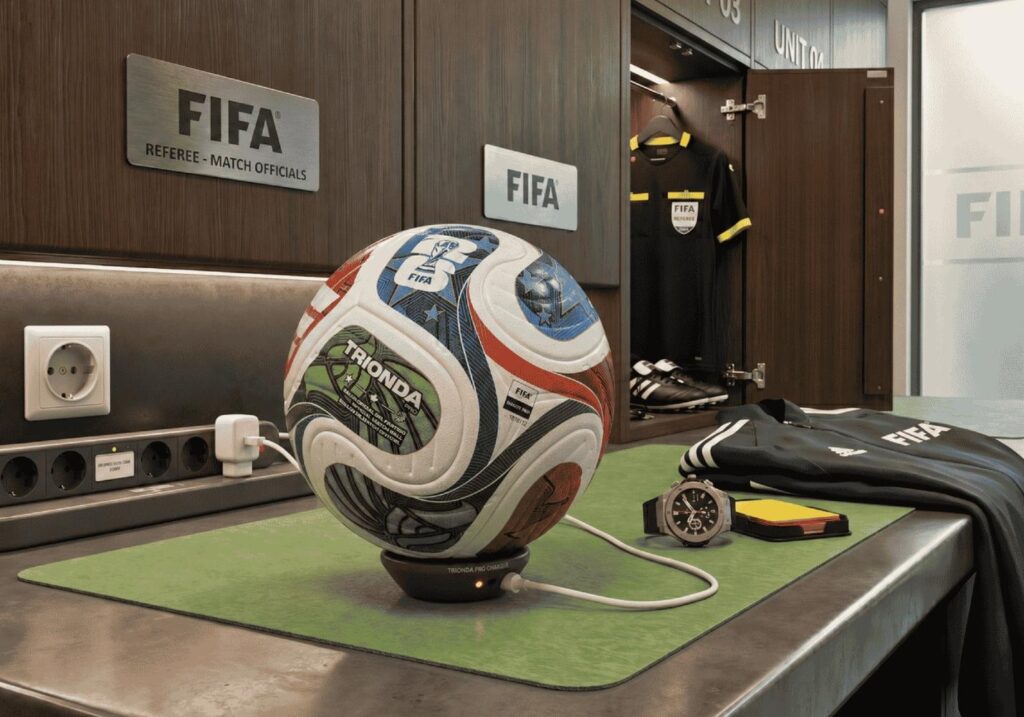
Image: from Free AstroScience X @astronomy_free
The official match ball for the 2026 FIFA World Cup is set to become one of the most advanced pieces of equipment ever used in professional football. Developed by Adidas, the new “Trionda” combines cutting-edge materials, embedded electronics, and artificial intelligence integration in a design intended to enhance both on-field performance and officiating accuracy.
Created for a tournament that will span three host nations, the United States, Canada, and Mexico, the Trionda represents a major leap forward in football technology, reflecting the growing role of data and digital innovation in the modern game.
A Design Inspired by Three Nations
The name “Trionda” blends the words “Tri”, symbolising the tournament’s three co-hosts, and “Onda”, the Spanish word for “wave”, representing the movement and connection between the nations.
Its design features a predominantly white surface accented with blue, red, and green elements, colours chosen to reflect the identities of the United States, Canada, and Mexico. The ball also incorporates subtle embossed details inspired by national symbols, including stars, eagles, and maple leaves, creating a visual tribute to the countries staging football’s biggest event.
The World Cup Starts Today and Here is Everything You need to know about the World Cup official ball 🧵👇
✅ For the 2026 FIFA World Cup, Adidas has introduced the "Trionda", making it the most technologically advanced and rigorously tested soccer ball in the history of the… pic.twitter.com/dmQ2JhqS8q
— Saheed Oladele 🇵🇹 (@HunkuOladele) June 11, 2026
Engineered for Stability
Adidas says the Trionda has undergone the most extensive testing programme ever conducted for an official World Cup ball. One of the main engineering goals was to avoid the aerodynamic unpredictability that surrounded previous tournament balls, most notably the controversial 2010 Jabulani.
The Trionda uses just four thermally bonded polyurethane panels, the lowest number ever used in a World Cup match ball. Combined with carefully designed deep seams and textured surface patterns, the construction aims to deliver greater flight stability, improved accuracy, and more consistent ball behaviour in a wide range of conditions.
The ball has also been specifically engineered to perform uniformly across the diverse environments that define the 2026 World Cup, from the altitude of Mexico City to the humidity of Miami and the cooler coastal climate of Vancouver.
A Smart Ball That Needs Charging
Perhaps the most striking innovation is hidden inside the ball itself. Embedded within the Trionda is a 500Hz motion sensor capable of recording speed, spin and precise points of contact hundreds of times every second.
Unlike traditional footballs, the technology requires power. Before matches, the official ball is placed on a wireless charging pad for approximately 90 minutes, providing enough battery life to operate throughout a full match day.
The sensor transmits data in real time to connected systems around the stadium, making the Trionda an active participant in the technological ecosystem of the modern game.
Supporting AI and Video Review
The embedded sensor is designed to work alongside AI-assisted camera systems already used by FIFA for officiating purposes. By capturing movement and contact data at extremely high speed, the Trionda can help power the tournament’s Semi-Automated Offside Technology while also assisting officials during Video Assistant Referee (VAR) reviews.
The system can identify subtle touches of the ball that might be difficult to detect with the naked eye or through conventional video replay, helping referees evaluate offside situations, handball incidents, and disputed deflections with greater precision.
FIFA and Adidas believe the combination of artificial intelligence and sensor technology could reduce controversy and improve the consistency of major refereeing decisions.
Sustainability and Global Production
In addition to its technological features, the Trionda reflects a growing emphasis on sustainability within sports manufacturing. Adidas says the official match ball is produced using a blend of recycled and bio-based materials, with a composition that includes approximately 60 percent polyurethane and 40 percent recycled polyester.
The company has also adopted environmentally conscious production methods, using water-based inks and adhesives as part of the manufacturing process.
While standard replica versions of the ball are assembled in Sialkot, Pakistan, a city renowned for its football production industry, the high-specification professional match balls with integrated electronics are manufactured in specialised facilities in Guangdong, China, where the delicate sensor systems are calibrated and balanced.
Football Enters the Digital Age
A broad digital marketing campaign is also accompanying Trionda’s launch. As part of a partnership between Adidas and Meta, users sending the football emoji through WhatsApp during the tournament will see it replaced with a digital version inspired by the official match ball.
The initiative reflects how the boundaries between sport, technology, and digital communication continue to blur, with the World Cup serving as a global platform for innovation both on and off the pitch.
As the 2026 FIFA World Cup approaches, the Trionda stands as a symbol of football’s technological transformation. Whether it’s advanced systems help eliminate refereeing disputes or spark new debates about the increasing role of technology in the sport, one thing is clear: the world’s most popular game is entering a new digital era.