
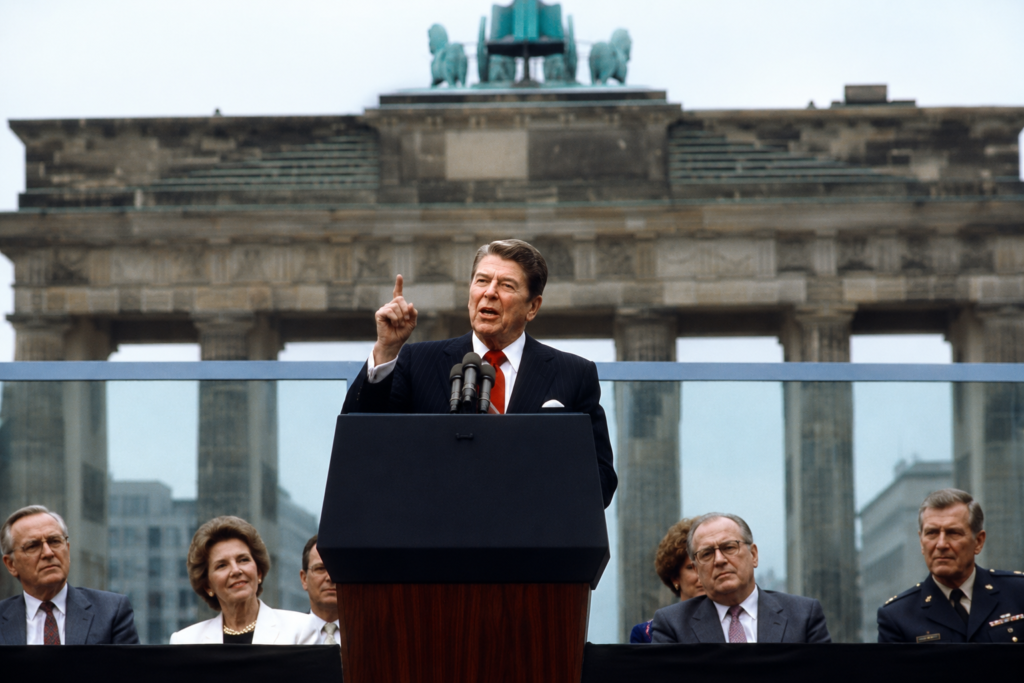
Image Credentials: Image Title: Today in History, June 12: “‘Mr Gorbachev, Tear Down This Wall’: Ronald Reagan’s Defining Berlin Speech”. Source: (chatgpt.com) Date: June 2026. Attribution: This image was created using AI-generated imagery (chatgpt.com) by Open Chronicle and does not depict a real-world scene.
By Open Chronicle
On 12 June 1987, in one of the defining moments of the late Cold War, United States President Ronald Reagan stood before the Brandenburg Gate in West Berlin and issued a direct challenge to Soviet leader Mikhail Gorbachev, declaring: “Mr. Gorbachev, tear down this wall!” The speech became one of the most memorable political addresses of the 20th century and a powerful symbol of the growing movement for freedom and the eventual end of the division of Europe.
The Berlin Wall, erected by the German Democratic Republic (East Germany) in 1961, had become the physical and ideological embodiment of the Iron Curtain that separated the Soviet-controlled East from the democratic nations of Western Europe. Stretching for more than 150 kilometres around West Berlin, the barrier prevented millions of East Germans from leaving the communist state and stood as a stark reminder of the tensions that had shaped international politics since the end of the Second World War.
Reagan delivered his speech during celebrations marking the 750th anniversary of Berlin. Speaking at the Brandenburg Gate, itself inaccessible from the East and overshadowed by the wall, he praised the resilience of the people of West Berlin and acknowledged the reforms that Soviet General Secretary Mikhail Gorbachev had begun introducing through the policies of glasnost (openness) and perestroika (restructuring). At the same time, Reagan argued that genuine reform required the removal of the barrier dividing the city.
His most famous words came near the end of the address: “General Secretary Gorbachev, if you seek peace, if you seek prosperity for the Soviet Union and Eastern Europe, if you seek liberalization: Come here to this gate! Mr. Gorbachev, open this gate! Mr. Gorbachev, tear down this wall!” The dramatic appeal was initially viewed by some observers as overly provocative, but it soon entered history as one of the defining rhetorical moments of the Cold War.
At the time, few expected the Berlin Wall to fall in the near future. Yet the political landscape of Eastern Europe was changing rapidly. Reform movements were gathering strength across the Soviet bloc, and Gorbachev’s unwillingness to use military force to suppress dissent marked a significant departure from previous Soviet policy. In November 1989, just over two years after Reagan’s speech, East German authorities unexpectedly opened the border crossings, leading thousands of Berliners to dismantle the wall with hammers and chisels in scenes broadcast around the world.
The fall of the Berlin Wall became a catalyst for the collapse of communist governments across Eastern Europe and paved the way for the reunification of Germany in October 1990. It also accelerated the dissolution of the Soviet Union itself, which formally ended in 1991.
Today, Reagan’s address at the Brandenburg Gate is remembered not only for its iconic challenge to the Kremlin but also for its enduring association with the triumph of democratic ideals over political division. The phrase “Mr. Gorbachev, tear down this wall!” remains one of the most recognisable quotations in modern political history, symbolising the hope that barriers, both physical and ideological, can ultimately be overcome.