
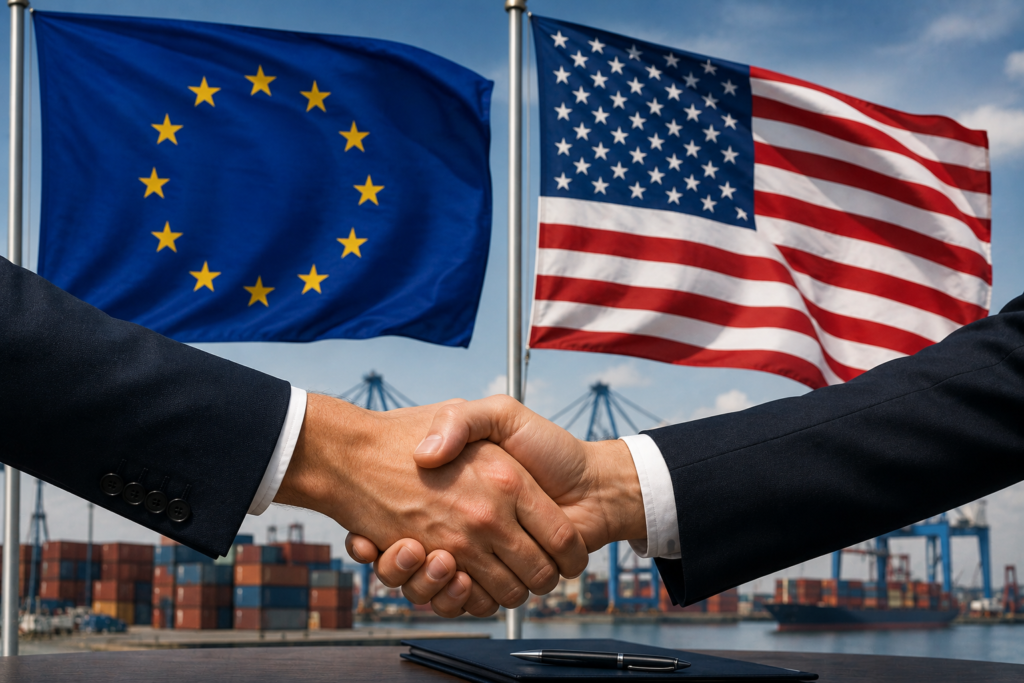
Image Credentials: Image Title: Europe Gives Final Approval to Long-Awaited US Tariff Deal, Marking New Chapter in Transatlantic Trade. Source: (chatgpt.com) Date: June 2026. Attribution: This image was created using AI-generated imagery (chatgpt.com) by Open Chronicle and does not depict a real-world scene.
By Open Chronicle with agencies
The European Union and the United States have taken a decisive step toward stabilising their often turbulent trade relationship after the European Parliament gave its final approval to a landmark tariff agreement negotiated with Washington.
The vote in Strasbourg closes a lengthy political process that began with the announcement of the agreement in July last year and is intended to reduce uncertainty for businesses on both sides of the Atlantic. The deal also places the EU on course to meet the timeline set by US President Donald Trump, helping to avoid the imposition of new tariffs on European-made vehicles.
🇪🇺🇺🇸 The EU–US trade deal has been adopted by @Europarl_EN.
For our Co-Chair @NProcaccini, this is the stability Europeans needed.
It's not perfect, but it delivers predictable rules, protected jobs, and pragmatism over politics.
👇Watch and let us know what you think 🤔 pic.twitter.com/lpjkrABiml
— ECR Group (@ecrgroup) June 16, 2026
Under the agreement, tariffs on most European exports to the United States will be set at 15 percent, while the European Union will eliminate tariffs on a wide range of American industrial goods. The arrangement is designed to ease trade tensions after months of negotiations complicated by geopolitical disputes and legal challenges in the United States.
Although EU member states had already endorsed the pact, approval by the European Parliament represented the final major political hurdle before implementation. Lawmakers voted 440 in favour of the agreement, while 151 opposed it and 50 abstained.
The accord comes after a period of significant strain in transatlantic relations. Following his return to the White House, President Trump introduced a series of tariffs targeting sectors including steel, aluminium, and automobiles. At the same time, disagreements over issues such as Greenland and a US Supreme Court ruling affecting previous tariff measures contributed to delays in the agreement’s ratification.
To address concerns among European lawmakers, the final text includes several safeguards. One provision establishes an expiration date at the end of 2029 unless both sides agree to renew the agreement. Another grants the European Commission the authority to suspend the pact if the United States fails to honour its commitments or adopts measures that disrupt trade and investment flows.
Bernd Lange, chairman of the European Parliament’s trade committee, acknowledged that the agreement is not perfect but argued that it represents a significant improvement over previous arrangements. He stressed that Parliament would continue to monitor its implementation closely and remain prepared to react if Washington breaches the terms.
Centrist MEP Karin Karlsbro described the agreement as a demonstration that the European Union had resisted external pressure while still securing a practical outcome. She argued that the deal provides a foundation for greater stability in transatlantic commerce, even as political uncertainty in Washington continues.
The European People’s Party, the largest political group in Parliament and the family of European Commission President Ursula von der Leyen, strongly backed the accord. EPP trade spokesman Jörgen Warborn said the approval should serve as a platform for expanding market access and deepening economic cooperation between the two allies.
The European Commission has repeatedly highlighted the strategic importance of the US-EU economic relationship, which is estimated to be worth around $2 trillion annually. Officials hope the agreement will reduce friction, encourage investment, and provide businesses with greater predictability in a period of heightened global economic uncertainty.
Only a handful of formal procedures remain before the agreement enters into force, including a final endorsement by member states and publication in the European Union’s Official Journal. Once completed, the deal is expected to usher in a more stable phase for transatlantic trade while preserving mechanisms to respond if future disputes emerge.