
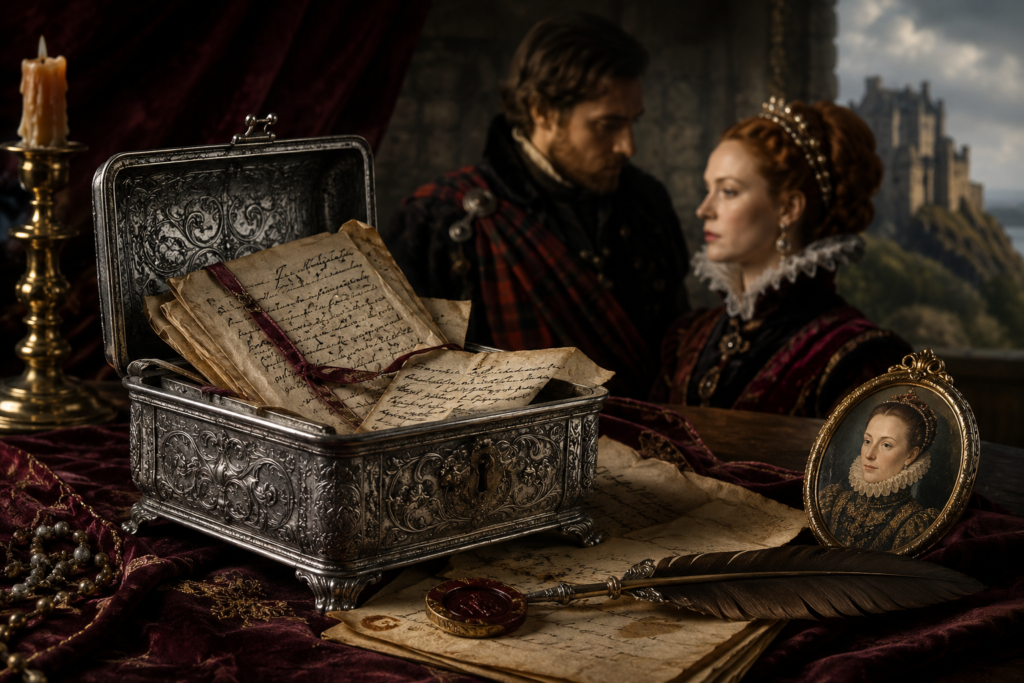
Image Credentials: Image Title: Today in History, June 20: The Discovery of the Casket Letters. Source: (chatgpt.com) Date: June 2026. Attribution: This image was created using AI-generated imagery (chatgpt.com) by Open Chronicle and does not depict a real-world scene.
By Open Chronicle
June 20, 1567
On this day in 1567, the so-called Casket Letters were said to have been discovered, a dramatic moment in the political crisis that surrounded Mary, Queen of Scots. The letters were presented as evidence that Mary had been involved with James Hepburn, 4th Earl of Bothwell, in a plot to murder her husband, Henry Stewart, Lord Darnley.
Lord Darnley had been killed earlier that year, on February 10, 1567, after an explosion destroyed the house at Kirk o’ Field in Edinburgh where he had been staying. His body was found outside the building, and suspicion quickly fell on Bothwell, one of the most powerful nobles in Scotland. Only months later, Mary married Bothwell, a decision that shocked many of her subjects and deepened opposition among the Scottish nobility.
The Casket Letters were allegedly found in a silver casket after Bothwell fled from his enemies. The documents were said to include letters and poems written by Mary to Bothwell, suggesting both an intimate relationship and possible knowledge of the plot against Darnley. Their authenticity, however, became one of the most fiercely debated questions in Scottish history.
Mary’s opponents used the letters to justify their rebellion against her rule. In July 1567, she was forced to abdicate in favour of her infant son, James VI. Mary later escaped captivity and sought refuge in England, but the controversy surrounding the letters followed her for the rest of her life.
To her enemies, the Casket Letters were proof of guilt. To her defenders, they were forged or manipulated documents designed to destroy a queen whose position had become politically dangerous. The originals eventually disappeared, leaving later generations to rely on copies, translations, and partisan accounts.
The discovery of the Casket Letters became a turning point in the downfall of Mary, Queen of Scots. More than a simple piece of evidence, they became symbols of intrigue, betrayal, and the uncertain boundary between justice and political propaganda in Renaissance Europe.