
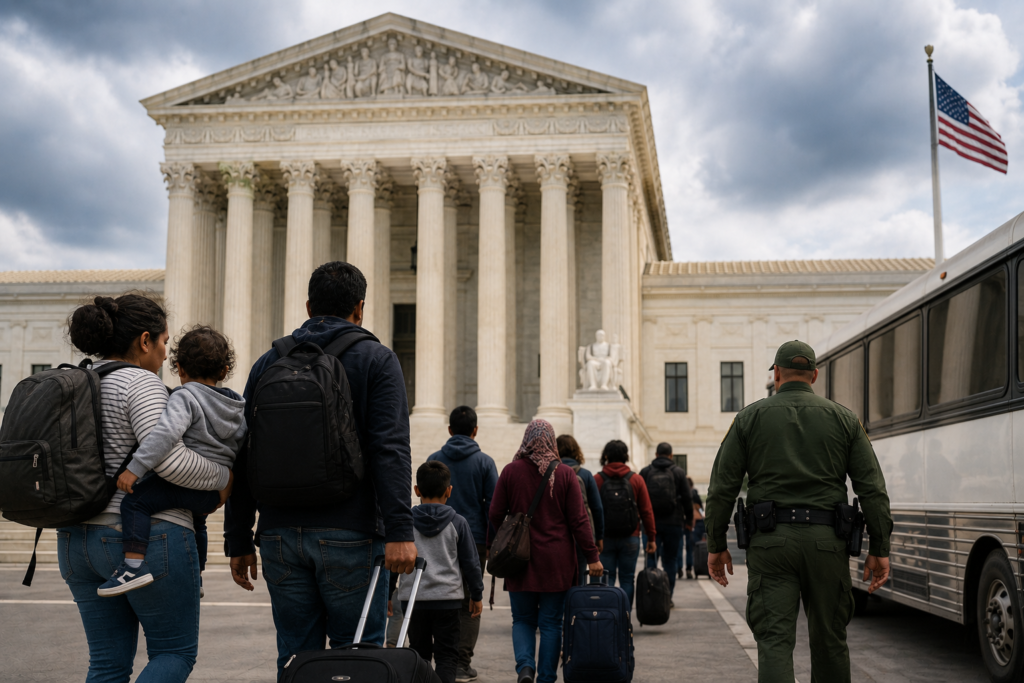
Image Credentials: Image Title: US Supreme Court Clears Way for Deportation of Syrians and Haitians After TPS Ruling. Source: (chatgpt.com) Date: June 2026. Attribution: This image was created using AI-generated imagery (chatgpt.com) by Open Chronicle and does not depict a real-world scene.
By Open Chronicle with agencies
The U.S. Supreme Court has ruled in favor of the Trump administration, allowing the federal government to end Temporary Protected Status (TPS) for approximately 350,000 Haitians and 6,000 Syrians living in the United States, a decision that could reshape the future of humanitarian immigration protections for more than one million people from countries affected by war, natural disasters, and political instability.
In a 6 to 3 decision delivered on Thursday, the conservative majority held that the Department of Homeland Security’s decision to terminate TPS protections is not subject to judicial review. Justice Samuel Alito, writing for the majority, concluded that federal courts do not have the authority to review the executive branch’s determination regarding the continuation or termination of the program.
Temporary Protected Status allows nationals of designated countries to remain legally in the United States when returning home would expose them to extraordinary dangers such as armed conflict, environmental disasters, or severe political instability. Beneficiaries are protected from deportation and are authorized to work while the designation remains in effect.
The ruling represents a significant victory for President Donald Trump’s immigration agenda. Throughout his presidential campaign, Trump pledged to tighten immigration enforcement and reduce humanitarian protections, arguing that TPS had evolved into a long-term immigration pathway rather than a temporary emergency measure.
Lawyers representing Haitian and Syrian TPS holders argued before the Court that both countries continue to face severe humanitarian crises. Haiti remains plagued by widespread gang violence, political instability, kidnappings, and economic collapse, conditions that have prompted the U.S. State Department to advise Americans against travel to the country. Syria continues to experience the consequences of years of civil war, despite shifting military dynamics across parts of the country.
Attorneys also argued that the administration’s decision was influenced in part by racial bias. Justice Alito rejected those claims, stating that neither President Trump nor Homeland Security officials had made statements that were overtly racial and that their public comments could reasonably be interpreted as policy positions supported by race-neutral justifications.
The Court’s liberal minority strongly disagreed.
Justice Elena Kagan, joined by the two other liberal justices in dissent, argued that race played a significant role in the administration’s treatment of Haitian immigrants. She criticized previous remarks made by President Trump, describing them as deeply rooted in harmful racial stereotypes and asserting that they demonstrated discriminatory intent behind the policy decision.
The administration maintained throughout the case that immigration and foreign policy decisions surrounding TPS fall squarely within executive authority and should not be subject to ongoing judicial oversight. Solicitor General John Sauer argued that allowing courts to intervene would result in unnecessary judicial interference in sensitive foreign policy determinations.
The ruling immediately drew strong political reactions.
Democratic Senator Elizabeth Warren condemned the decision, arguing that it places hundreds of thousands of lawfully residing immigrants at risk of deportation despite ongoing humanitarian crises in their home countries.
Republican Representative Mike Lawler acknowledged that the president possesses the legal authority to revoke TPS but questioned whether doing so under current conditions was appropriate. He warned that many Haitian TPS holders work in the U.S. healthcare sector and that their removal could worsen staffing shortages in hospitals and nursing homes across the country.
Humanitarian organizations also expressed concern. Krish O’Mara Vignarajah, president of Global Refuge, described the ruling as devastating for families who have legally lived and worked in the United States for years, paid taxes, and contributed to their communities while now facing uncertainty over their future.
The decision could serve as a precedent affecting TPS beneficiaries from numerous other countries, including Afghanistan, Cameroon, Ethiopia, Honduras, Myanmar, Nepal, Nicaragua, Somalia, South Sudan, Venezuela, and Yemen, many of whom have also seen their protections challenged under the current administration.
The Supreme Court’s ruling marks one of the most consequential immigration decisions in recent years and reinforces the executive branch’s broad authority over humanitarian immigration programs, even as debate continues over the balance between national immigration policy and humanitarian obligations.