
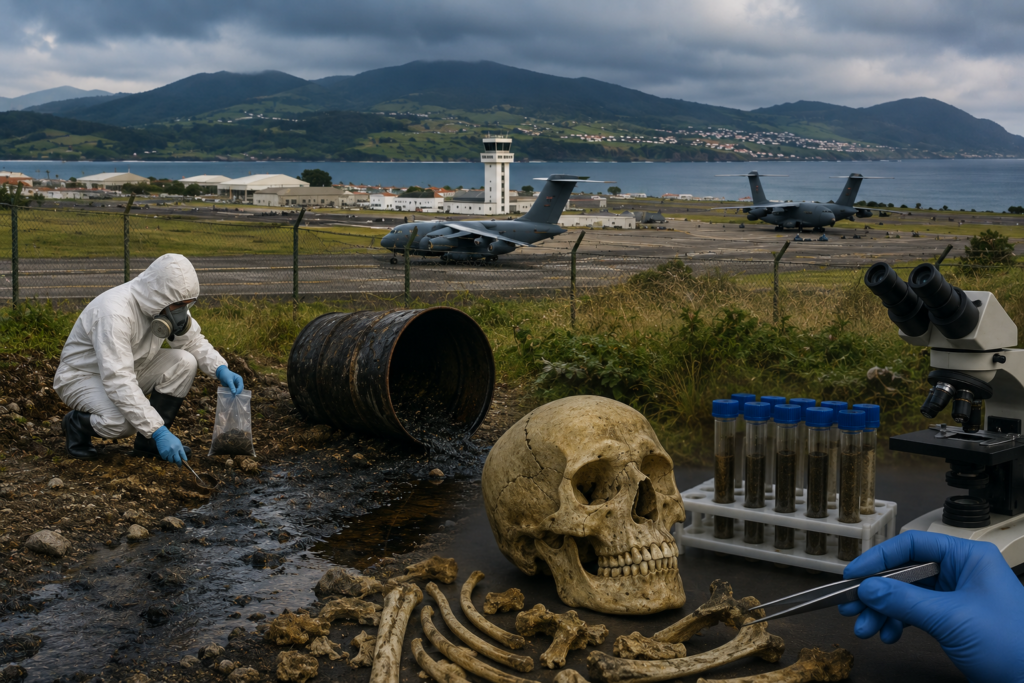
Image Credentials: Image Title: Lead Found in Lajes Area Skeletons Strengthens Concerns Over Long-Term Contamination and Cancer Cases. Source: (chatgpt.com) Date: June 2026. Attribution: This image was created using AI-generated imagery (chatgpt.com) by Open Chronicle and does not depict a real-world scene.
By Open Chronicle
PRAIA DA VITÓRIA, Portugal, June 26, 2026 — A new scientific study has identified elevated concentrations of lead and other heavy metals in the skeletal remains of former residents living near the Lajes Air Base on Portugal’s Azores archipelago, reinforcing longstanding concerns about environmental contamination and its possible connection to increased cancer rates in the region.
The research, conducted at the University of Coimbra as part of a doctoral thesis in Forensic Anthropology, found significantly higher levels of toxic metals in skeletons recovered from Praia da Vitória, on Terceira Island, than in remains from Angra do Heroísmo, located approximately 23 kilometers away from the areas most affected by contamination.
The findings provide new scientific evidence linking human exposure to the same hazardous substances previously identified in soils surrounding Lajes Air Base, where decades of fuel storage and handling by the United States military resulted in extensive environmental pollution.
New evidence of long-term exposure
According to the research, residents who lived near the contaminated areas accumulated measurable levels of lead and other heavy metals in their bodies, suggesting prolonged exposure to environmental pollutants.
Although the study does not establish a direct causal relationship between contamination and cancer, researchers say the results strengthen the case for further epidemiological investigations into the unusually high number of cancer cases reported by residents and healthcare professionals over many years.
The doctoral thesis, scheduled to be formally defended later this summer, could become an important scientific foundation for future public health studies.
Longstanding concerns over cancer incidence
The findings revive concerns that have circulated for decades among residents of Praia da Vitória, where families and healthcare workers have repeatedly questioned whether environmental contamination contributed to higher rates of cancer and other serious illnesses.
Nurses have previously alleged that attempts to investigate local cancer incidence encountered institutional obstacles, leaving many questions unanswered.
Researchers stress that additional multidisciplinary studies will be necessary before any definitive medical conclusions can be reached.
Contamination first confirmed years ago
Environmental contamination around Lajes Air Base was first identified by U.S. authorities in 2005 and later confirmed by Portugal’s National Laboratory for Civil Engineering (LNEC) in 2009.
The pollution resulted from decades of fuel storage, spills, and handling activities carried out by the United States Air Force at the military installation.
Since 2012, LNEC has monitored the remediation process involving contaminated soils and groundwater across Praia da Vitória.
The latest publicly available monitoring report was released in January 2024.
Socialist Party calls for greater transparency
The Socialist Party (PS) of the Azores has renewed calls for continuous, transparent, and rigorous monitoring of the environmental cleanup effort.
Speaking after a visit to Air Base No. 4, Socialist parliamentary leader Berto Messias said the issue has largely disappeared from public debate despite its continued importance for public health and environmental protection.
“The latest monitoring report available dates from January 2024. It is essential that more recent data be made available so everyone can follow the progress of this process,” Messias said.
The party has requested updated information from LNEC, the municipal company Praia Ambiente, and the Regional Government of the Azores regarding both the remediation work and ongoing environmental monitoring.
Focus on water, soil, and public health
Messias emphasized that monitoring should extend beyond drinking water quality to include the surrounding agricultural land where livestock destined for human consumption graze.
He also called for a comprehensive scientific assessment of cancer incidence in Praia da Vitória and across Terceira Island to determine whether statistically significant differences exist compared with other regions.
“We do not want to create unnecessary alarm,” he said. “Our objective is to ensure that residents can have confidence in the safety of their water and environment.”
While acknowledging progress through infrastructure removal and environmental monitoring, Messias argued that the remediation process should move beyond merely mitigating contamination toward achieving full environmental restoration, with U.S. authorities bearing primary responsibility for addressing the environmental legacy left by decades of military activity.
The new forensic findings are expected to renew scientific and political attention on one of Portugal’s longest-running environmental contamination cases.