
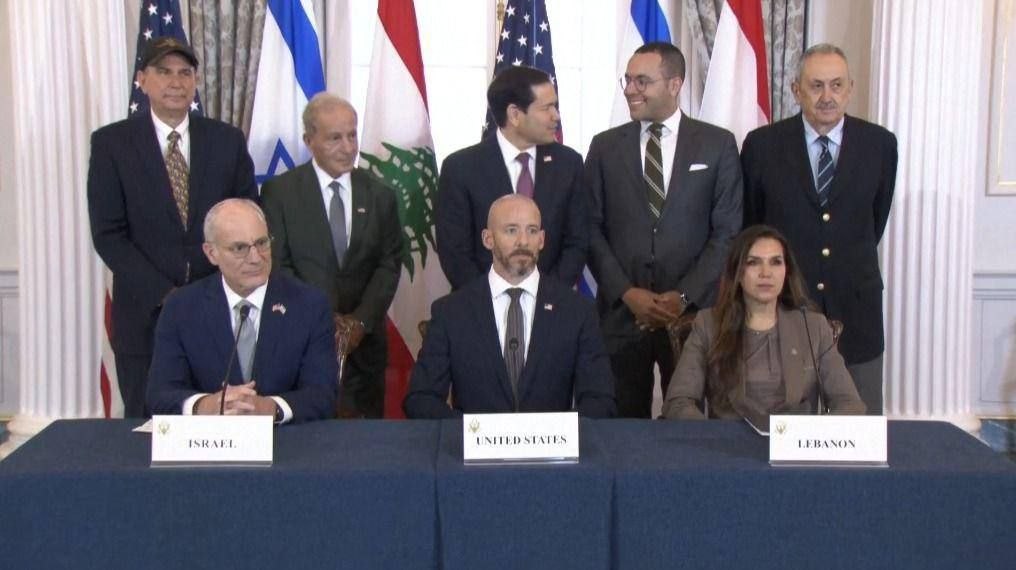
Image: from Middle East Observer X @ME_Observer_
By Open Chronicle with Agencies
WASHINGTON, June 26, 2026 — The United States has unveiled a new diplomatic framework between Lebanon and Israel aimed at restoring Lebanese sovereignty, dismantling Hezbollah’s military infrastructure, and ultimately enabling Israeli forces to withdraw from southern Lebanon once security conditions are met.
The agreement, announced following talks in Washington and mediated by the United States, establishes a phased implementation process backed by security, humanitarian, and military assistance.
Israel and Lebanon have officially signed a U.S.-brokered framework agreement in Washington.
Israeli Army Radio: Israeli forces have not yet began their withdrawal from southern Lebanon under the U.S.-brokered framework, and troops on the ground have not received orders… pic.twitter.com/B2lLkmFeBQ
— World Source News (@Worldsource24) June 26, 2026
Framework outlines phased implementation
According to the U.S. State Department, the trilateral framework seeks to strengthen the authority of the Lebanese state across its entire territory while gradually removing armed non-state military structures.
The agreement calls for:
- The restoration of full Lebanese sovereignty throughout the country.
- The disarmament of Hezbollah.
- The dismantling of Hezbollah’s military infrastructure.
- The eventual withdrawal of Israeli forces to the internationally recognized border after the security threat has been eliminated.
The framework also establishes a Military Coordination Group for Lebanon (MCG4L), a U.S.-facilitated mechanism that will supervise implementation and coordinate between Lebanese and Israeli authorities throughout the process.
Humanitarian and military assistance
Washington pledged $100 million in humanitarian assistance to be delivered in coordination with the United Nations to support communities affected by years of conflict.
In addition, the United States announced more than $30 million in prepared reimbursements for the Lebanese Armed Forces (LAF) to reinforce the country’s security institutions and expand government authority across Lebanese territory.
Officials said strengthening the national army is considered essential for replacing armed groups with state-controlled security structures.
Rubio calls the agreement a first step
U.S. Secretary of State Marco Rubio described the agreement as an important diplomatic breakthrough while cautioning that implementation would require sustained political commitment.
“This is the beginning of the beginning,” Rubio said after the Washington negotiations.
He acknowledged that significant challenges remain before the framework can be fully implemented, describing the process as “a long road.”
Israel to begin pilot security transfer
Israeli Prime Minister Benjamin Netanyahu confirmed that Israel will begin allowing the Lebanese Armed Forces to assume responsibility for two pilot areas in southern Lebanon.
However, he said Israeli forces will continue maintaining positions within the existing security belt until Hezbollah has been fully disarmed and the agreed security objectives have been achieved.
Israeli officials described the phased approach as necessary to prevent renewed militant activity near the border.
Hezbollah rejects the agreement
The framework immediately faced opposition from Hezbollah.
Senior Hezbollah parliamentarian Hassan Fadlallah rejected the agreement, declaring that the group would resist its implementation.
He also stated that Hezbollah would continue to hold onto its weapons despite international efforts to dismantle its military capabilities.
The statement highlights the considerable political and security challenges facing the agreement, as Hezbollah remains one of Lebanon’s most influential political and military organizations.
A fragile path forward
The new framework represents one of the most ambitious diplomatic initiatives involving Lebanon and Israel in recent years.
Its success will largely depend on the willingness of all parties to implement the agreed measures, the ability of the Lebanese Armed Forces to expand state authority, and the broader regional security environment.
While Washington has presented the agreement as a roadmap toward lasting stability along Israel’s northern border, analysts note that Hezbollah’s immediate rejection underscores the complex obstacles that remain before the framework can achieve its objectives.