
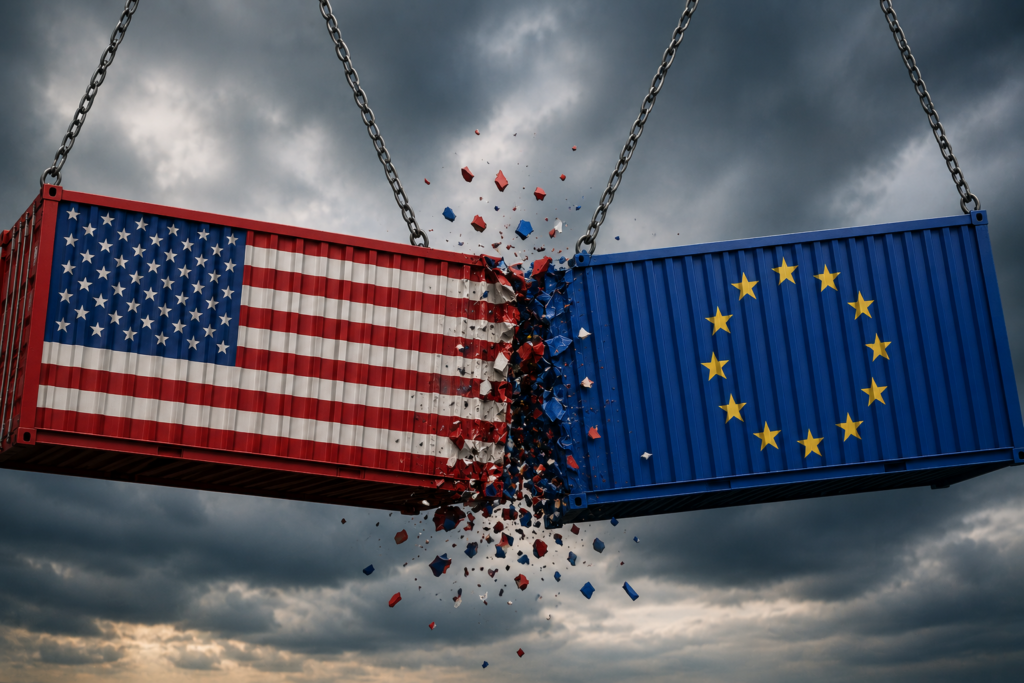
Image Credentials: Image Title: Trump Threatens 100% Tariffs on Countries Taxing US Digital Services, Raising Risk of New Trade Conflict. Source: (chatgpt.com) Date: June 2026. Attribution: This image was created using AI-generated imagery (chatgpt.com) by Open Chronicle and does not depict a real-world scene.
By Open Chronicle with Agencies
WASHINGTON, June 26, 2026 — U.S. President Donald Trump has threatened to impose 100 percent tariffs on imports from any country that introduces or maintains taxes on American digital services, escalating tensions with Europe and raising the prospect of a new transatlantic trade dispute.
In a statement posted on social media Friday, Trump warned that nations seeking to tax major U.S. technology companies would face immediate and sweeping trade penalties, regardless of any existing trade agreements with the United States.
BREAKING: President Trump sends a massive warning to European countries considering adding a new digital services tax on U.S. companies, saying any nation that moves forward will "immediately be met with a 100% TARIFF on any and all Goods sent to the United States."
"This TARIFF… pic.twitter.com/UURMNGSwPZ
— Fox News (@FoxNews) June 26, 2026
Trump issues sweeping tariff warning
Trump said the proposed measure would apply to any country implementing digital services taxes but singled out European nations, where several governments have debated or already introduced such levies.
“Please let this statement serve to represent that any Country that imposes such a Tax will immediately be met with a 100% TARIFF on any Goods sent to the United States of America,” Trump wrote.
He also declared that the proposed tariffs would override previously negotiated trade agreements if necessary.
The warning represents one of the strongest trade threats issued by the administration since the recent U.S.–European Union trade agreement.
EU defends digital taxation
The European Commission responded quickly, rejecting Trump’s criticism and defending the bloc’s ability to regulate and tax large technology companies.
European Commission spokesperson Olof Gill said digital services taxes are legitimate public policy tools designed to ensure multinational technology companies contribute fairly to national tax systems.
“Unilateral measures targeting such legitimate policies are unjustified,” Gill said.
“If pursued, the EU will respond swiftly and decisively to defend its rights and regulatory autonomy.”
He emphasized that the taxes are non-discriminatory and apply equally to all qualifying companies regardless of where they are headquartered.
Digital taxes remain a key dispute
Although the United States and the European Union finalized a trade agreement in May that capped tariffs on most European exports at 15 percent, digital taxation was excluded from the negotiations.
The issue has remained one of the principal points of friction between Washington and Brussels.
Several European governments argue that multinational technology companies generate significant revenue within their countries while paying comparatively little corporate tax under existing international rules.
Britain already applies a digital services tax
Outside the European Union, the United Kingdom has imposed a 2 percent Digital Services Tax since 2020.
The measure applies to revenues earned by large search engines, social media platforms, and online marketplaces that derive value from British users.
British authorities have argued that traditional corporate tax rules fail to reflect where digital value is created and that multinational technology firms should make a fair contribution toward funding public services.
The UK system includes revenue thresholds, meaning only the largest international technology companies are subject to the tax.
Risk of wider trade confrontation
Trump has consistently opposed foreign taxation and regulation of American technology companies, arguing that such measures unfairly target successful U.S. businesses.
His latest warning comes just days before the July 4 implementation deadline for the recently negotiated U.S.–EU tariff agreement.
Analysts warn that if Washington follows through with the proposed tariffs and the European Union retaliates, the dispute could escalate into a broader trade conflict affecting industries well beyond the technology sector.
Higher tariffs on both sides of the Atlantic could increase consumer prices, disrupt supply chains, and slow economic growth while adding further uncertainty to international trade relations.