
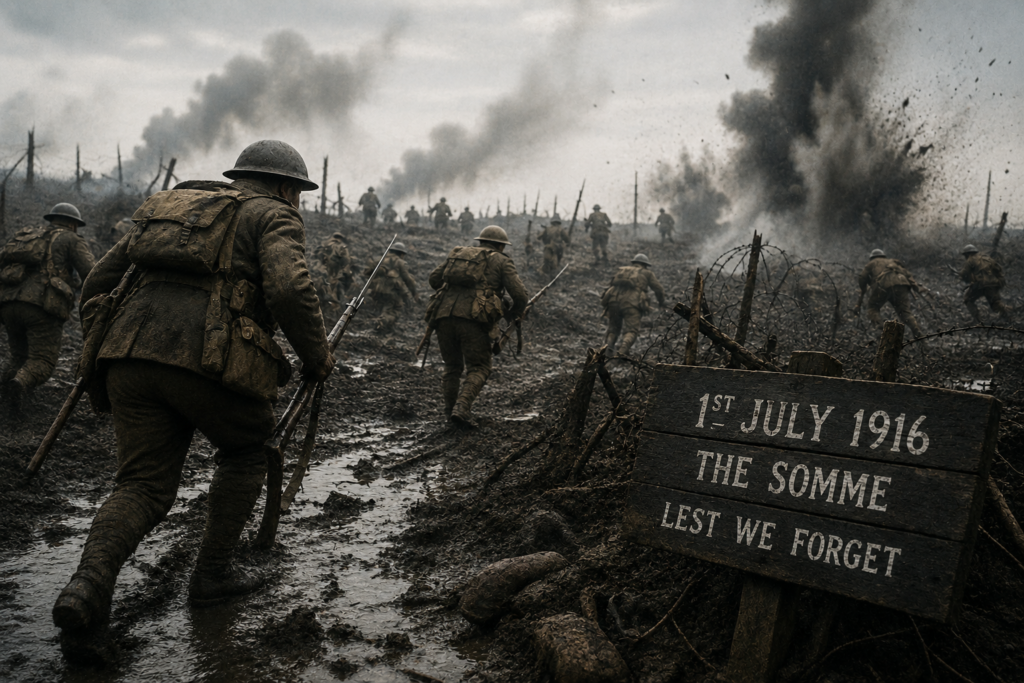
Image Credentials: Image Title: Today in History, July 1: The Battle of the Somme Begins. Source: (chatgpt.com) Date: June 2026. Attribution: This image was created using AI-generated imagery (chatgpt.com) by Open Chronicle and does not depict a real-world scene.
By Open Chronicle
July 1, 1916
On this day in 1916, the Battle of the Somme began along the Western Front in northern France. Conceived as a major Allied offensive against the German Army during the First World War, the opening day became the bloodiest in the history of the British Army, leaving an enduring mark on the memory of Britain and the wider Commonwealth.
The offensive was planned jointly by British and French commanders with the aim of breaking through German defensive lines, relieving pressure on French forces fighting at Verdun, and weakening the German military through sustained attrition. After a week-long artillery bombardment intended to destroy enemy trenches and barbed wire, Allied commanders believed the German defences had been severely weakened.
At 7:30 a.m. on July 1, thousands of British soldiers climbed out of their trenches and advanced across No Man’s Land toward the German positions. Many troops expected to encounter only scattered resistance. Instead, much of the German defensive system had survived the bombardment. Deep underground bunkers protected German soldiers, who emerged as the shelling ended and manned their machine guns.
The attacking infantry soon found themselves advancing across open ground under devastating fire. Entire units suffered catastrophic losses within minutes. By the end of the day, the British Army had recorded approximately 57,000 casualties, including more than 19,000 soldiers killed. It remains the deadliest single day in the history of the British Army.
Despite the horrific losses on the opening day, the battle continued for more than four months. British, French, and later Dominion forces from Canada, Australia, New Zealand, South Africa, and Newfoundland fought alongside each other in a relentless campaign that stretched until November 1916. The fighting introduced new military technologies, including the first use of tanks by the British Army in September, although these early machines had only a limited impact.
When the battle finally ended, the Allies had advanced only a few kilometres at an enormous human cost. Combined casualties on both sides exceeded one million men, making the Somme one of the deadliest battles in military history. Although historians continue to debate its strategic value, the offensive inflicted severe losses on the German Army while exposing the terrible realities of industrialized warfare.
Today, the Battle of the Somme stands as one of the defining symbols of the First World War. The rows of cemeteries, memorials, and preserved battlefields across northern France serve as lasting reminders of the sacrifice made by hundreds of thousands of soldiers during one of history’s most devastating conflicts.