
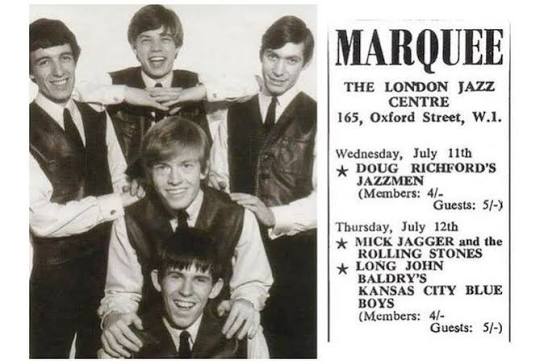
Image: from Jim Forbin X @piratenations1
By Open Chronicle
12 July 1962
On 12 July 1962, a little-known rhythm and blues band called The Rolling Stones gave its first public performance at London’s Marquee Club, an event that marked the beginning of one of the most influential careers in the history of popular music. Although few in the audience could have imagined it at the time, the concert launched a band that would become a defining force in rock music for more than six decades.
The Marquee Club, located on Oxford Street in central London, had already established itself as one of Britain’s leading venues for emerging jazz, blues, and rock musicians. During the early 1960s, it became an important gathering place for young artists inspired by American blues, rhythm and blues, and early rock and roll, genres that were rapidly gaining popularity among British audiences.
The original lineup that took the stage that evening differed slightly from the group that would later achieve worldwide fame. The band featured vocalist Mick Jagger, guitarist Keith Richards, guitarist Brian Jones, bassist Dick Taylor, and drummer Mick Avory, who temporarily filled in before Charlie Watts joined the group in early 1963. Brian Jones, who had organized the performance, chose the name “The Rolling Stones” after a song by American blues musician Muddy Waters.
Their repertoire consisted largely of American blues and rhythm and blues classics by artists including Chuck Berry, Bo Diddley, Jimmy Reed, and Muddy Waters. Rather than presenting polished pop music, the group embraced a raw, energetic style that distinguished them from many contemporary British acts and reflected their admiration for African American blues traditions.
The concert attracted only a modest audience, but it immediately established the band’s reputation within London’s growing music scene. Their energetic stage presence, improvisational performances, and commitment to authentic blues music quickly earned them a loyal following among fans seeking a more rebellious alternative to mainstream pop.
Over the following years, The Rolling Stones developed their own songwriting partnership between Mick Jagger and Keith Richards, producing a remarkable succession of hit singles and albums that helped define the British Invasion alongside other major British groups. Songs such as “(I Can’t Get No) Satisfaction,” “Paint It, Black,” “Jumpin’ Jack Flash,” and “Gimme Shelter” became enduring classics of rock music.
The band’s influence extended far beyond commercial success. Their music shaped generations of musicians, while their image challenged conventional ideas of fashion, performance and youth culture during the 1960s and beyond. Throughout decades of changing musical trends, The Rolling Stones continued to tour internationally, remaining one of the world’s most successful and longest-performing rock bands.
The Marquee Club performance is now regarded as one of the defining moments in the history of modern music. What began as a small club performance by an ambitious group of blues enthusiasts evolved into the foundation of a cultural phenomenon that transformed rock music and popular culture across the world.
More than sixty years later, the first Rolling Stones concert remains a landmark in music history, symbolising the birth of a band whose influence continues to resonate across generations and whose legacy stands among the greatest in the history of popular music.