
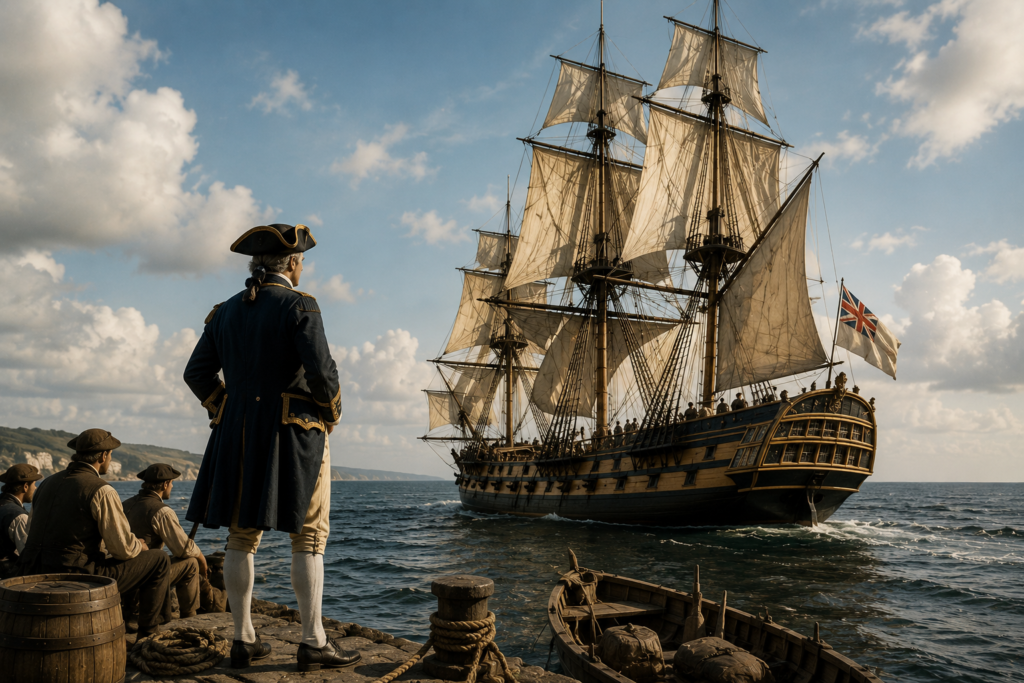
Image Credentials: Image Title: Today in History, July 13: 1772 Captain James Cook Departs on His Second Voyage Aboard HMS Resolution. Source: (chatgpt.com) Date: July 2026. Attribution: This image was created using AI-generated imagery (chatgpt.com) by Open Chronicle and does not depict a real-world scene.
By Open Chronicle
13 July 1772
On 13 July 1772, British explorer Captain James Cook departed from Plymouth aboard HMS Resolution, beginning his second great voyage of discovery. Commissioned by the British Admiralty and supported by the Royal Society, the expedition sought to determine whether the legendary southern continent, known as Terra Australis Incognita, truly existed. The voyage would become one of the most important scientific and geographical expeditions of the eighteenth century.
Cook had already earned international recognition following his first voyage between 1768 and 1771, during which he observed the Transit of Venus in Tahiti and charted the eastern coastline of Australia. His exceptional navigational skills and detailed maps established him as one of Britain’s most accomplished explorers, leading to a second commission with even more ambitious objectives.
The expedition was led by HMS Resolution, widely regarded as one of the finest exploration vessels of its era. A second ship, HMS Adventure, commanded by Captain Tobias Furneaux, accompanied the voyage. Both ships carried experienced sailors, naturalists, astronomers, and artists whose work would greatly expand European knowledge of the world’s oceans and distant lands.
One of the principal goals was to search for the hypothetical southern continent that many geographers believed occupied the unexplored regions of the Southern Hemisphere. European scholars had long speculated that such a vast landmass existed to balance the continents of the Northern Hemisphere, but no expedition had been able to confirm its presence.
During the voyage, Cook pushed farther south than any previous navigator. In January 1773, HMS Resolution became the first known ship to cross the Antarctic Circle, a remarkable achievement that demonstrated the expedition’s extraordinary determination. Although thick pack ice prevented Cook from reaching the Antarctic continent itself, his observations convinced him that no large, habitable southern continent existed within the navigable latitudes.
Beyond its geographical discoveries, the expedition made significant scientific contributions. The crew conducted extensive astronomical observations, tested increasingly accurate marine chronometers for determining longitude at sea, and collected valuable information about ocean currents, weather patterns, plants, animals, and indigenous cultures encountered throughout the Pacific.
The expedition visited numerous islands across the South Pacific, including New Zealand, Easter Island, Tonga, the Marquesas, and several subantarctic islands. Cook’s charts proved exceptionally accurate and remained in use by mariners for many decades, greatly improving the safety of navigation throughout the region.
After more than three years at sea, Cook returned to England in July 1775. His second voyage had effectively disproved one of geography’s oldest theories while dramatically expanding scientific understanding of the Southern Hemisphere. The success of the expedition strengthened Britain’s reputation as a leading maritime and scientific power during the Age of Enlightenment.
Captain James Cook’s second voyage remains one of history’s greatest expeditions of exploration. Combining careful observation, scientific inquiry, and extraordinary seamanship, it transformed European knowledge of the Pacific Ocean and the southern regions of the globe. The journey demonstrated that exploration could serve not only imperial ambitions but also the advancement of science, geography, and human understanding.
Today, the departure of HMS Resolution on 13 July 1772 is remembered as the beginning of a voyage that reshaped the world’s maps and helped define the modern age of exploration.