
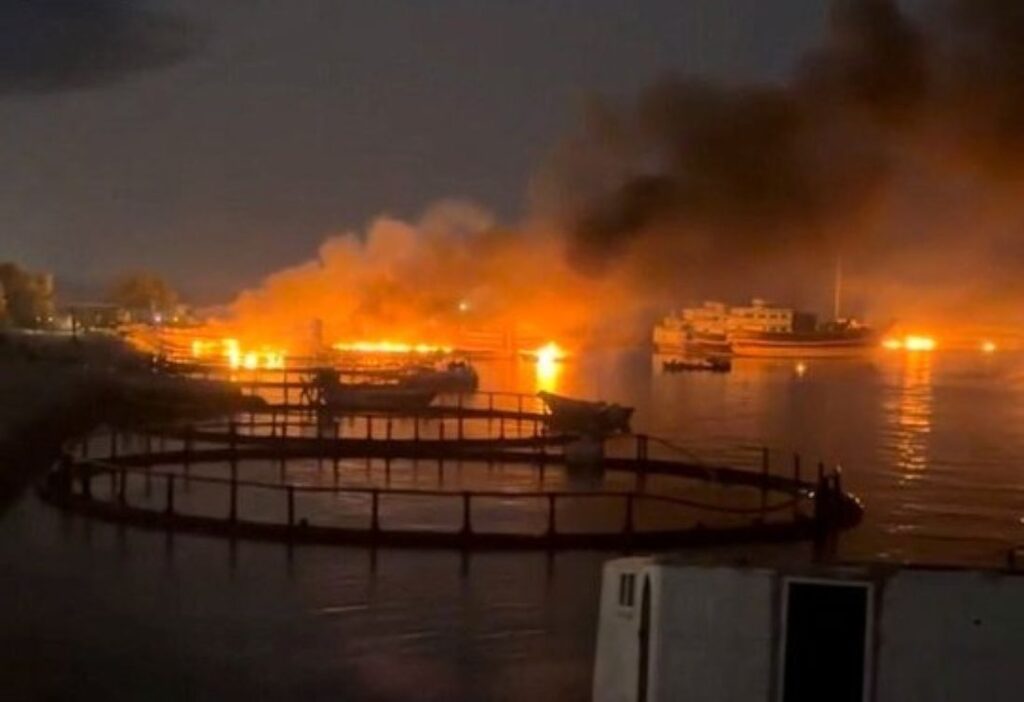
Image: from Kataeb.Org in English X @Kataeb_Eng
By Open Chronicle with Agencies
The United States has launched several new waves of strikes against Iranian military targets. At the same time, Tehran has retaliated against countries across the Gulf that host American forces, deepening fears that the fragile ceasefire could collapse into a broader regional conflict.
The latest escalation followed an Iranian attack on a container ship in the Strait of Hormuz that set the vessel ablaze and left one crew member missing. U.S. Central Command said American forces were prepared to protect commercial navigation through the strategic waterway and rejected Iran’s claim that it alone could determine access to the strait.
⚡️U.S. Central Command has said that they have completed the most recent wave on strikes against Iran, as dozens of strikes were carried out against Iranian military air-defense systems, coastal radar sites, missile and drone capabilities, and small boats. pic.twitter.com/rn2E5HXvCU
— The Global Monitor (@theglobal4u) July 13, 2026
U.S. strikes around 140 Iranian targets
According to Iranian opposition sources, these are the locations targeted by the United States overnight:
•Qeshm
•Sirik
•Bandar Abbas
•Jask
•Bushehr
•Khondab (near the Arak heavy water facility)
•Bandar Mahshahr
•Behbahan
•Andimeshk
•Dezful
•Ahvaz
•Abadan… pic.twitter.com/66VWfYRvKa— Gameover 🇦🇺🇮🇱 (@MarkoS2075) July 13, 2026
The U.S. military said it struck approximately 140 targets in Iran during one of its heaviest operations since the latest confrontation began.
The targets reportedly included missile and drone launch sites, ammunition depots, communications equipment and other military facilities linked to Iran’s ability to threaten shipping and regional bases.
President Donald Trump said the strikes had been extensive, while CENTCOM insisted that American forces would continue acting to preserve freedom of navigation in the Strait of Hormuz.
Iran expands retaliation across the Gulf
Iran responded by launching attacks toward several Gulf countries, including Bahrain, Kuwait, Qatar, Jordan, and Oman.
Missile alert sirens sounded in Bahrain, home to the U.S. Navy’s Fifth Fleet, while Kuwait said its air defences had engaged incoming threats. Qatar, which has played a mediation role in ceasefire talks, was also targeted, as was the United Arab Emirates, whose air defences intercepted Iranian missiles and drones.
The expansion of the Iranian response marked a dangerous broadening of the conflict, placing several states that host U.S. troops or support regional security efforts directly in the line of fire.
Strait of Hormuz becomes a central battleground
The Strait of Hormuz remains at the centre of the confrontation.
Iran insists that it has the right to regulate and potentially charge vessels passing through the waterway, while Washington argues that the strait is an international maritime corridor that must remain open.
The U.S. military has supported commercial vessels using a southern route closer to Oman, a move that has angered Tehran and prompted repeated Iranian attacks against ships using that passage.
Before the conflict, roughly a fifth of the world’s oil and natural gas passed through the strait, making any prolonged disruption a major threat to global energy markets and international trade.
Ceasefire under severe pressure
The United States and Iran are now approaching the midpoint of a 60-day interim arrangement intended to create space for negotiations on a permanent end to the war.
Instead, the period has been dominated by attacks on shipping, retaliatory strikes, and competing claims over control of the Strait of Hormuz.
United Nations Secretary-General António Guterres warned that a return to full-scale hostilities would have catastrophic consequences. Mediators, including Pakistan, Qatar, and Egypt, have continued attempts to prevent the ceasefire from collapsing completely.
Regional instability deepens
The latest exchange shows how quickly the crisis can spread beyond the confrontation between Washington and Tehran.
By targeting countries hosting U.S. military forces, Iran appears to be increasing the political and security costs of American operations. At the same time, repeated U.S. strikes are steadily degrading Iranian military infrastructure while increasing the risk of further retaliation.
With commercial shipping under pressure, Gulf air defences on alert and diplomatic talks struggling to contain events, the region remains dangerously close to another phase of open warfare.