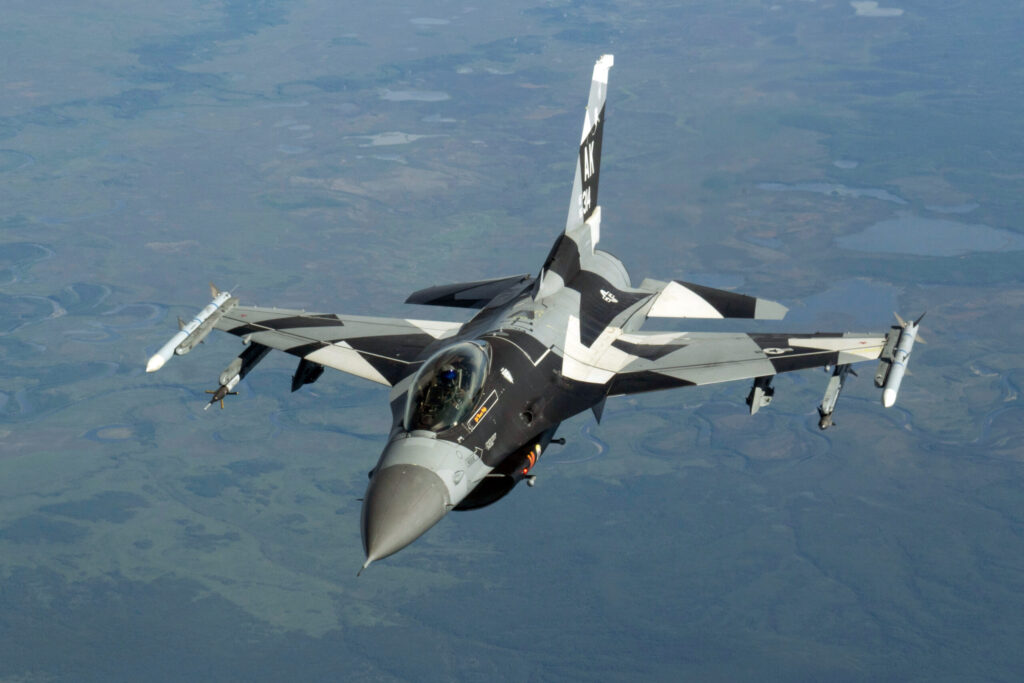
An F 16 Fighting Falcon manoeuvres into position for aerial refuelling after an air combat manoeuvring sortie over the Joint Pacific Alaska Range Complex on 18 June 2021, during exercise Red Flag Alaska 21 2.
Image Credit: U.S. Air Force photo by Airman 1st Class Mario Calabro.
By Open Chronicle
The F-16 Fighting Falcon is a single-engine, supersonic multirole combat aircraft originally developed by General Dynamics for the United States Air Force. Conceived during the 1970s as a lightweight and comparatively affordable air superiority fighter, it evolved into one of the most successful, adaptable, and widely operated military aircraft in aviation history.
The aircraft combined high manoeuvrability, advanced electronic flight controls, strong acceleration, and a cockpit designed to improve pilot awareness. Its introduction helped establish technologies that later became standard across modern fighter aviation, including relaxed static stability, digital fly-by-wire flight controls, a side-mounted control stick, and a highly reclined ejection seat.
Although initially intended primarily for daylight air combat, successive versions transformed the F-16 into an all-weather multi-role platform capable of conducting air defence, precision strike, close air support, suppression of enemy air defences, reconnaissance, maritime attack, and nuclear delivery missions.
More than 4,500 F-16s have been produced, and approximately 3,000 remained operational across about 25 countries during the early 2020s. Production continues through the advanced Block 70 and Block 72 versions, demonstrating the unusual longevity of a design whose origins date to the Cold War.
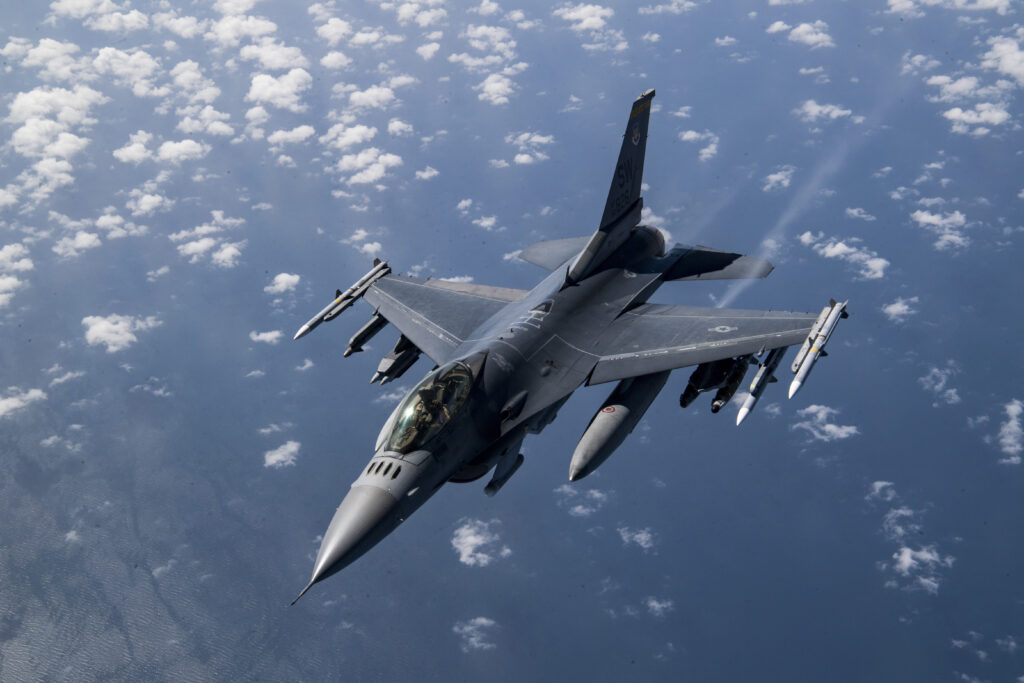
Quick Facts
Official designation: F-16 Fighting Falcon
Common nickname: Viper
Original manufacturer: General Dynamics
Current manufacturer: Lockheed Martin
Country of origin: United States
Aircraft type: Single-engine supersonic multirole fighter
Primary operator: United States Air Force
First YF-16 flight: 1974
First production F 16A flight: December 1976
First operational delivery: January 1979
Crew: One in the F-16A and F 16C, two in the F 16B and F 16D
Maximum speed: Approximately Mach 2 at altitude
Service ceiling: Above 50,000 feet
Primary internal armament: One M61A1 Vulcan 20 millimetre cannon
Major current production versions: F-16 Block 70 and Block 72
Principal roles: Air defence, air superiority, precision strike, suppression of enemy air defences, close air support, reconnaissance, and training
Why It Matters
The F-16 became one of the defining combat aircraft of the late twentieth and early twenty-first centuries.
Its importance does not arise from a single technological breakthrough or one particular military campaign. Instead, it reflects the successful combination of performance, affordability, adaptability, and international cooperation.
The aircraft demonstrated that a relatively lightweight fighter could deliver exceptional manoeuvrability while remaining capable of carrying a substantial weapons load. Its modular design and expandable avionics architecture allowed it to absorb new radar systems, weapons, sensors, computers, and electronic warfare equipment across decades of service.
The F-16 also became the foundation of an extensive international defence network. Allied air forces adopted common training systems, maintenance procedures, weapons and operational concepts built around the aircraft.
For many countries, acquiring the F-16 represented more than purchasing a fighter. It provided access to a broad military aviation ecosystem connected to the United States and NATO.
Its continuing production and modernisation illustrate how a well-designed airframe can remain relevant long after the technologies originally installed inside it have become obsolete.
Origins of the Lightweight Fighter
The origins of the F-16 can be traced to debates within the United States defence establishment during the late 1960s and early 1970s.
Combat experience and aircraft development trends had produced increasingly large, complex, and expensive fighters. Some engineers, pilots, and defence analysts argued that excessive weight and technological complexity could undermine the qualities most important in close air combat.
This group became informally associated with the expression Fighter Mafia or Lightweight Fighter Mafia.
Its members advocated aircraft with high thrust-to-weight ratios, low wing loading, rapid acceleration, strong energy retention, and exceptional manoeuvrability. They believed that a smaller fighter designed around these principles could complement heavier aircraft and provide greater numbers at a manageable cost.
Among the influential figures connected to this movement were defence analyst Pierre Sprey, United States Air Force officers John Boyd and Everest Riccioni, and engineer Harry Hillaker.
Boyd’s work on energy manoeuvrability theory became particularly influential. The theory provided a mathematical framework for comparing how combat aircraft gained, maintained, and lost energy during manoeuvres.
The future F-16 was not created exclusively by these individuals, but the debates they encouraged helped shape the environment in which the Lightweight Fighter programme emerged.
The Lightweight Fighter Programme
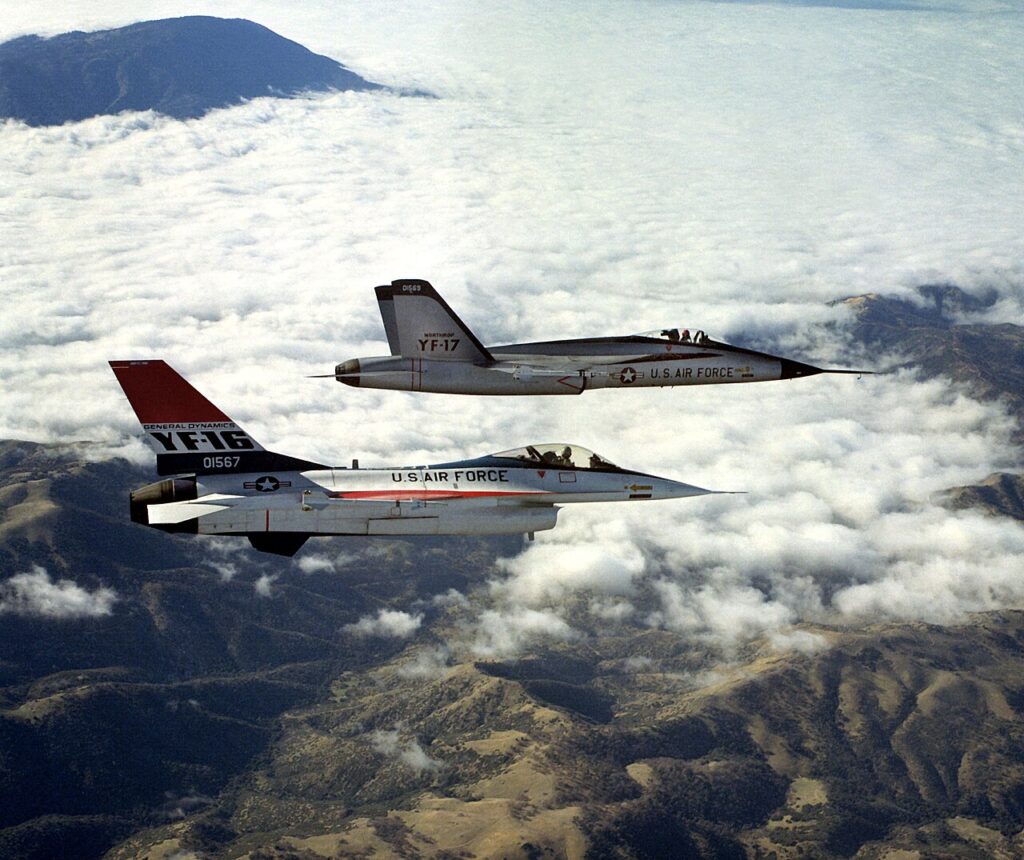
In 1972, the United States Air Force initiated the Lightweight Fighter programme to evaluate experimental aircraft demonstrating high performance at lower weight and cost.
Several companies submitted proposals.
General Dynamics developed the Model 401, which became the YF-16. Northrop produced the competing YF-17, a twin-engine aircraft that later contributed to the development of the F A 18 Hornet.
The YF-16 was designed around a single powerful turbofan engine, blended wing body aerodynamics, relaxed static stability, and electronic flight controls.
Its first flight occurred unexpectedly during a high-speed ground test in January 1974. Oscillations caused the aircraft to become briefly airborne, and test pilot Phil Oestricher chose to continue into a short flight rather than risk damaging the prototype while attempting to stop.
The first planned flight followed shortly afterwards.
The YF-16 and YF-17 underwent competitive testing throughout 1974.
In January 1975, the United States selected the YF-16 for development under the Air Combat Fighter programme.
The decision reflected several considerations, including performance, projected cost, engine commonality with the F-15, and the suitability of the design for a multinational procurement programme.
A Multinational Fighter

The F-16 became an international programme from an early stage.
Belgium, Denmark, the Netherlands, and Norway joined the United States in a multinational production and acquisition arrangement. The four European countries sought a modern replacement for ageing combat aircraft, while the United States wanted to strengthen NATO standardisation and distribute production among allied industries.
The agreement included aircraft assembly and component manufacturing in Europe.
Belgian and Dutch production lines assembled hundreds of aircraft, while companies across the participating countries manufactured structural components and equipment.
This multinational structure helped establish the F-16 as a central NATO combat aircraft.
It also created a large common support network that contributed to the fighter’s long operational life.
The arrangement became an important model for later multinational military aviation programmes, even though subsequent projects adopted different industrial and political structures.
From YF-16 to Production Aircraft

The production aircraft differed from the original YF-16 prototype.
The fuselage was lengthened, the wing area was increased, and the structure was strengthened to accommodate additional fuel, weapons, and operational equipment.
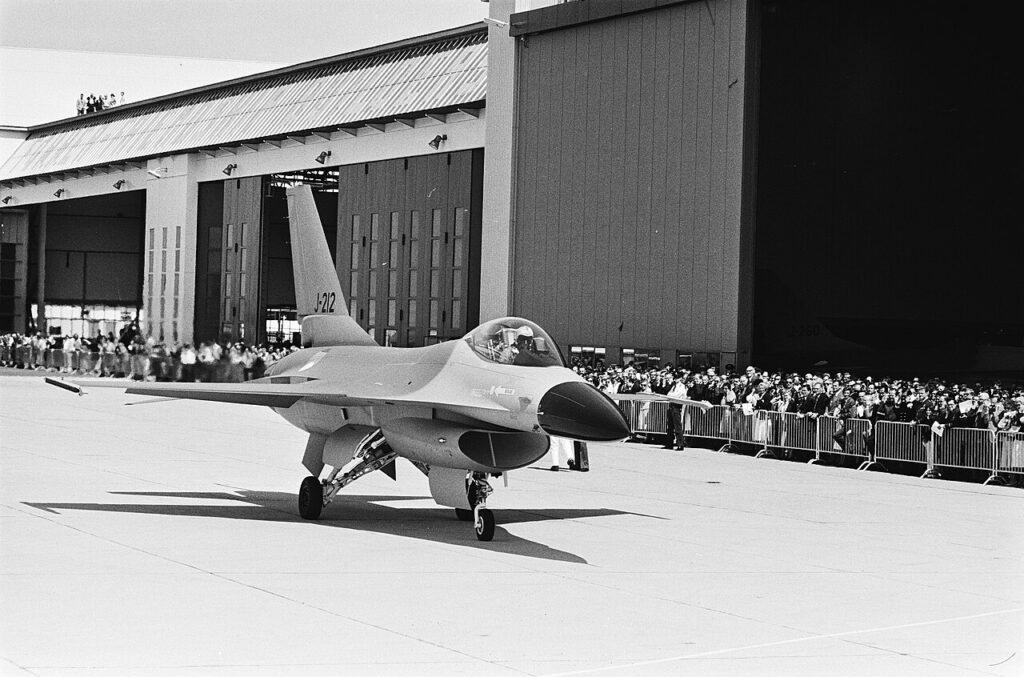
The first production standard F 16A flew in December 1976.
The F 16A was the single-seat combat version, while the F 16B incorporated a second seat for training and operational conversion.
The United States Air Force received its first operational F 16A in January 1979. The aircraft was delivered to the 388th Tactical Fighter Wing at Hill Air Force Base in Utah.
The F-16 initially entered service as a relatively simple daytime fighter, but the aircraft was designed with substantial development potential.
Later production blocks added improved radar, greater weapons compatibility, enhanced navigation, stronger structures, and increasingly sophisticated electronic systems.
The Name Fighting Falcon
The official name Fighting Falcon was selected by the United States Air Force.
However, pilots and maintainers commonly refer to the aircraft as the Viper.
The nickname emerged partly because the aircraft’s appearance was considered similar to a snake and partly because the television series Battlestar Galactica, which featured fictional Viper fighters, was popular during the period when the F-16 entered service.
Although Fighting Falcon remains the formal designation, Viper became deeply embedded in the aircraft’s operational culture.
The unofficial name is widely used by pilots, ground crews, and aviation enthusiasts.
Revolutionary Flight Control System
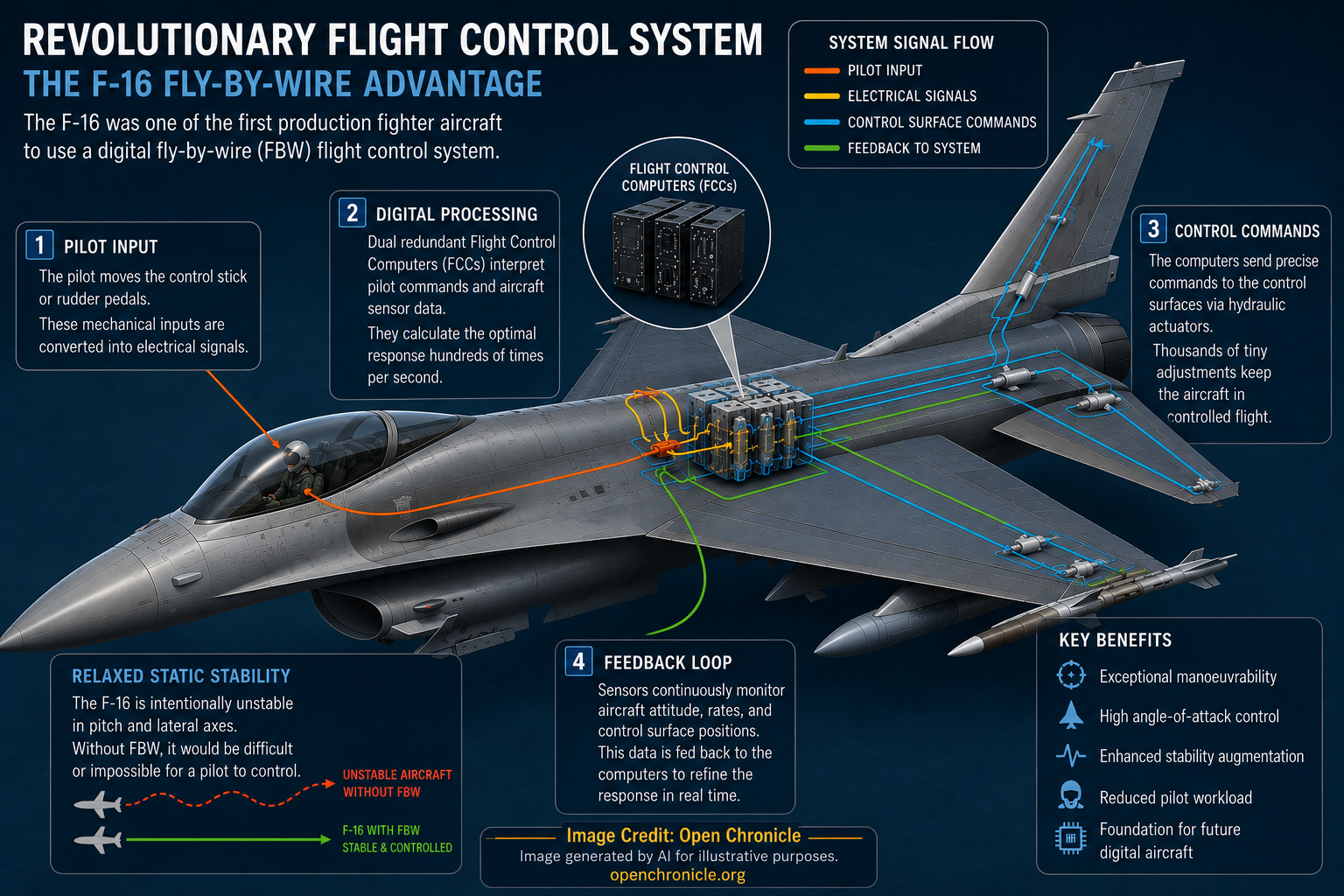
One of the F 16’s most important innovations was its digital fly-by-wire flight control system.
Traditional aircraft rely on aerodynamic stability to return to level flight after a control disturbance. Designers normally achieve this by arranging the aircraft’s centre of gravity and aerodynamic forces so that the aircraft naturally resists changes in attitude.
The F-16 was intentionally designed with relaxed static stability.
This made it aerodynamically unstable under certain conditions, allowing it to respond more rapidly to control inputs and improving manoeuvrability.
Such an aircraft would be extremely difficult or impossible for a human pilot to control continuously through direct mechanical connections.
The fly-by-wire system solved this problem.
Electronic computers interpret the pilot’s commands and continuously adjust the flight control surfaces to maintain controlled flight. The system makes thousands of small corrections that the pilot does not need to manage directly.
This architecture allowed the F-16 to combine instability with practical controllability.
It also represented a major step towards the computer-mediated flight systems now found in modern combat aircraft.
Side Stick Controller
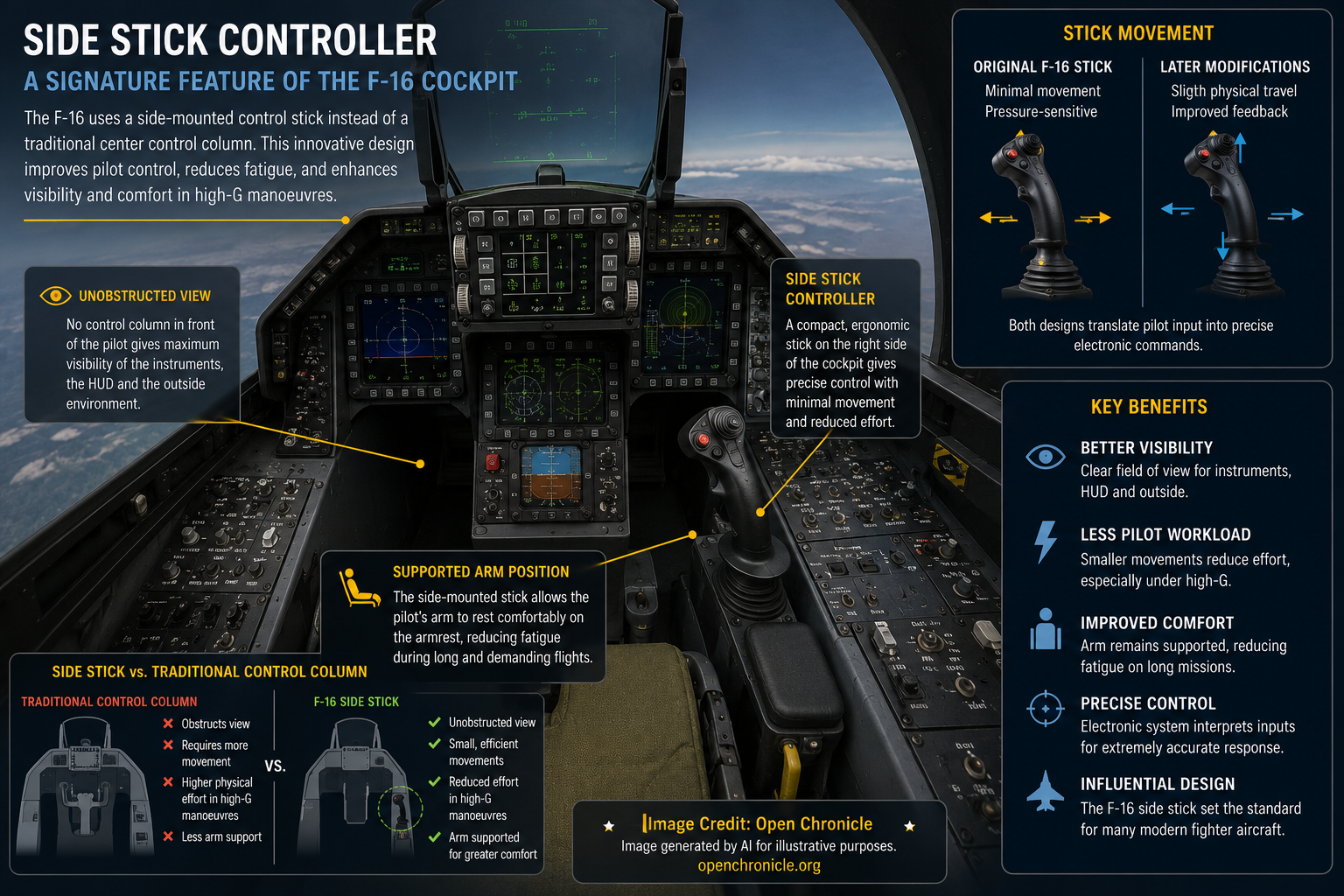
Unlike traditional aircraft, the F-16 does not use a large central control column.
Instead, the pilot operates a small side-mounted control stick positioned on the right side of the cockpit.
The original stick moved very little and responded primarily to pressure. Later modifications introduced a small amount of physical movement to improve pilot feedback.
The side stick reduced the effort required during high gravitational force manoeuvres and left more space directly in front of the pilot.
Its placement also allowed the pilot’s arm to remain supported while operating the aircraft under demanding conditions.
This configuration became one of the most recognisable features of the F-16 cockpit and influenced later fighter designs.
Bubble Canopy and Pilot Visibility
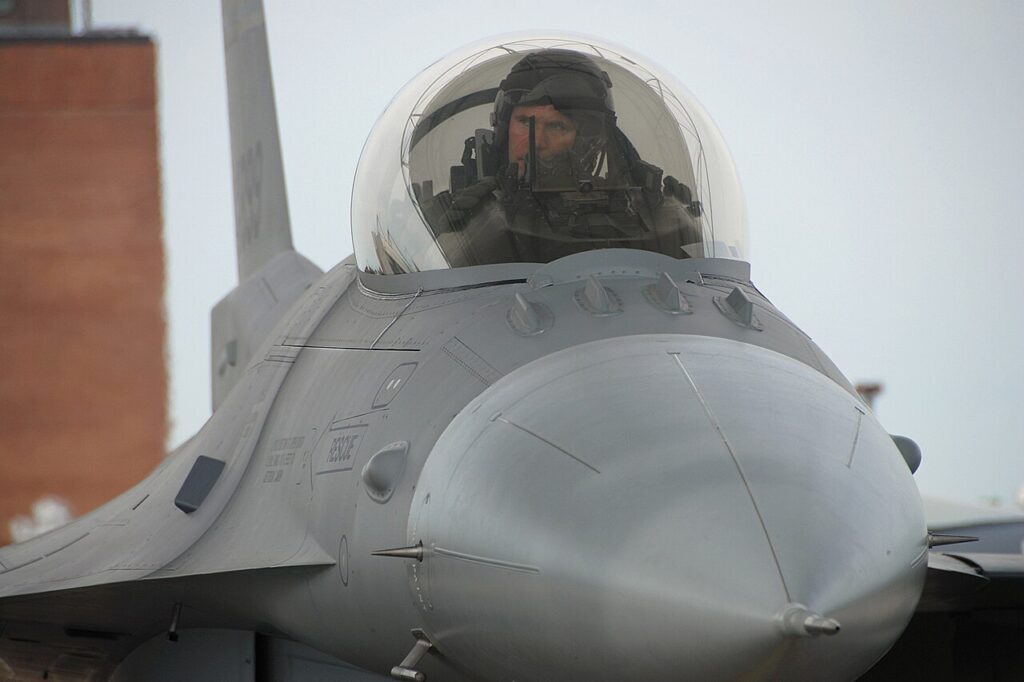
The F-16 was designed to provide exceptional external visibility.
Its frameless bubble canopy gives the pilot a wide field of view, including strong visibility to the sides and rear.
This was particularly important for visual air combat, where detecting another aircraft before being detected can determine the outcome of an engagement.
The pilot sits in a seat reclined approximately 30 degrees, considerably more than in many earlier fighters.
The reclined position helps the pilot tolerate gravitational forces generated during high-performance manoeuvres.
However, it also required specialised cockpit design and pilot adaptation.
Together, the canopy, seat, and compact cockpit contributed to an aircraft built around close integration between pilot and machine.
Aerodynamic Design
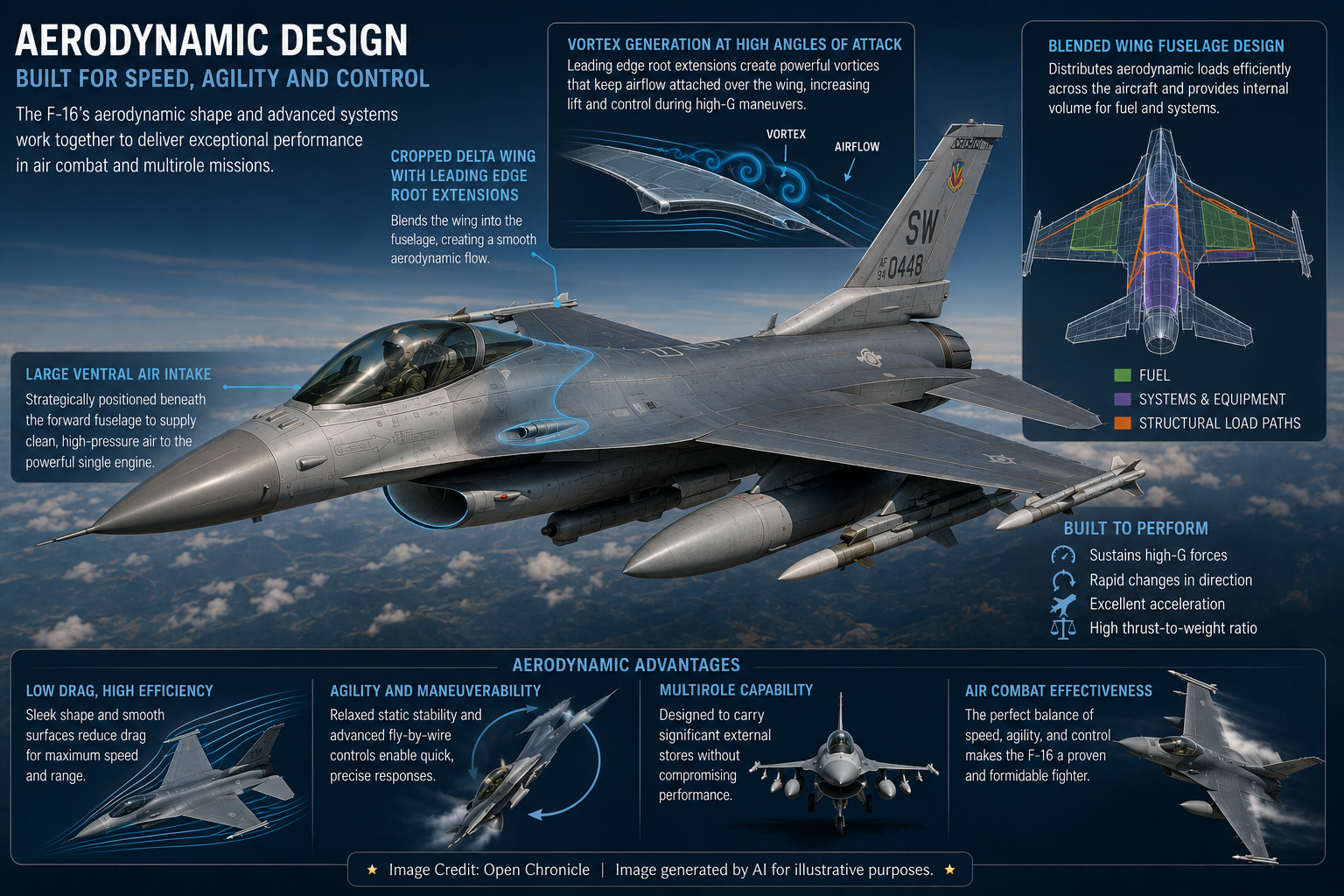
The F-16 has a cropped delta wing combined with leading edge root extensions that blend the wing into the fuselage.
These extensions generate vortices at high angles of attack, helping maintain airflow over the wing and improving lift during aggressive manoeuvres.
A large air intake beneath the forward fuselage supplies the single engine.
The aircraft’s blended wing fuselage design distributes aerodynamic loads efficiently and creates internal volume for fuel and equipment.
The F-16 is capable of sustaining high gravitational forces and rapid changes in direction.
Its combination of low weight, powerful engine, and advanced flight controls produced excellent acceleration and turning performance.
These qualities made the aircraft highly effective in air combat while also allowing it to carry significant external stores.
Engine Development
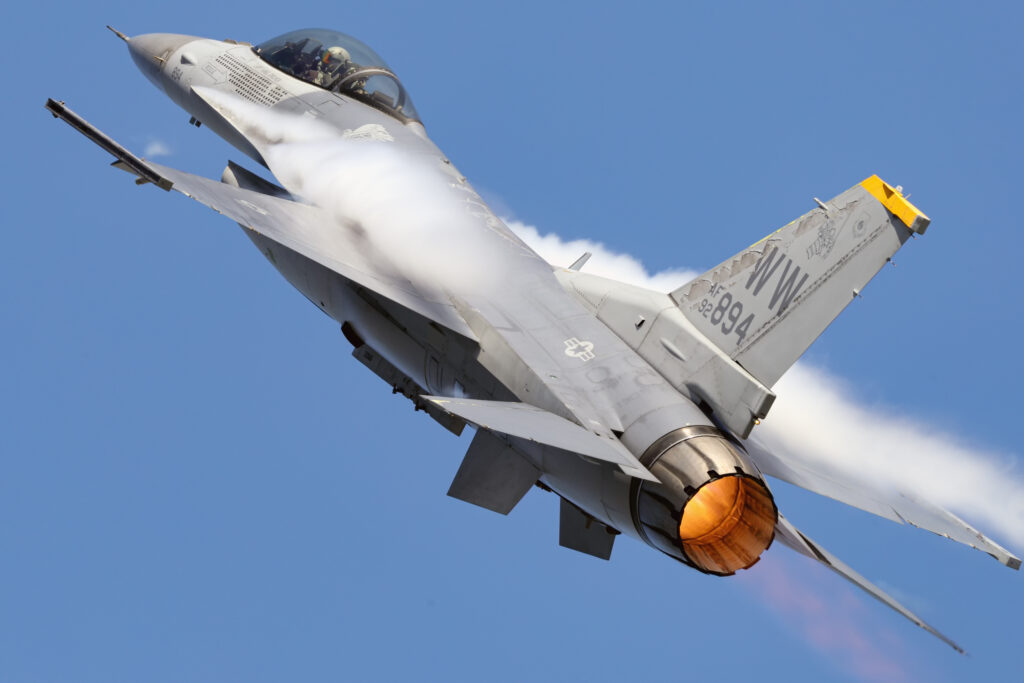
Early F-16 aircraft used versions of the Pratt & Whitney F100 afterburning turbofan engine, which was also associated with the F 15 Eagle.
The use of a common engine family helped reduce development risk and supported logistical compatibility.
Later, F-16 variants introduced the General Electric F110 as an alternative.
The availability of two engine families became an important element of the F-16 programme.
Aircraft equipped with General Electric engines normally use a larger intake, while those powered by Pratt & Whitney engines retain a smaller intake configuration.
The choice between engines varies by production block and operator.
Both engine families have received successive improvements in thrust, reliability, and maintainability.
Multirole Transformation
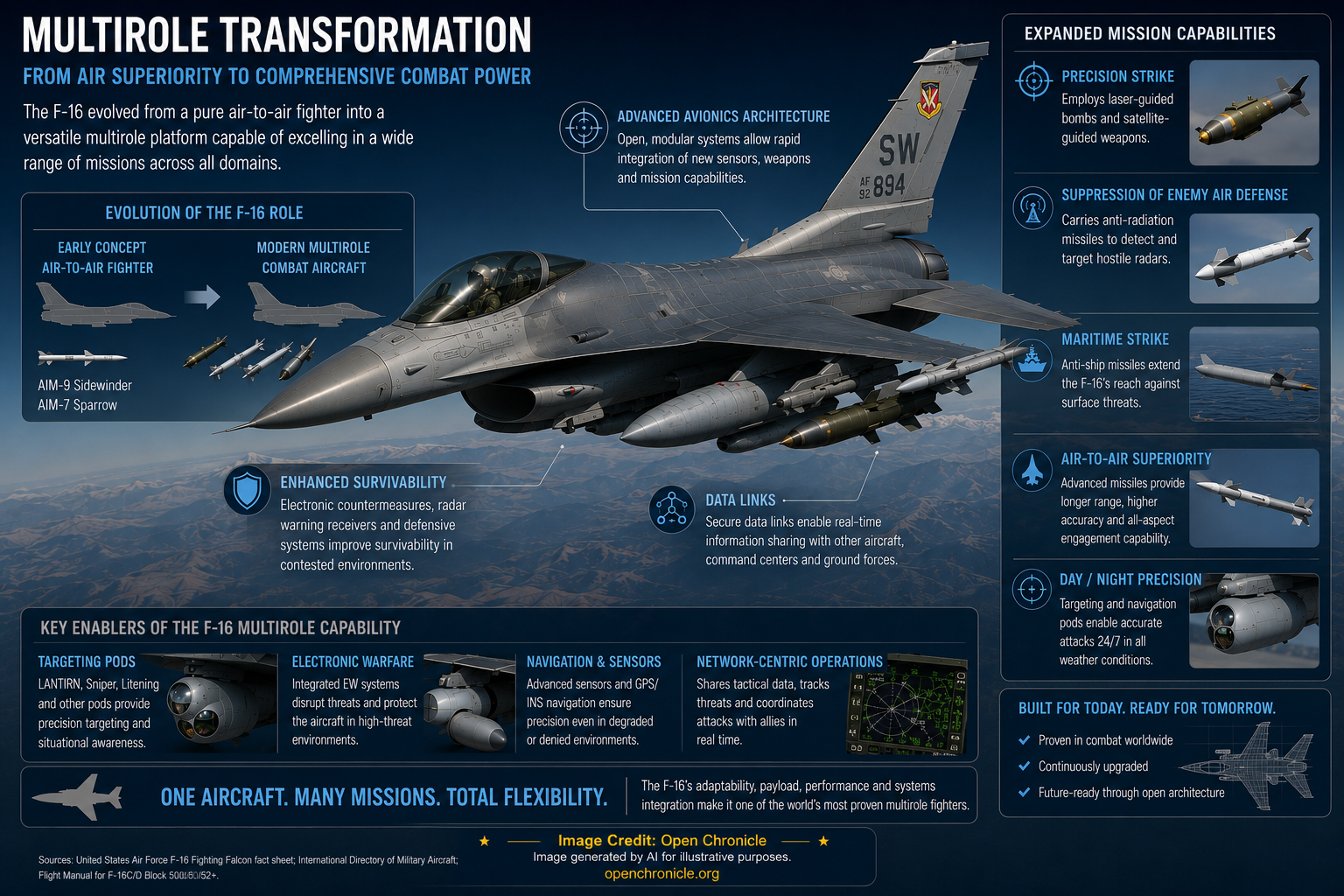
The earliest concept emphasised air-to-air combat, but operational requirements rapidly expanded.
The F-16’s payload capacity, avionics architecture, and flight performance made it suitable for a broad range of missions.
New versions gained the ability to employ laser-guided bombs, satellite-guided weapons, anti-radiation missiles, anti-ship weapons, and advanced air-to-air missiles.
Navigation and targeting pods allowed the aircraft to conduct precision attacks by day or night.
Electronic countermeasures and radar warning systems improved survivability.
Data links enabled pilots to exchange tactical information with other aircraft and command networks.
These changes transformed the F-16 from a lightweight fighter into a comprehensive multirole combat platform.
Technical Characteristics
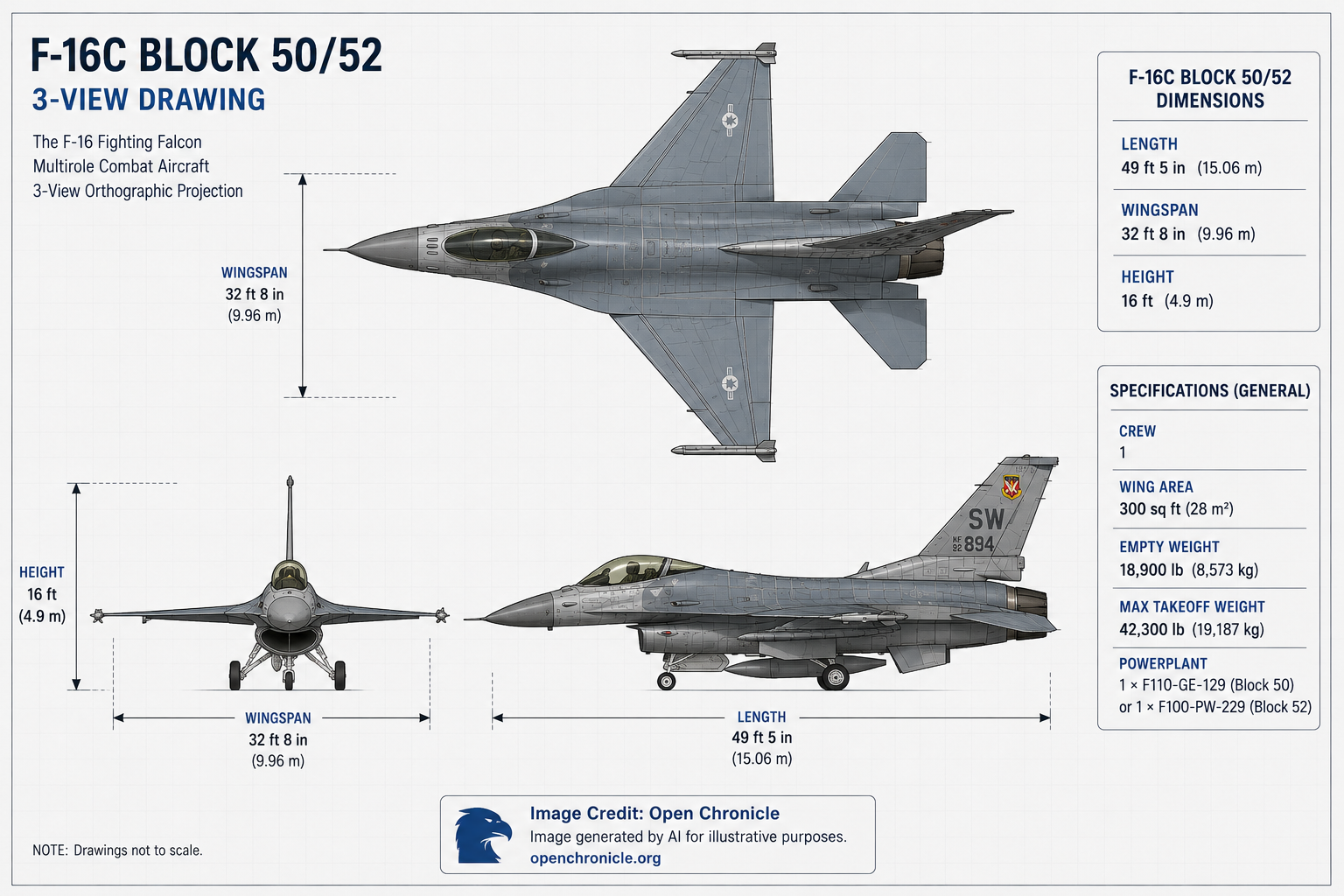
Specifications vary significantly among versions, engines, and national configurations.
A typical United States Air Force F 16C has a maximum speed of approximately 1,500 miles per hour, or about Mach 2 at altitude.
Its service ceiling exceeds 50,000 feet.
The aircraft has a ferry range exceeding 2,000 miles when carrying external fuel tanks.
Internal fuel capacity is approximately 7,000 pounds, while external tanks can significantly increase endurance.
The aircraft carries one internally mounted M61A1 Vulcan 20 millimetre rotary cannon.
External weapons and equipment are carried on multiple stations beneath the wings and fuselage.
A representative combat load can include air-to-air missiles, precision-guided bombs, external fuel tanks, electronic warfare equipment, and targeting pods.
Specifications, F-16C Block 50 and Block 52
| Category | Specification |
|---|---|
| Crew | 1 |
| Length | 49 ft 5 in, 15.06 m |
| Wingspan | 32 ft 8 in, 9.96 m |
| Height | 16 ft, 4.9 m |
| Wing area | 300 sq ft, 28 m² |
| Airfoil | NACA 64A204 |
| Empty weight | 18,900 lb, 8,573 kg |
| Gross weight | 26,500 lb, 12,020 kg |
| Maximum takeoff weight | 42,300 lb, 19,187 kg |
| Internal fuel capacity | 7,000 lb, approximately 3,200 kg |
| Block 50 powerplant | 1 × General Electric F110 GE 129 |
| Block 50 thrust | 17,155 lbf, 76.31 kN dry; 29,500 lbf, 131 kN with afterburner |
| Block 52 powerplant | 1 × Pratt & Whitney F100 PW 229 |
| Block 52 thrust | 17,800 lbf, 79 kN dry; 29,160 lbf, 129.7 kN with afterburner |
Performance
| Category | Specification |
|---|---|
| Maximum speed at altitude | Mach 2.05, 1,176 kn, 1,353 mph, 2,178 km/h at 40,000 ft, clean configuration |
| Maximum speed at sea level | Mach 1.2, 800 kn, 921 mph, 1,482 km/h |
| Cruise speed | 504 kn, 580 mph, 933 km/h |
| Combat range | 295 nmi, 339 mi, 546 km, hi lo hi mission with 4 × 1,000 lb bombs |
| Ferry range | 2,277 nmi, 2,620 mi, 4,217 km, with three external fuel tanks |
| Service ceiling | 50,000 ft, 15,000 m |
| Maximum g limit | +9 g |
| Roll rate | 324° per second |
| Wing loading | 88.3 lb/sq ft, 431 kg/m² |
| Thrust-to-weight ratio | 1.095, up to approximately 1.24 with loaded weight and 50% internal fuel |
Armament and Stores
| Category | Capability |
|---|---|
| Internal gun | 1 × 20 mm M61A1 Vulcan six-barrel rotary cannon |
| Ammunition | 500 rounds |
| Hardpoints | 2 wingtip missile rails, 6 underwing stations, and 3 under fuselage stations, with 2 of the latter typically available for sensors |
| Maximum external storage capacity | Up to 17,000 lb, approximately 7,700 kg |
| Rocket pods | LAU 61, LAU 68, LAU 5003, and LAU 10 |
| Air-to-air missiles | AIM 9 Sidewinder, AIM 120 AMRAAM, IRIS T, Python 4, Python 5, and, in compatible configurations, AIM 7 Sparrow |
| Air-to-surface missiles | AGM 65 Maverick, AGM 88 HARM, AGM 158 JASSM |
| Anti-ship missiles | AGM 84 Harpoon, AGM 119 Penguin, with Joint Strike Missile integration planned for compatible configurations |
| General-purpose bombs | Mark 82, Mark 83, Mark 84 |
| Precision-guided weapons | GBU 10, GBU 12, GBU 24, GBU 27, JDAM, GBU 39 SDB, AGM 154 JSOW |
| Other conventional munitions | CBU 87, CBU 89, CBU 97, and WCMD compatible munitions |
| Nuclear capability | B61 nuclear bomb in authorised configurations; historical source material also lists the B83 |
| Decoys | ADM 160 MALD |
| External fuel tanks | Up to three external tanks, depending on configuration and mission |
Mission Equipment
| System | Function |
|---|---|
| LANTIRN | Low-altitude navigation and targeting |
| Sniper XR | Advanced electro-optical targeting pod |
| Litening | Targeting and reconnaissance |
| AN/ASQ 213 HTS | Detection and targeting of hostile radar emitters for HARM employment |
| DB 110 | Long-range electro-optical and infrared reconnaissance |
| AN/ALQ 131 | Electronic countermeasures |
| AN/ALQ 184 | Electronic countermeasures |
| SUU 42A/A | Countermeasure dispensing capability |
Avionics
| System | Description |
|---|---|
| Radar | AN/APG 68 |
| Radar warning receiver | AN/ALR 56M |
| Updated radar warning receiver | AN/ALR 69A(V), replacing earlier systems on modernised USAF Block 40/42 and 50/52 aircraft |
| Electronic warfare architecture | AN/ALQ 213 |
| Updated electronic warfare system | AN/ALQ 257, being introduced on modernised USAF aircraft |
| Data bus | MIL STD 1553 |
Sources: United States Air Force F-16 Fighting Falcon fact sheet; International Directory of Military Aircraft; Flight Manual for F 16C/D Block 50/52+. Exact performance, weapons compatibility, and avionics vary according to production block, national operator, software configuration, and modernisation programme.
Armament
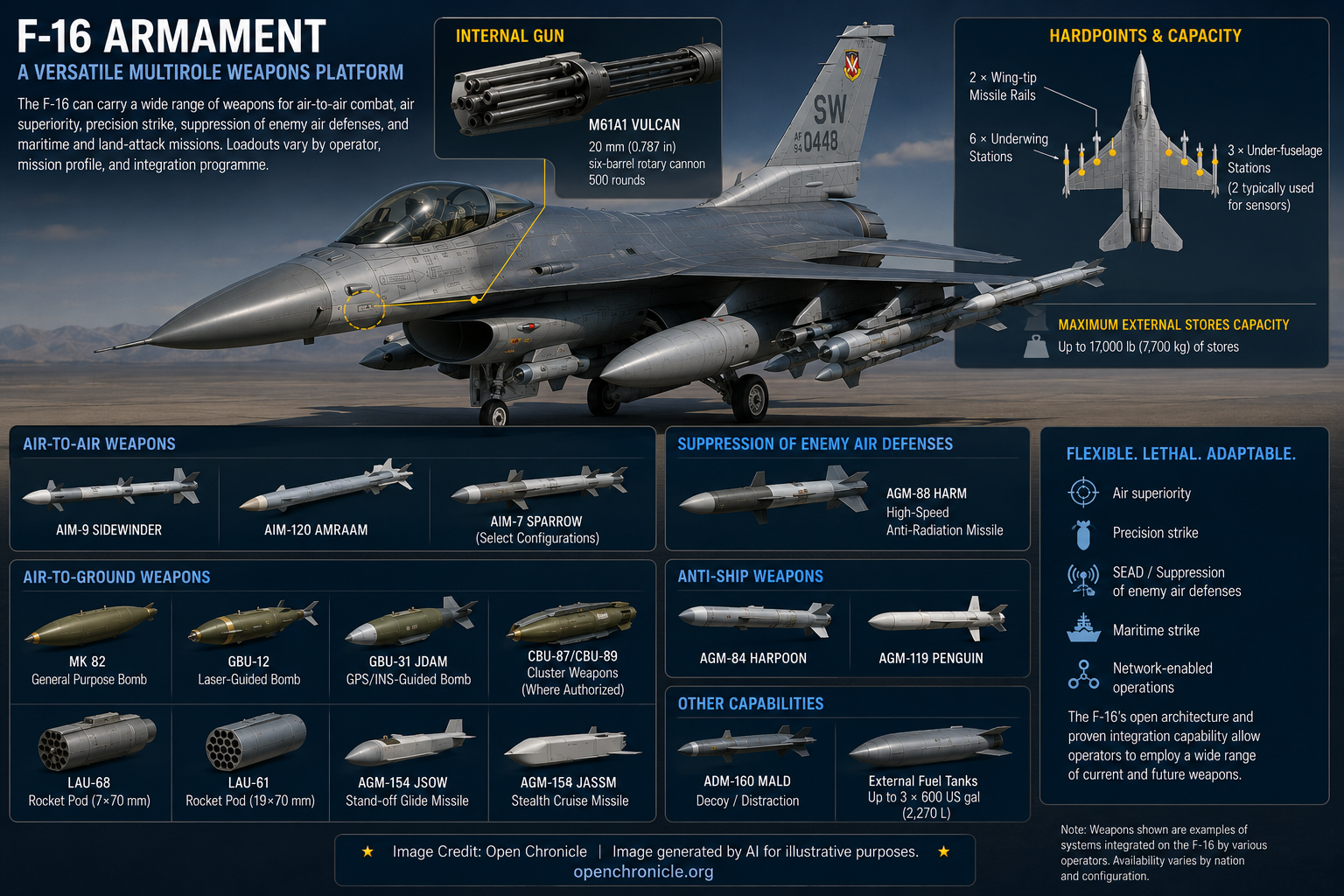
The F-16’s internal weapon is the M61A1 Vulcan, a six-barrelled 20 millimetre rotary cannon mounted on the left side of the forward fuselage.
The aircraft can employ numerous air-to-air weapons, including versions of the AIM 9 Sidewinder and AIM-120 Advanced Medium Range Air-to-Air Missile.
Earlier configurations also used the AIM-7 Sparrow in some export and specialised applications.
For air-to-ground missions, the F-16 can carry conventional bombs, laser-guided bombs, satellite-guided Joint Direct Attack Munitions, cluster weapons where authorised, rockets, and stand-off missiles.
Specialised F-16s can employ the AGM-88 High-Speed Anti-Radiation Missile against hostile radar systems.
Depending on the operator and integration programme, the aircraft may also use anti-ship missiles, cruise missiles, and nationally developed weapons.
The exact armament differs considerably between countries and versions.
F 16A and F 16B
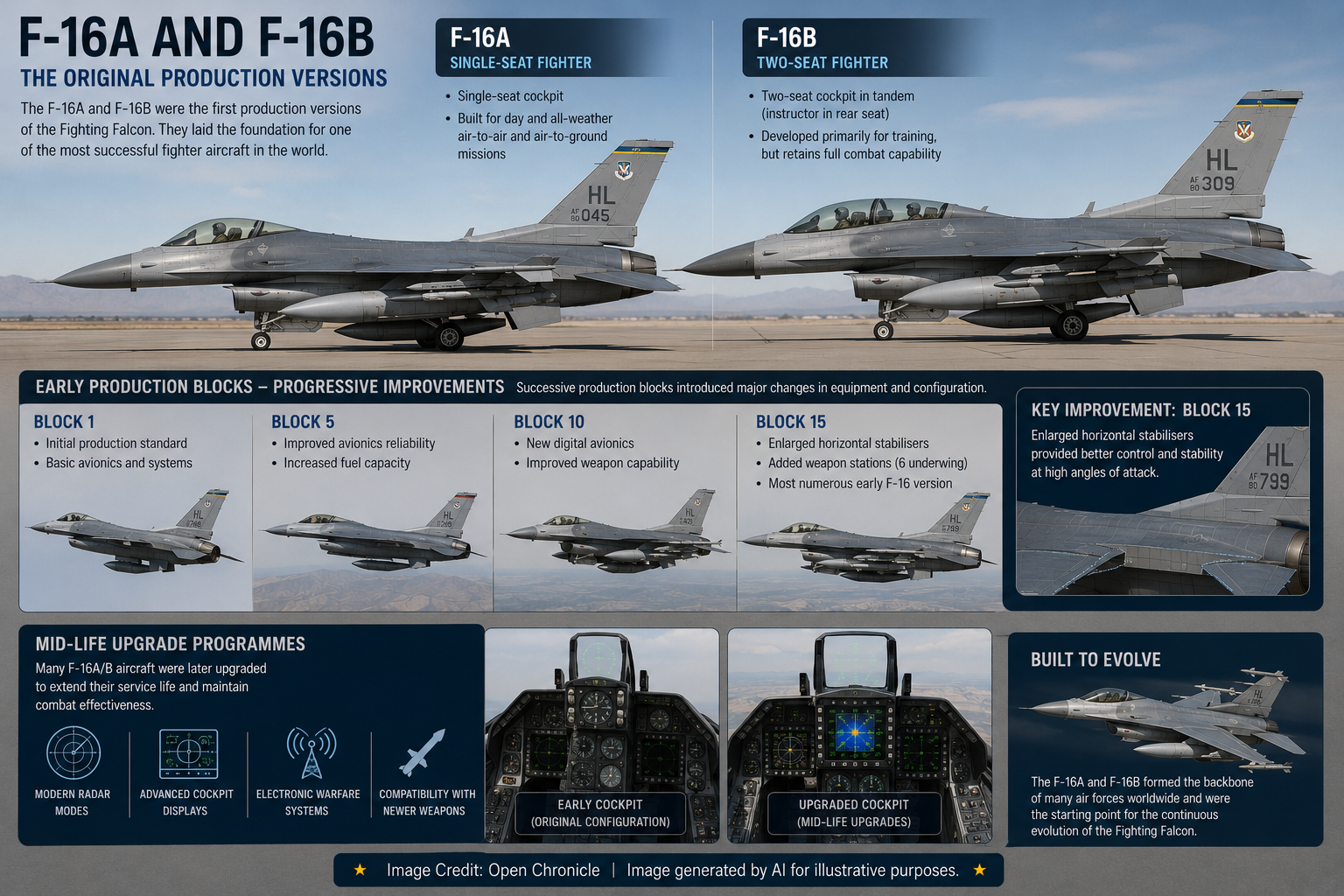
The F 16A and F 16B were the original production versions.
The F 16A has a single-seat cockpit, while the F 16B has two seats arranged in tandem.
The two-seat aircraft was developed primarily for training, but it retains combat capability.
Early aircraft were built in successive production groups known as blocks.
These block numbers identified major changes in equipment and manufacturing configuration.
The Block 1, Block 5, Block 10, and Block 15 aircraft introduced progressive improvements.
Block 15 became the most numerous early F-16 version and featured enlarged horizontal stabilisers and additional weapon stations.
Many F 16A and F 16B aircraft later underwent mid-life upgrade programmes that added modern radar modes, cockpit displays, electronic warfare systems and compatibility with newer weapons.
F 16C and F 16D
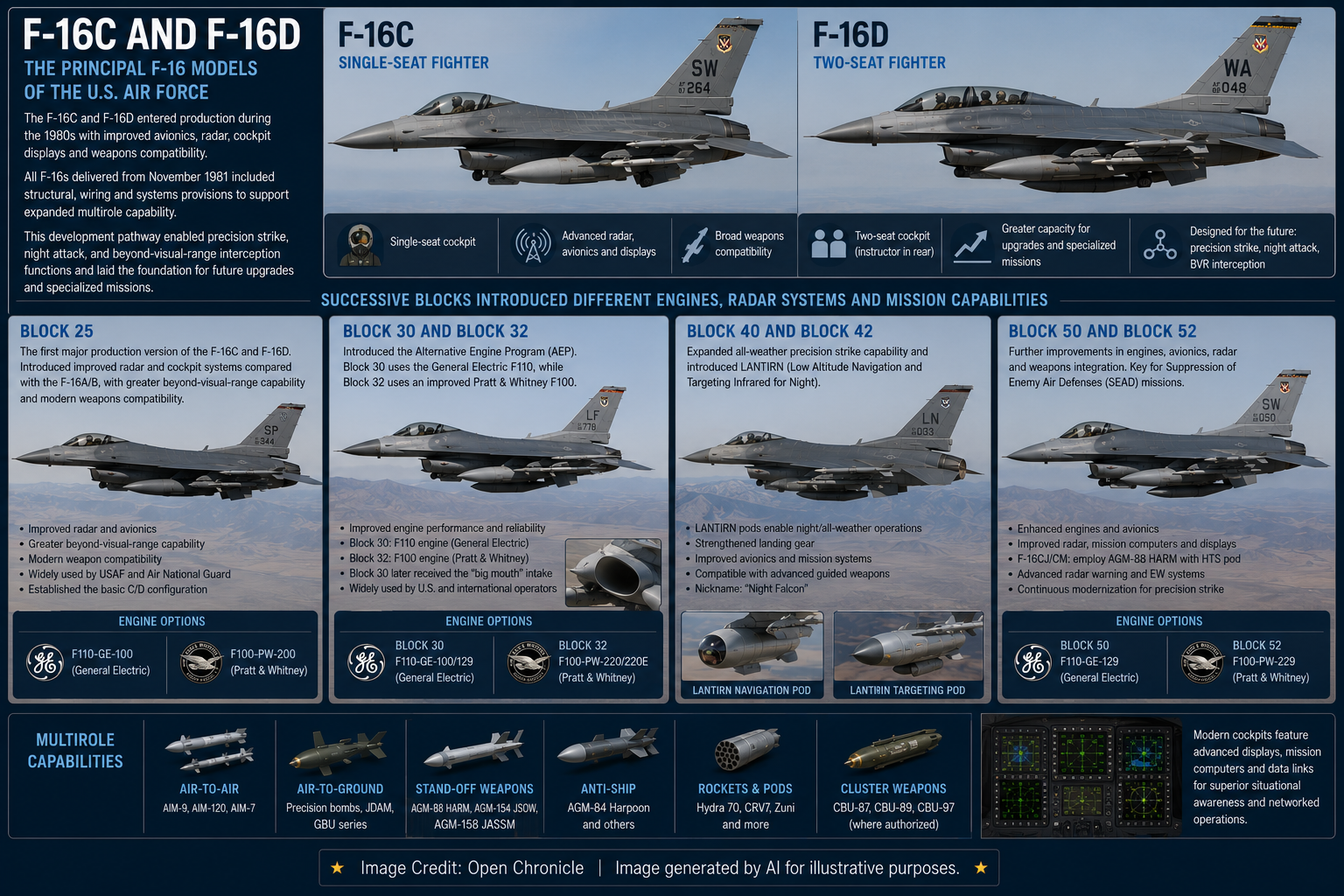
The F-16C and F 16D entered production during the 1980s.
The F 16C is the single-seat version, while the F 16D has two seats.
These aircraft incorporated improved cockpit displays, updated radar, enhanced avionics, and broader weapons compatibility.
The new architecture provided greater capacity for future upgrades and specialised missions.
All F-16s delivered from November 1981 included structural, wiring, and systems provisions intended to support expanded multirole capability. This development pathway eventually supported precision strike, night attack, and beyond-visual-range interception functions.
Successive F 16C and F 16D blocks introduced different engines, radar systems, and mission capabilities.
These versions became the principal F-16 models operated by the United States Air Force.
Block 25
The Block 25 represented the first major production version of the F-16C and F-16D.
It introduced improved radar and cockpit systems compared with the F 16A and F 16B.
The aircraft gained greater beyond-visual-range capability and improved compatibility with modern weapons.
Block 25 aircraft served extensively with the United States Air Force and Air National Guard.
Although later blocks provided greater power and more advanced systems, the Block 25 established the basic C and D model configuration.
Block 30 and Block 32
Block 30 and Block 32 aircraft introduced the alternative engine programme.
Block 30 aircraft generally used the General Electric F110 engine, while Block 32 aircraft used an improved Pratt & Whitney F100.
This block pairing system continued in later versions.
The General Electric-powered Block 30 eventually received the larger modular common inlet duct, often called the big mouth intake.
These aircraft offered improved thrust and became widely used by the United States and international operators.
Block 40 and Block 42
The Block 40 and Block 42 versions expanded the F-16’s all-weather precision strike capability.
They became associated with the Low Altitude Navigation and Targeting Infrared for Night system, commonly known as LANTIRN.
LANTIRN allowed pilots to navigate and attack targets at night and in adverse weather using externally mounted navigation and targeting pods.
These blocks also incorporated strengthened landing gear, improved avionics, and compatibility with advanced guided weapons.
Their enhanced strike role led to the informal description Night Falcon.
Block 50 and Block 52
Block 50 and Block 52 aircraft introduced further improvements in engines, avionics, weapons integration, and radar capability.
They became particularly important in the suppression of enemy air defences mission.
Specialised aircraft designated F 16CJ or later F 16CM could employ the AGM 88 HARM and associated targeting systems to detect and attack hostile radar emitters.
The Block 50 generally uses a General Electric engine, while the Block 52 normally uses a Pratt & Whitney engine.
Modernisation programmes have continued to improve cockpit displays, mission computers, radar warning equipment, and precision strike capabilities.
F 16E and F 16F
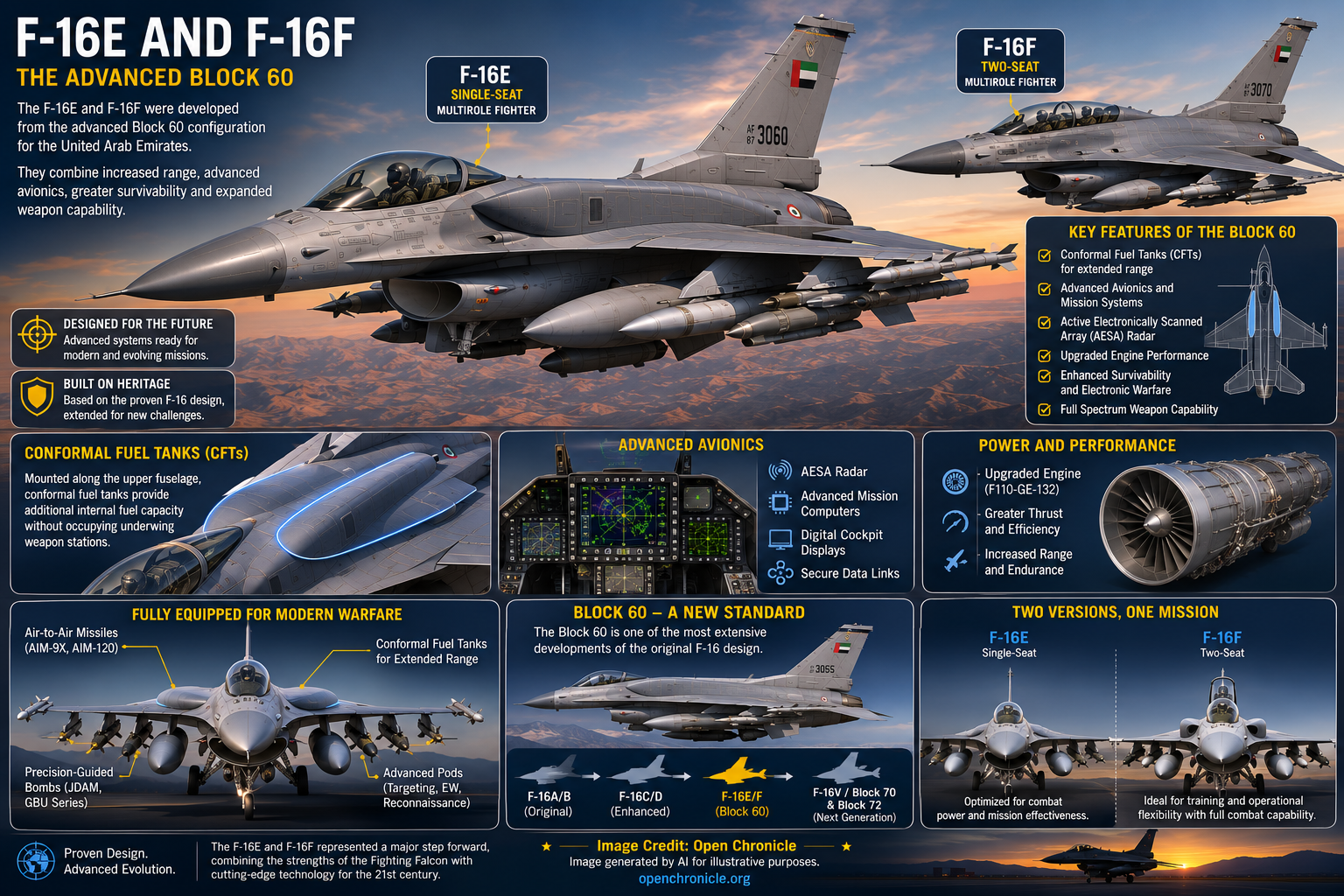
The F-16E and F-16F were developed from the advanced Block 60 configuration for the United Arab Emirates.
The F 16E is the single-seat version, while the F 16F has two seats.
These aircraft incorporated conformal fuel tanks, advanced avionics, an active electronically scanned array radar, and an upgraded engine.
Conformal fuel tanks are mounted along the upper fuselage and increase fuel capacity without occupying the principal underwing weapon stations.
The Block 60 represented one of the most extensive developments of the original F-16 design.
Its technology helped establish a pathway towards later F-16V and Block 70 and Block 72 configurations.
F 16V
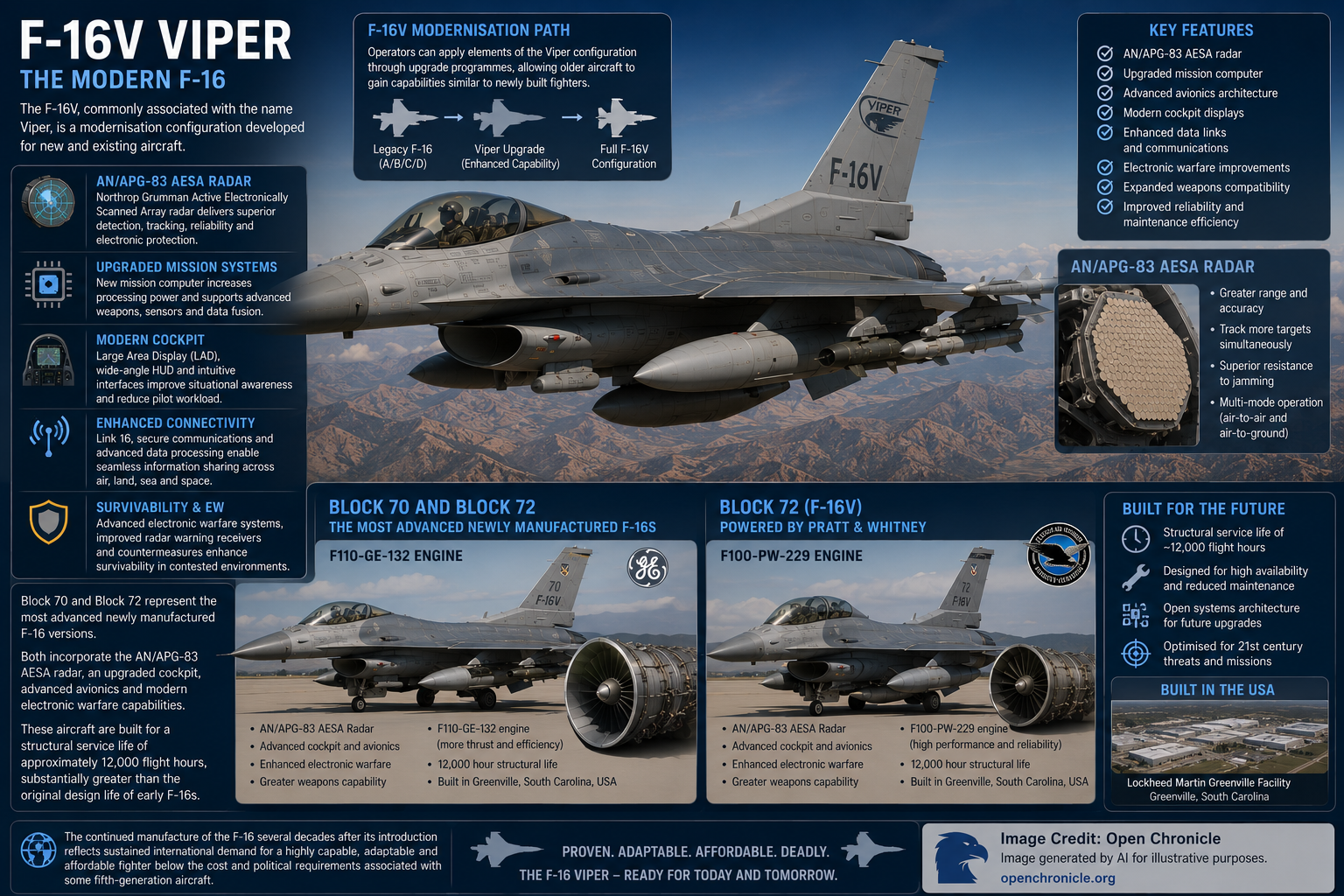
The F 16V, commonly associated with the name Viper, is a modernisation configuration developed for new and existing aircraft.
Its central feature is the Northrop Grumman AN APG 83 active electronically scanned array radar.
The radar provides improved detection, tracking, reliability, and electronic protection compared with older mechanically scanned systems.
The F 16V also incorporates an upgraded mission computer, modern cockpit displays, improved data processing, and enhanced communications.
Operators can apply elements of the configuration through upgrade programmes, allowing older aircraft to gain capabilities similar to newly built fighters.
The F-16V concept forms the technological basis for the latest production models.
Block 70 and Block 72
The Block 70 and Block 72 represent the most advanced newly manufactured F-16 versions.
Both incorporate the AN APG 83 active electronically scanned array radar, an upgraded cockpit, advanced avionics, and modern electronic warfare capabilities.
The distinction between Block 70 and Block 72 principally reflects engine selection.
Block 70 aircraft use a General Electric engine, while Block 72 aircraft use a Pratt & Whitney engine.
The new aircraft are designed for a structural service life of approximately 12,000 flight hours, substantially greater than the original design life of early F-16s.
Production takes place at Lockheed Martin’s facility in Greenville, South Carolina.
The continued manufacture of the F-16 several decades after its introduction reflects sustained international demand for an advanced fighter below the cost and political requirements associated with some fifth-generation aircraft.
Specialised Versions
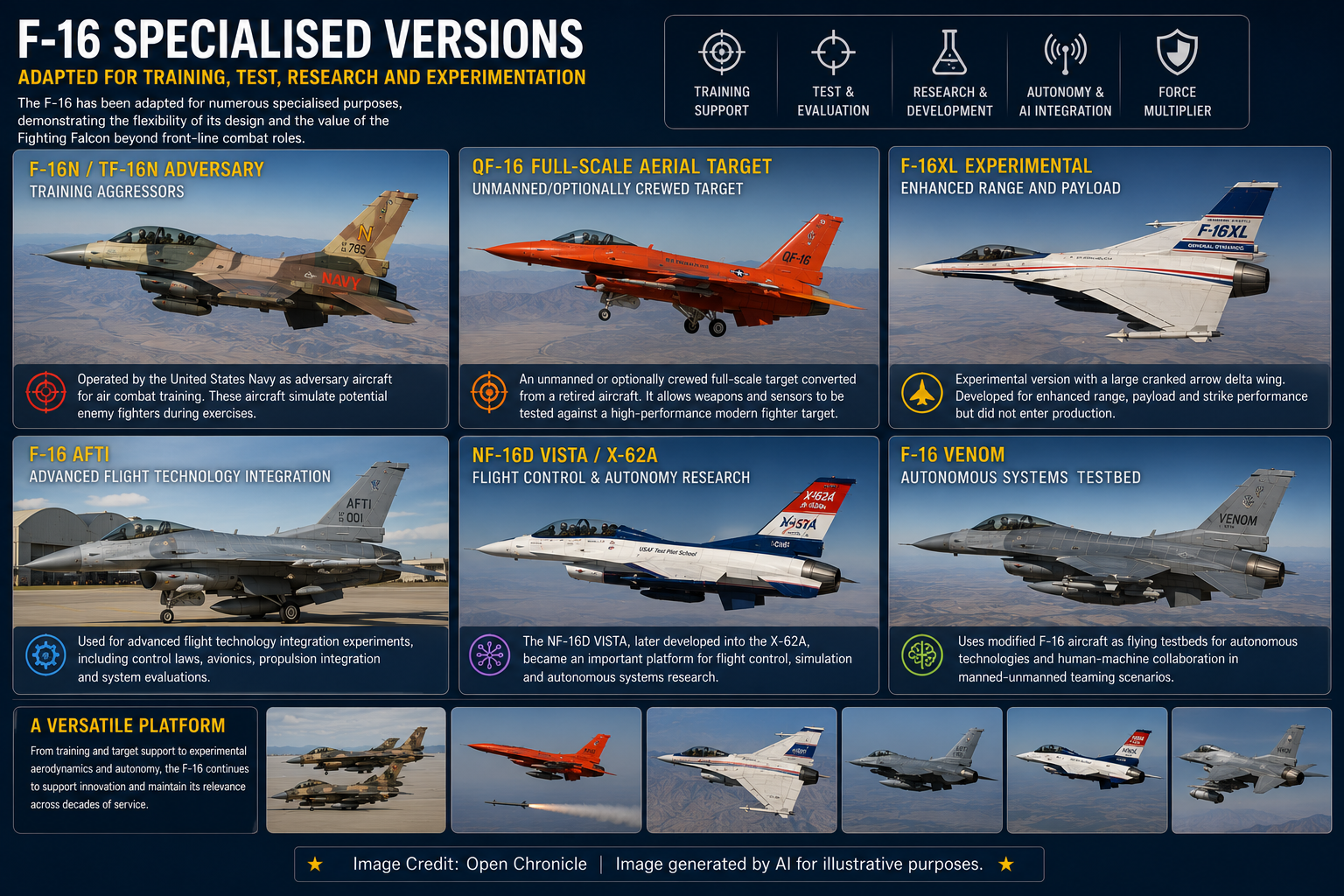
The F-16 has been adapted for numerous specialised purposes.
The F 16N and TF 16N were operated by the United States Navy as adversary aircraft for air combat training.
These aircraft simulated potential enemy fighters during exercises.
The QF-16 is an unmanned or optionally crewed full-scale aerial target converted from a retired aircraft. It allows weapons and sensors to be tested against a high-performance target representing a modern fighter.
The F-16XL was an experimental version with a large cranked arrow delta wing. It was developed for enhanced range, payload and strike performance but did not enter production.
The F-16 AFTI was used for advanced flight technology integration experiments.
The NF 16D VISTA, later developed into the X 62A, became an important platform for flight control, simulation, and autonomous systems research.
The F-16 VENOM programme uses modified F-16 aircraft as flying testbeds for autonomous technologies and human-machine collaboration.
These experimental versions demonstrate the design’s value not only as a combat aircraft but also as an aviation research platform.
Israeli Variants
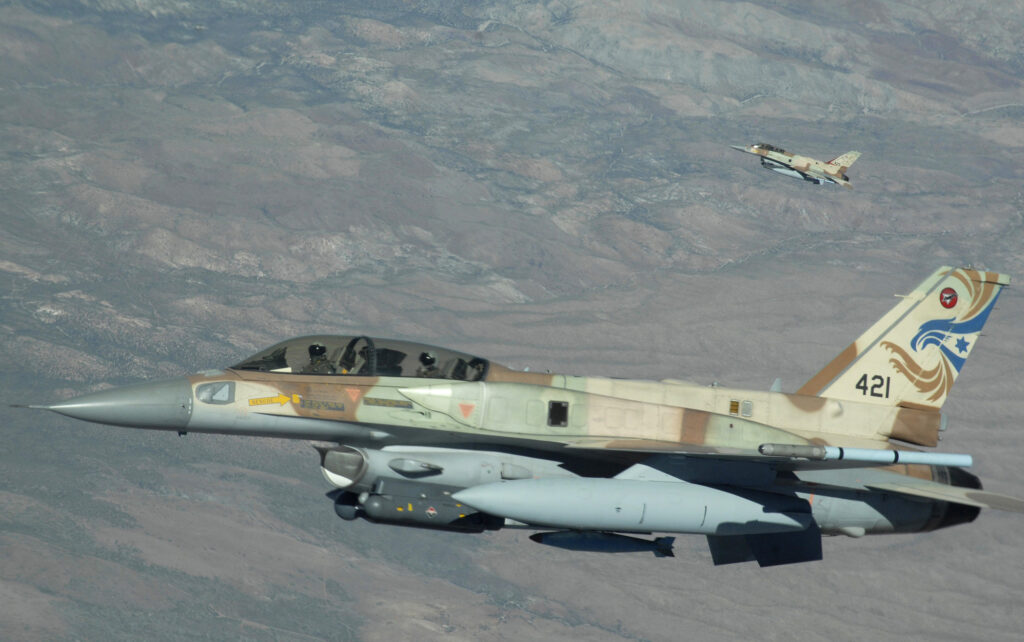
Israel became one of the earliest and most experienced international F-16 operators.
Its aircraft received locally developed avionics, electronic warfare systems, and weapons.
Israeli F 16A and F 16B aircraft were followed by F 16C and F 16D versions adapted to national requirements.
The F 16I Sufa, based on the Block 52 Plus, is a two-seat long-range strike version equipped with conformal fuel tanks and extensive Israeli systems.
Israeli modifications reflect the broader adaptability of the F-16 design.
National industries have been able to integrate domestic sensors, communications equipment, and weapons while retaining the aircraft’s core structure and flight characteristics.
Japanese F 2 Development
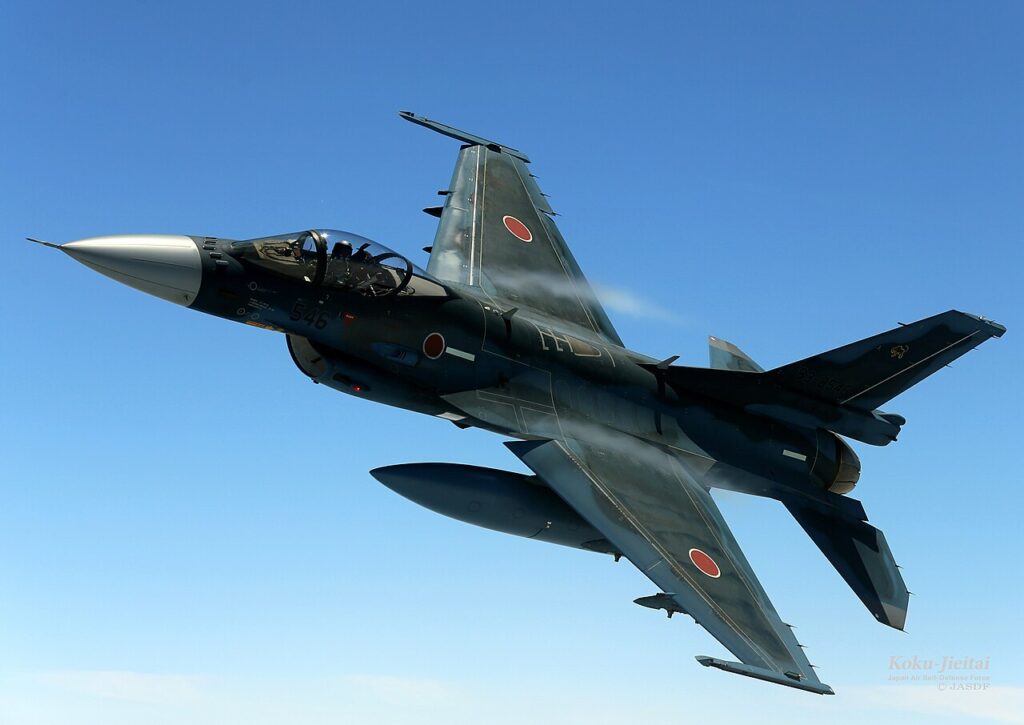
Japan’s Mitsubishi F 2 was developed from the F 16 but became a substantially modified aircraft.
The F 2 has a larger wing, increased use of composite materials, Japanese avionics, and an active electronically scanned array radar.
It was designed primarily for air defence and maritime strike missions.
Although visually similar to the F-16, the F 2 is generally treated as a separate aircraft type rather than an ordinary F 16 variant.
Its development demonstrates how the original F-16 configuration could serve as the basis for a specialised national fighter programme.
Cockpit Evolution
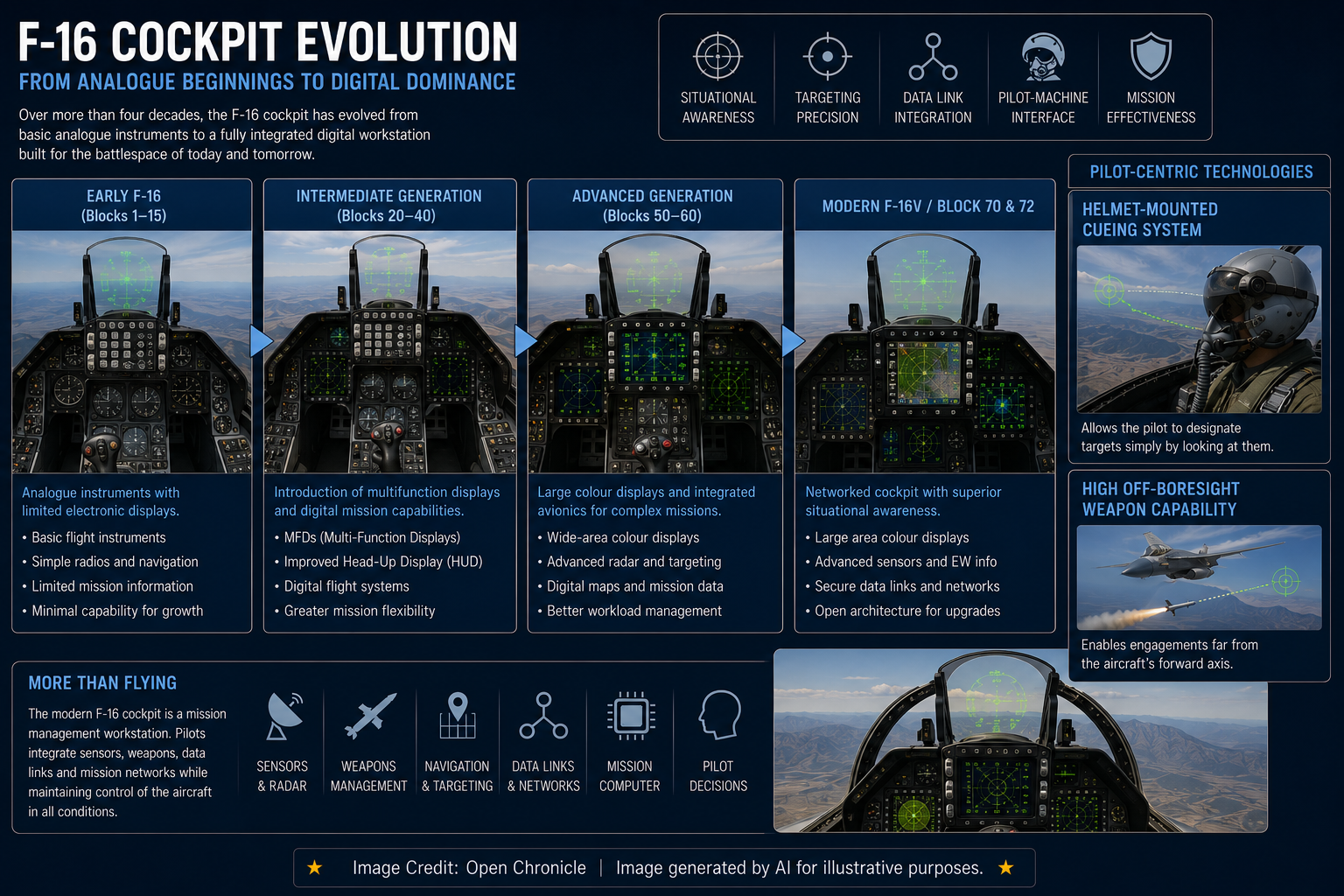
Early F-16 cockpits combined analogue instruments with limited electronic displays.
Successive blocks introduced multifunction displays, improved head-up displays, and digital mission systems.
Modern aircraft use large colour displays capable of presenting radar, targeting, navigation, and tactical information.
Helmet-mounted cueing systems allow the pilot to designate targets by looking towards them.
This capability is particularly important when combined with high off-boresight air-to-air missiles, which can engage targets located far from the aircraft’s forward axis.
The cockpit’s evolution reflects a broader change in fighter aviation.
Modern pilots manage sensors, weapons, data links, and mission networks in addition to physically flying the aircraft.
Radar and Sensors
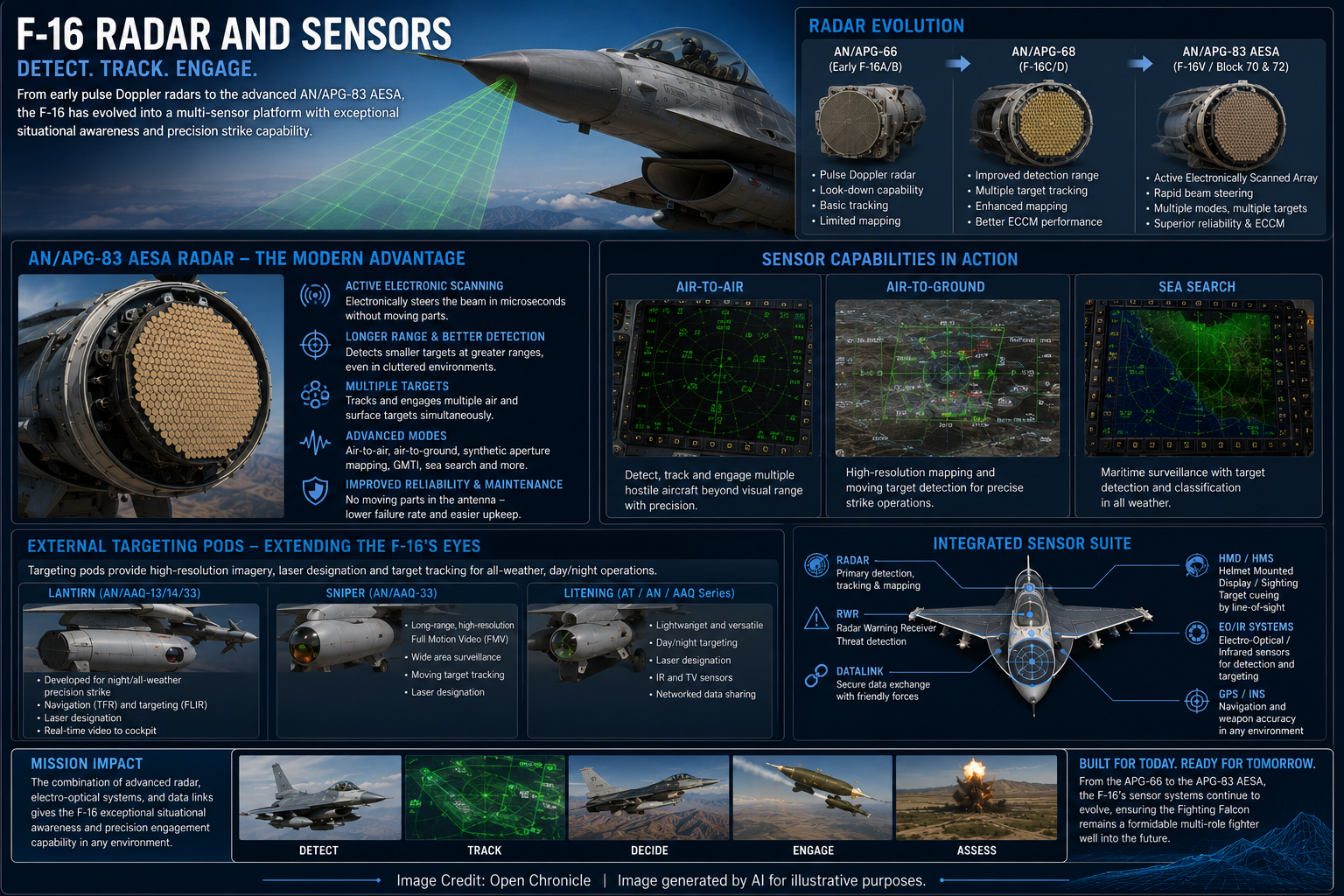
The original F 16 used versions of the Westinghouse AN APG 66 pulse Doppler radar.
Later, F-16C and F 16D aircraft introduced the more capable AN APG-68 family.
These radars provided improved detection range, tracking, mapping, and weapons support.
Modern F 16V, Block 70 and Block 72 aircraft use the AN APG 83 active electronically scanned array radar.
An electronically scanned radar can redirect its beam rapidly without physically moving a large antenna.
This improves reliability and enables flexible search, tracking, and mapping functions.
External targeting pods further expand the aircraft’s sensor capabilities.
Systems such as LANTIRN, Sniper, and Litening allow pilots to identify targets, guide weapons, assess damage, and share imagery.
Electronic Warfare
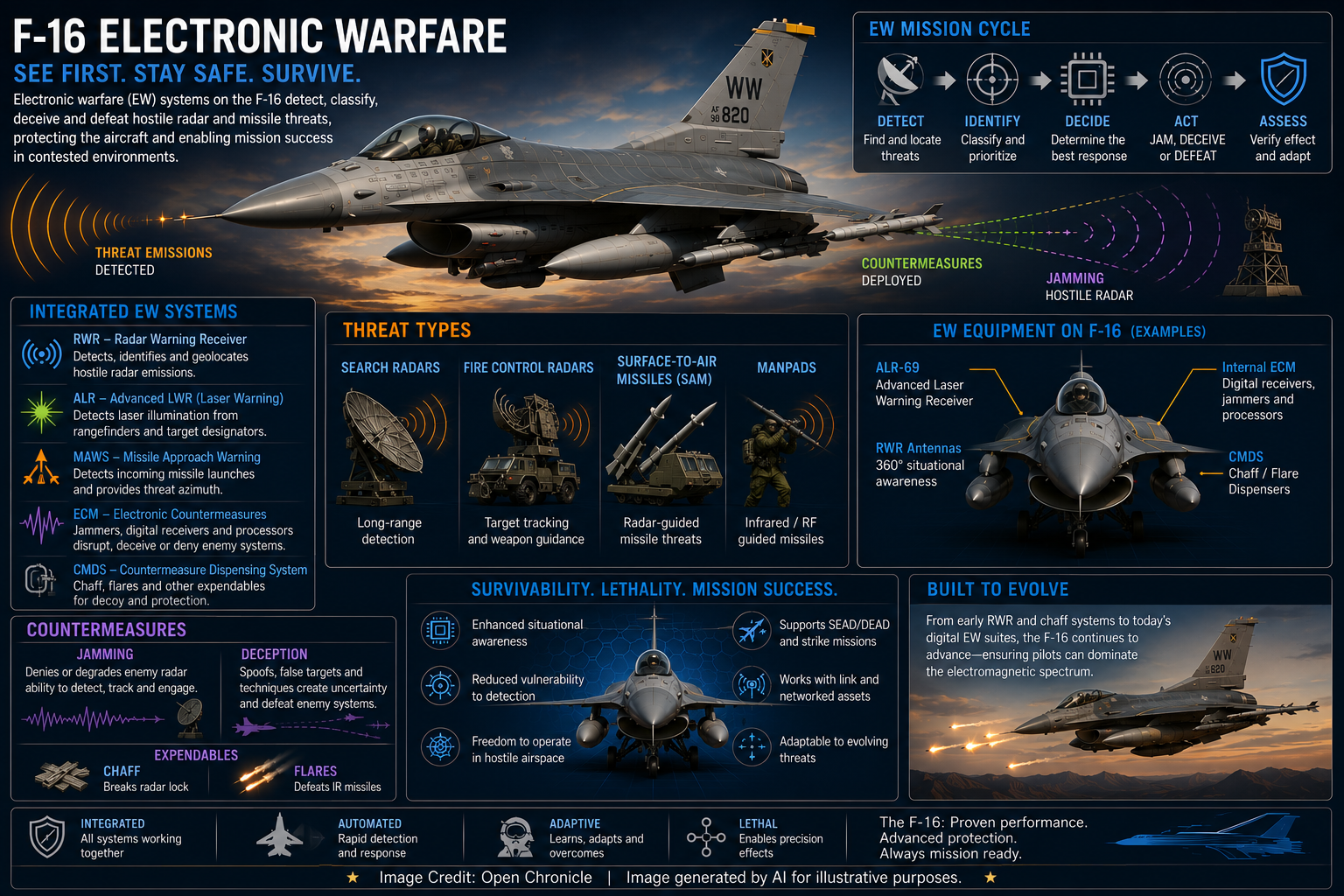
Survival in modern air combat requires more than speed and manoeuvrability.
F-16 aircraft use radar warning receivers, electronic countermeasures, chaff, and flares to detect and respond to threats.
The exact defensive system varies by operator and version.
Some countries install nationally developed electronic warfare suites.
External jamming pods can provide additional protection during operations in contested environments.
Modern upgrade programmes increasingly integrate threat detection, electronic protection and data sharing into a broader defensive architecture.
These capabilities are especially important because the basic F-16 was not designed with the low-observable characteristics associated with later stealth aircraft.
Suppression of Enemy Air Defences
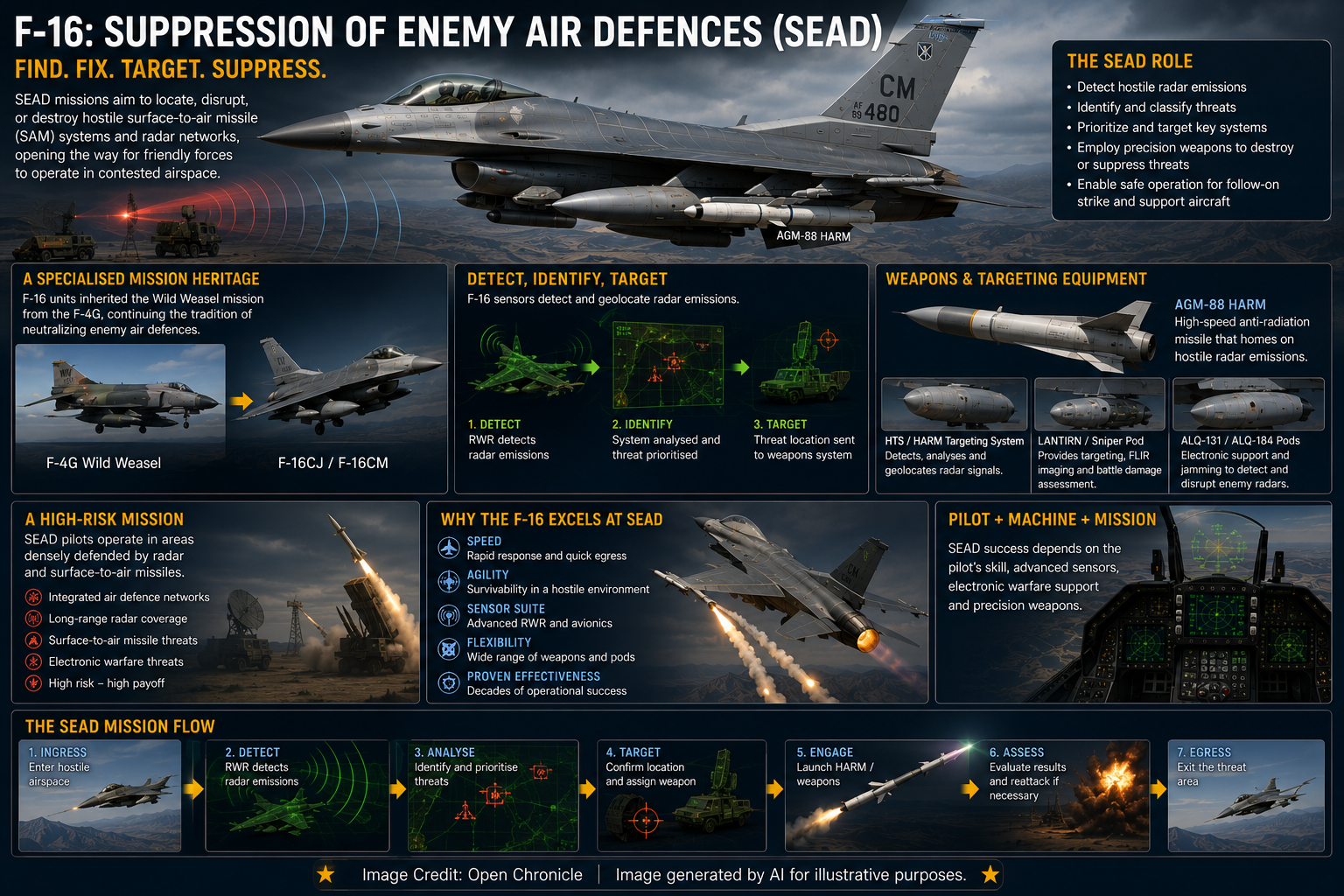
One of the F 16’s most specialised missions is the suppression of enemy air defences, commonly abbreviated as SEAD.
Aircraft performing this role seek to locate, disrupt, or destroy hostile surface-to-air missile systems and associated radar networks.
Specialised F-16 units inherited the Wild Weasel mission previously performed by aircraft such as the F 4G.
F 16CJ and F 16CM aircraft can carry the AGM 88 HARM and targeting equipment designed to detect radar emissions.
The mission requires pilots to operate in areas specifically defended against aircraft.
It combines electronic detection, rapid tactical decision-making, and precision weapons employment.
The F-16’s speed, agility, and adaptable avionics made it well suited to this demanding role.
Air-to-Air Combat
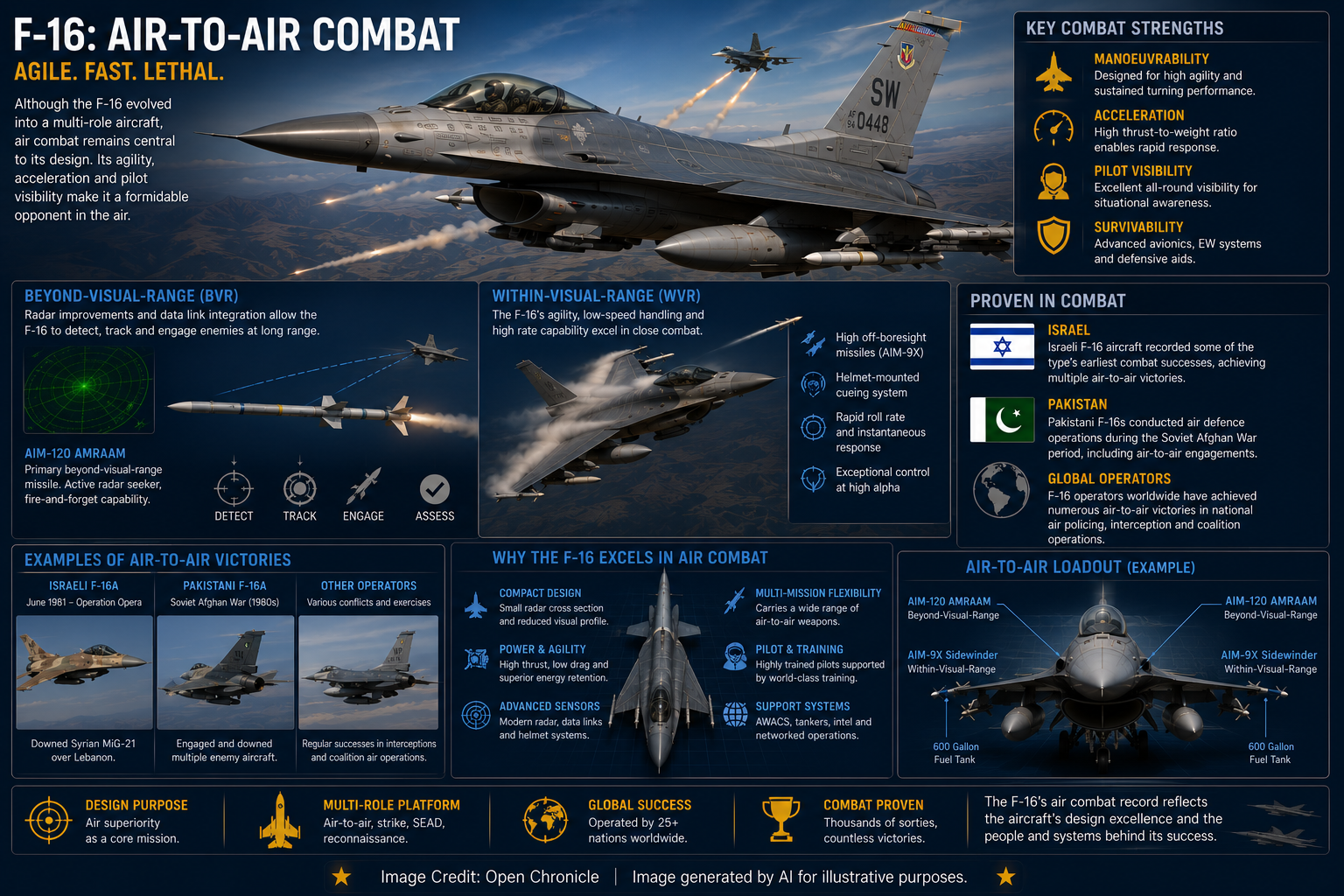
Although the F 16 evolved into a multi-role aircraft, air combat remained central to its design.
The aircraft’s manoeuvrability, acceleration, and visibility made it highly capable in close-range engagements.
Radar improvements and integration of the AIM-120 AMRAAM added effective beyond-visual-range capability.
International F-16 operators have achieved numerous air-to-air victories.
Israeli aircraft recorded some of the type’s earliest combat successes.
Pakistani F-16s also conducted air defence operations during the Soviet Afghan War period.
Other operators have used the aircraft in national air policing, interception, and coalition operations.
The F 16’s combat record reflects both the qualities of the aircraft and the training, intelligence, and support systems available to its operators.
Operation Opera
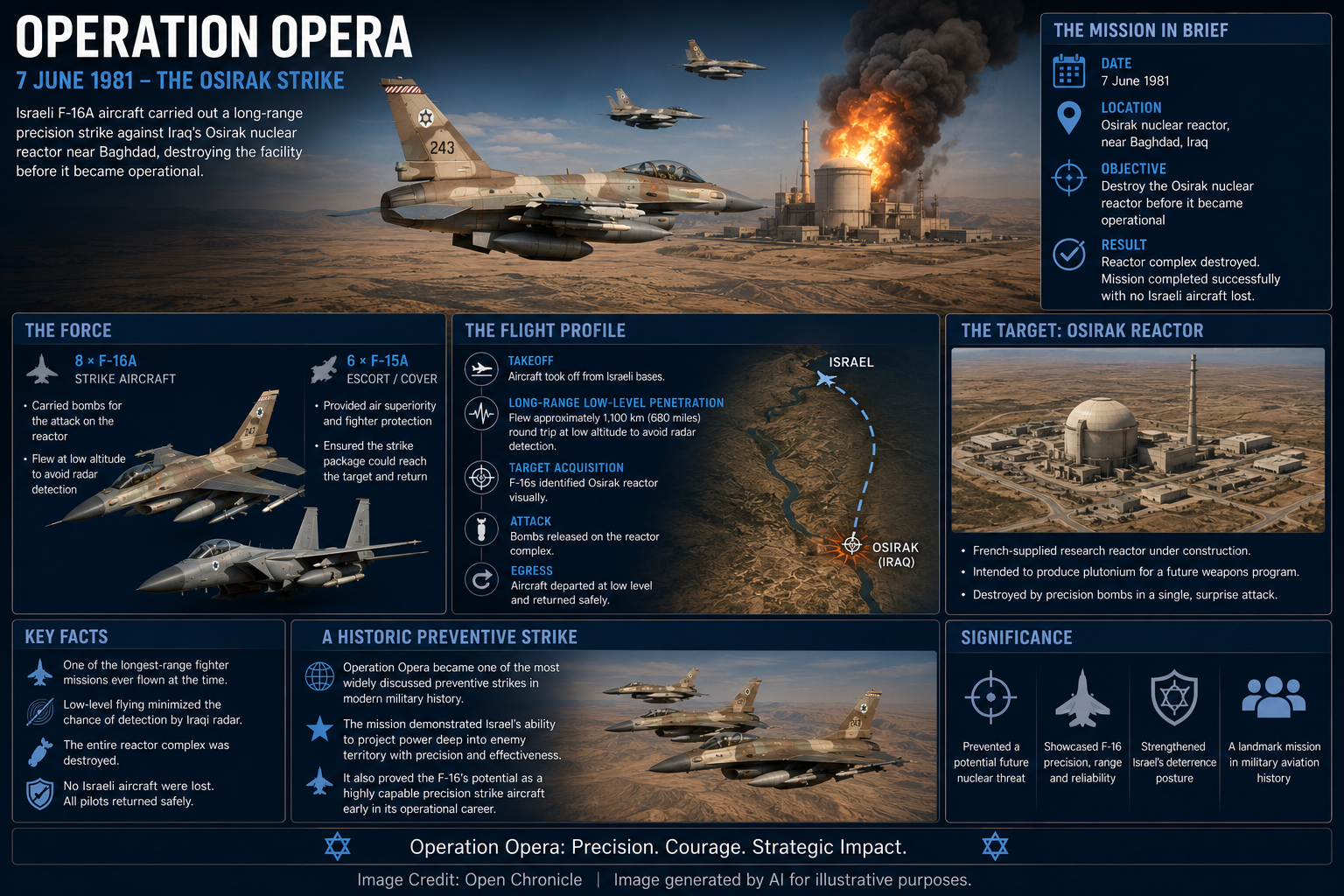
On 7 June 1981, Israeli F 16A aircraft participated in Operation Opera, the attack on Iraq’s Osirak nuclear reactor near Baghdad.
Eight F-16s carried bombs to the target, while F-15s provided fighter protection.
The aircraft flew a long distance at low altitude to reduce the probability of detection.
The attack destroyed the reactor complex before it became operational.
Operation Opera became one of the most widely discussed preventive strikes in modern military history.
It also demonstrated the F-16’s potential as a precision strike aircraft relatively early in its operational career.
The 1982 Lebanon War
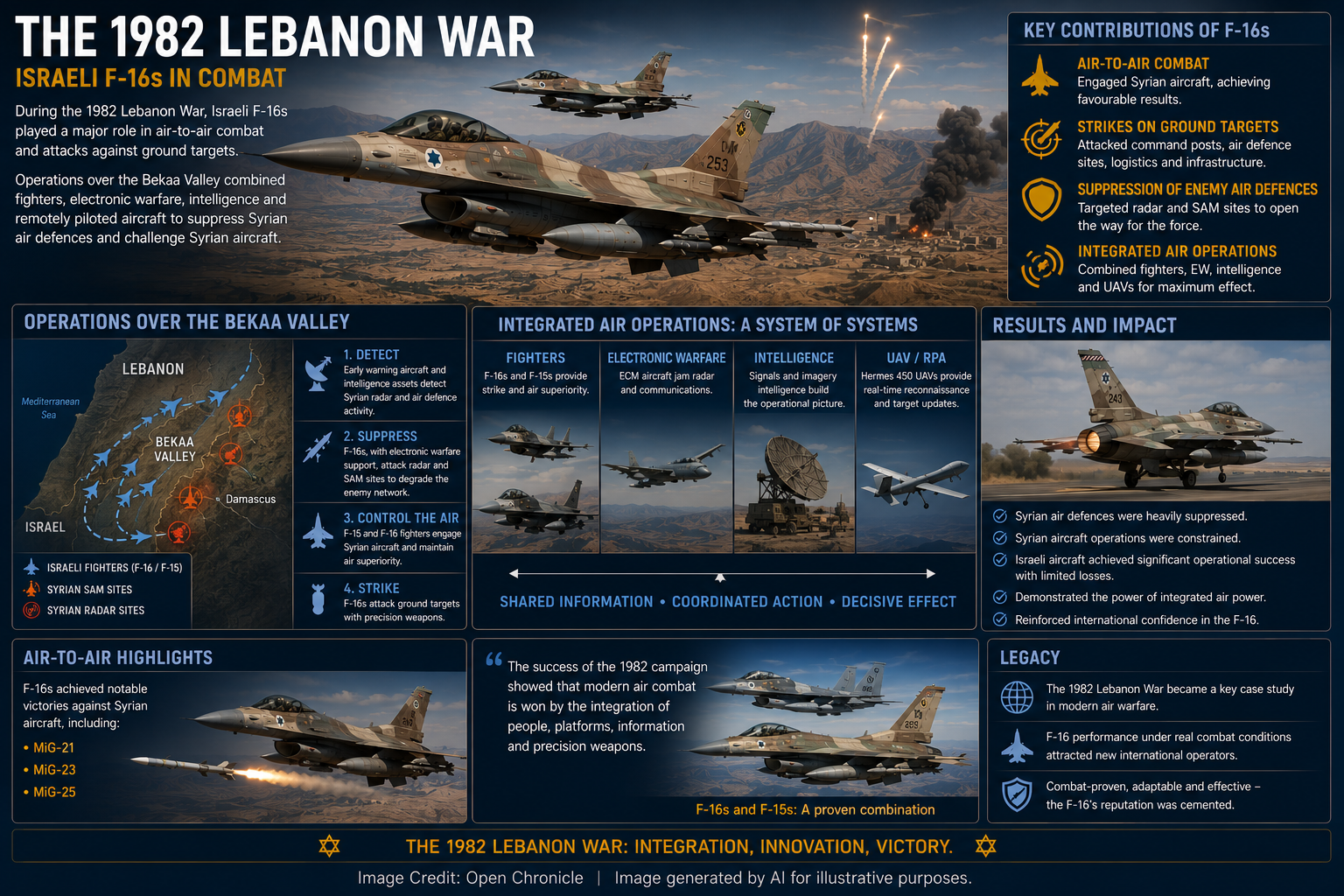
Israeli F-16s played a major role during the 1982 Lebanon War.
They conducted air-to-air combat and attacks against ground targets.
During operations over the Bekaa Valley, Israeli forces combined fighters, electronic warfare, intelligence, and remotely piloted aircraft to suppress Syrian air defences and challenge Syrian aircraft.
The campaign became an important example of integrated air operations.
F-16s and F 15s achieved significant success when operating as part of a broader system rather than as isolated aircraft.
The experience reinforced international interest in the F-16 and contributed to its reputation as a combat-proven fighter.
Operation Desert Storm
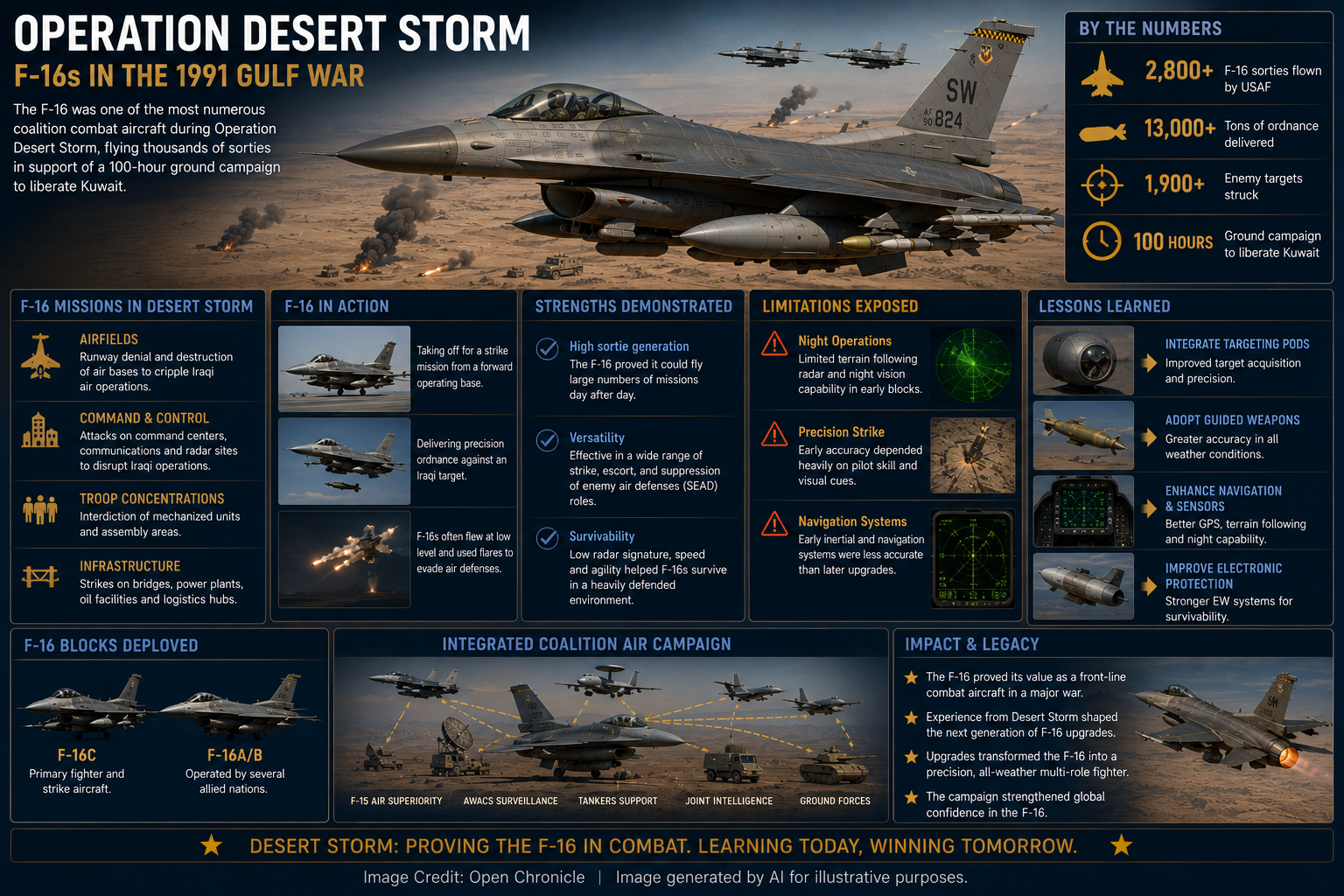
The F-16 was one of the most numerous coalition combat aircraft used during the 1991 Gulf War.
United States Air Force F-16s conducted thousands of missions against Iraqi military targets.
Their tasks included attacks on airfields, command facilities, troop concentrations, and infrastructure.
The aircraft demonstrated its ability to generate large numbers of sorties during an intensive campaign.
However, the war also exposed limitations in early precision strike and night attack capabilities.
Lessons from Desert Storm influenced later upgrades involving targeting pods, navigation systems, guided weapons, and electronic protection.
The campaign helped accelerate the transformation of the F-16 into a more capable all-weather precision attack aircraft.
The Balkans
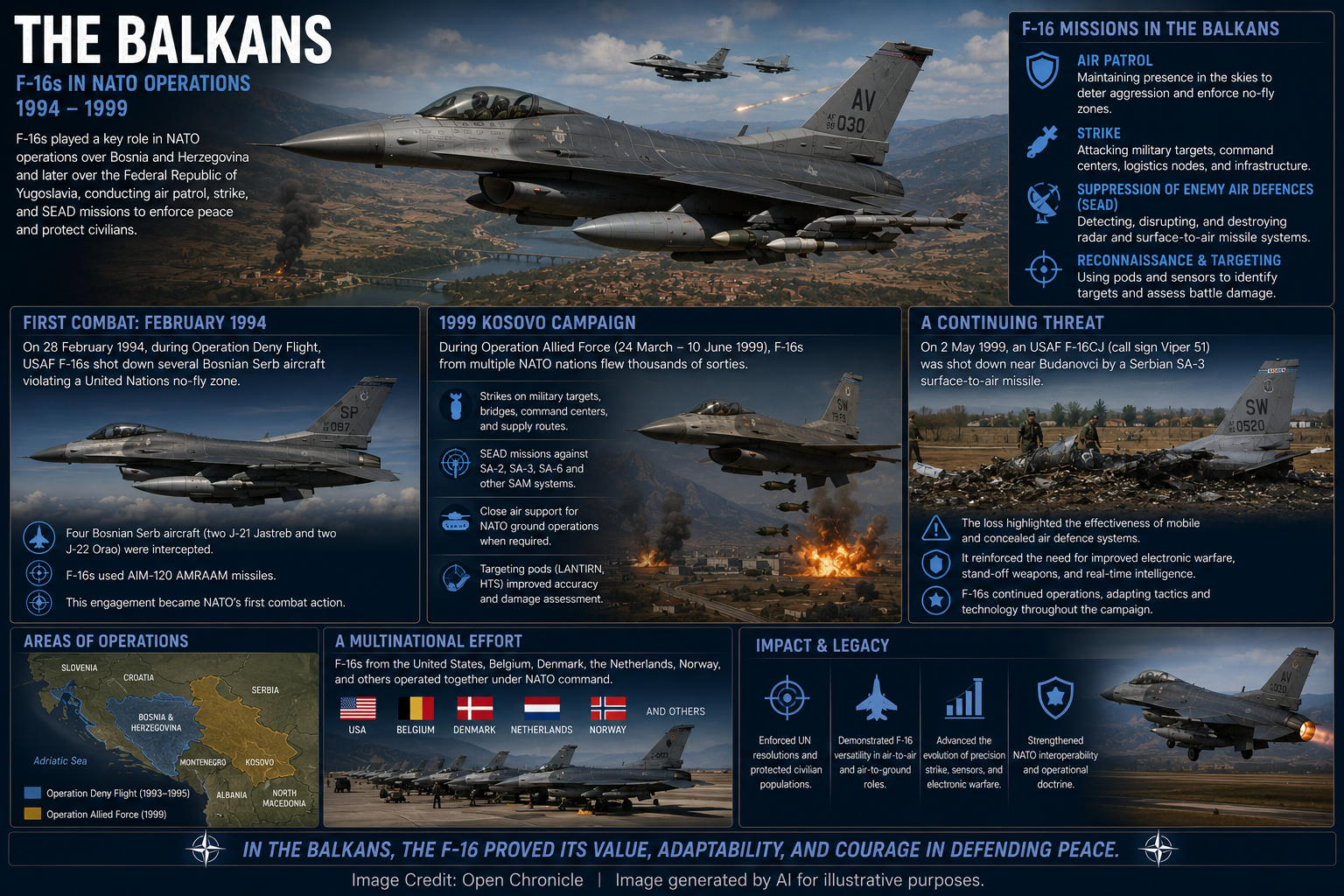
F-16s participated in NATO operations over Bosnia and Herzegovina and later over the Federal Republic of Yugoslavia.
The aircraft conducted air patrol, strike, and suppression of enemy air defences missions.
In February 1994, United States Air Force F-16s shot down several Bosnian Serb aircraft violating a United Nations no-fly zone.
This action became NATO’s first combat engagement.
During the 1999 Kosovo campaign, F-16s attacked ground targets and hostile air defence systems.
The loss of a United States F 16 to a surface-to-air missile demonstrated the continuing danger posed by mobile and concealed air defence networks.
Afghanistan and Iraq
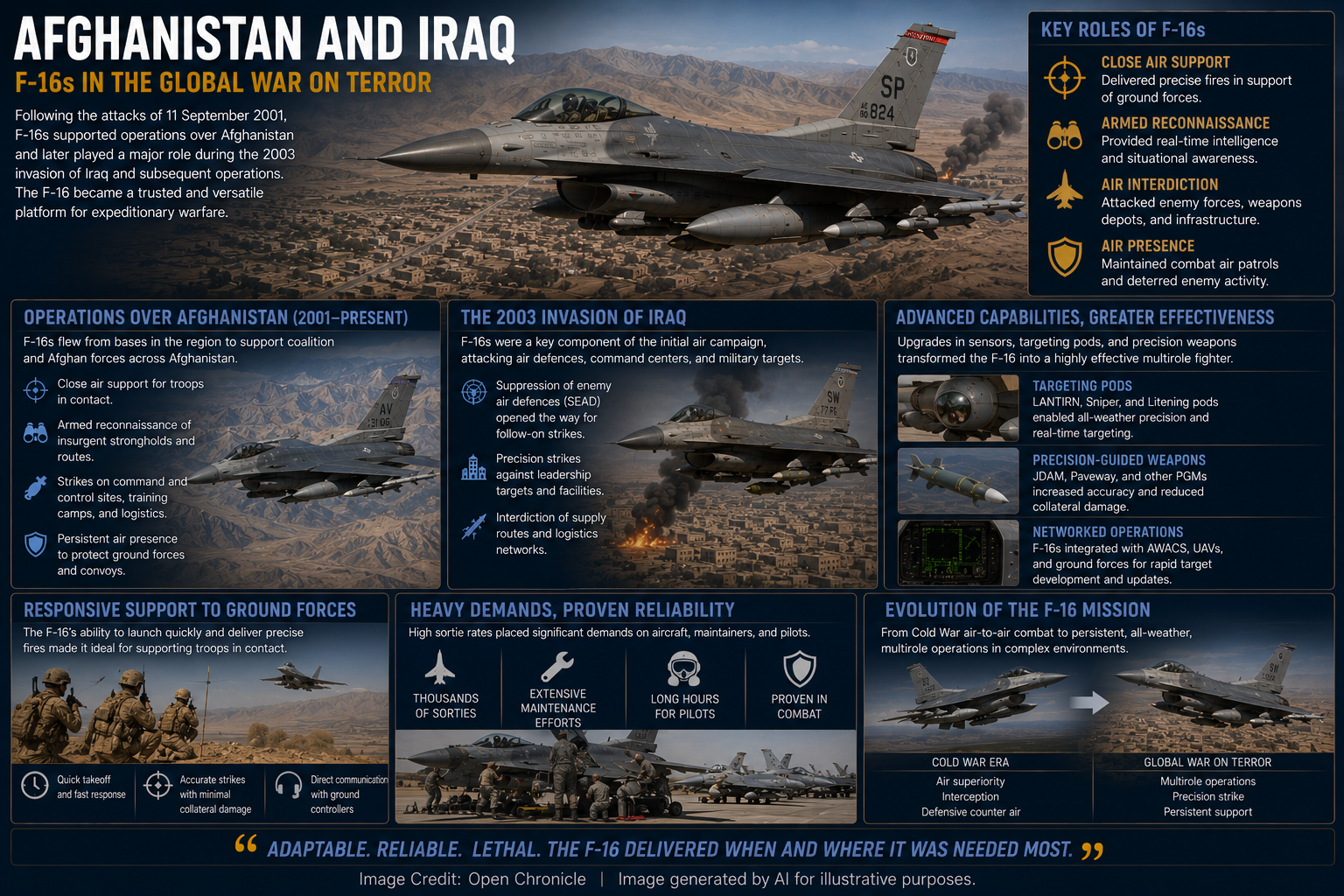
Following the attacks of 11 September 2001, F-16s supported operations over Afghanistan.
Their missions included close air support, armed reconnaissance, and air presence for ground forces.
The aircraft also played a major role during the 2003 invasion of Iraq and subsequent operations.
Advances in targeting pods and precision-guided weapons allowed F-16 pilots to provide responsive support to troops while reducing the need for large strike formations.
These campaigns placed heavy demands on aircraft, maintainers, and pilots.
They also demonstrated how the F 16’s mission had evolved from Cold War air combat towards persistent multirole operations.
Counterterrorism Operations
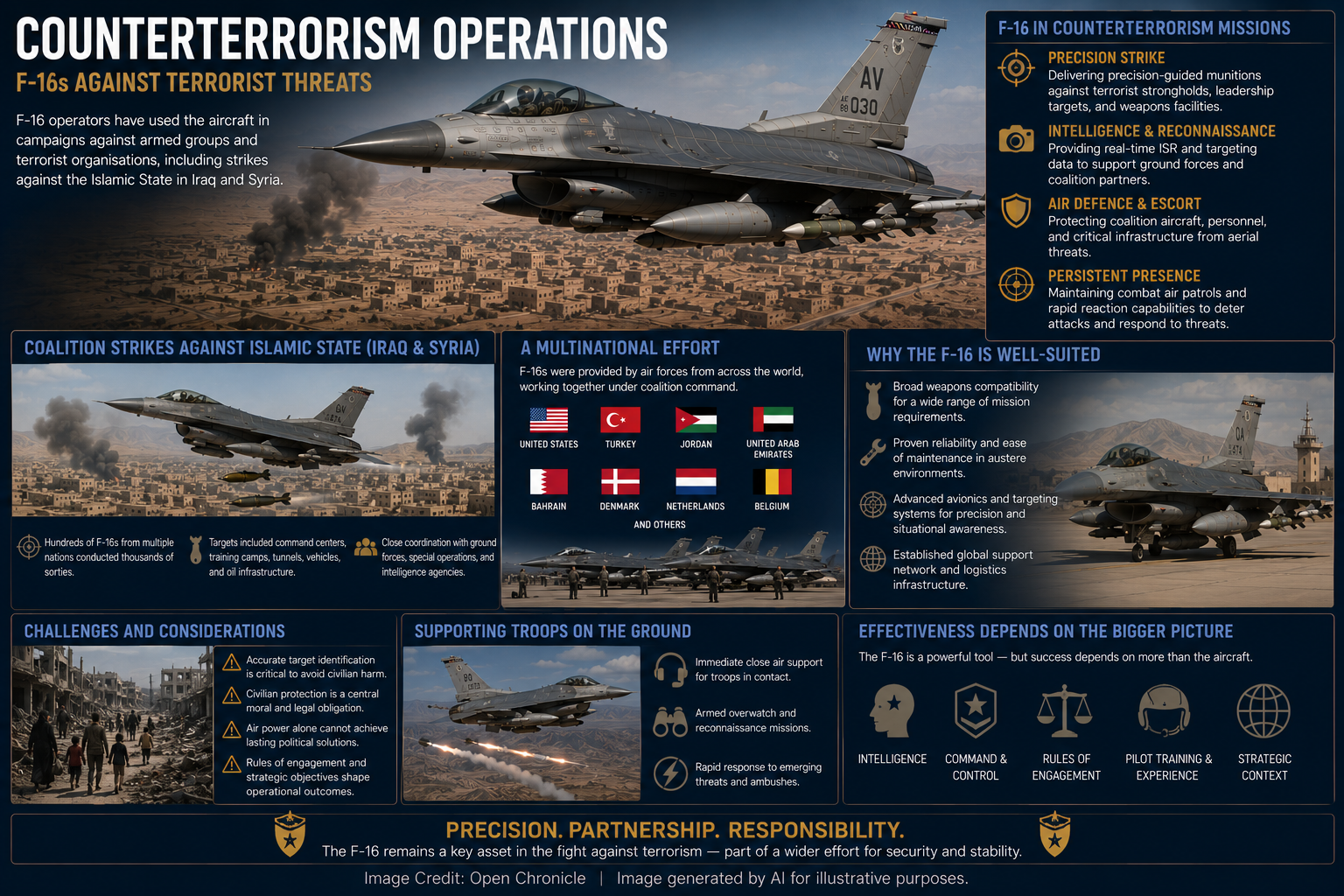
F-16 operators have used the aircraft in campaigns against armed groups and terrorist organisations.
Coalition aircraft conducted strikes against the Islamic State in Iraq and Syria.
Different national air forces contributed F-16s for precision attack, reconnaissance support, and defensive missions.
The aircraft’s broad weapons compatibility and established support infrastructure made it suitable for multinational operations.
However, these missions also raised questions concerning target identification, civilian protection, and the political consequences of air power.
As with all combat aircraft, the F-16’s effectiveness depends on intelligence, command decisions, rules of engagement, and the wider strategic context.
Training and Adversary Roles
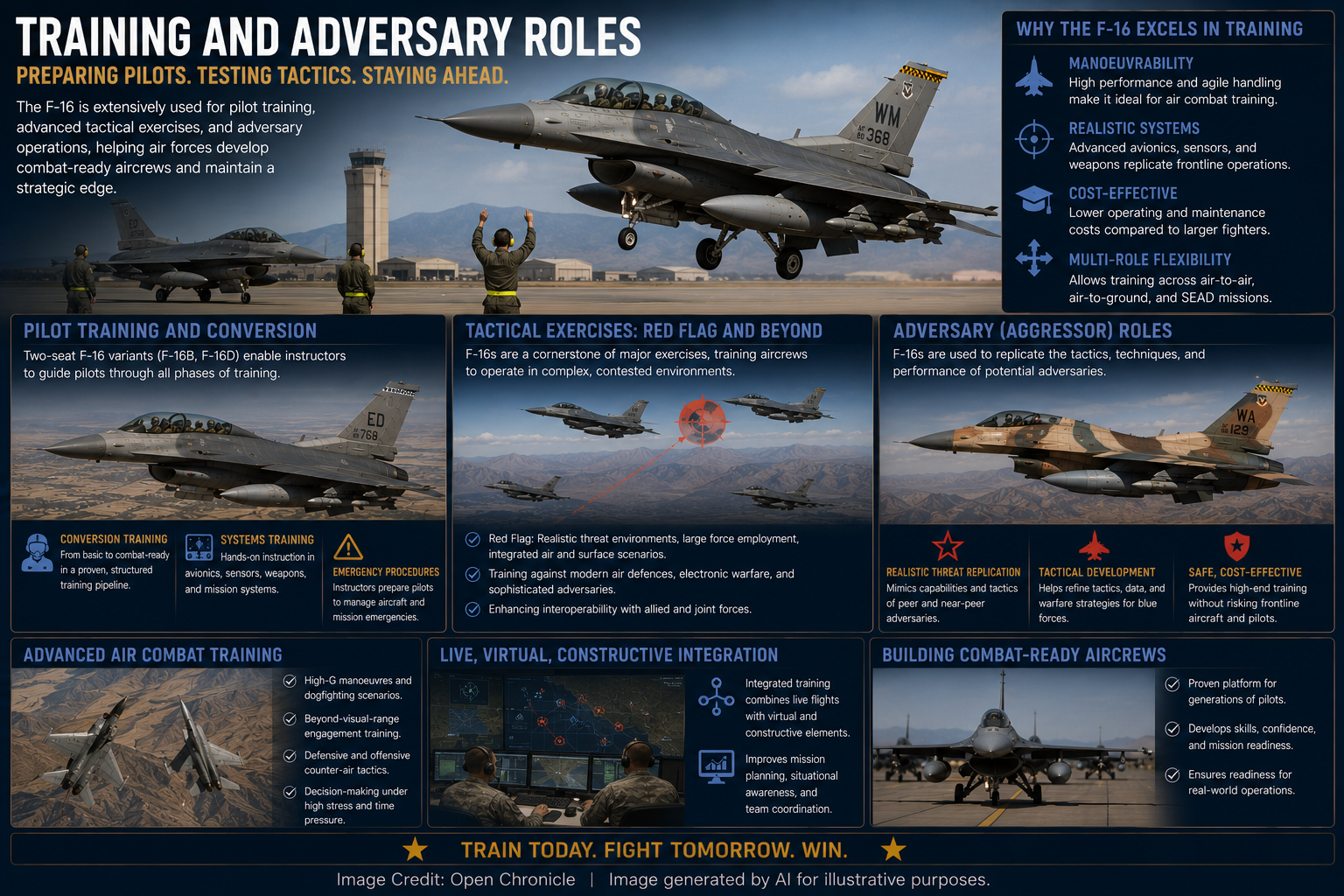
The F-16 is extensively used for pilot training and advanced tactical exercises.
Two-seat aircraft allow instructors to accompany pilots during conversion training.
Operational conversion units teach pilots to manage the aircraft’s flight characteristics, weapons, sensors, and emergency procedures.
F-16s also participate in major exercises such as Red Flag, where aircrews train against complex simulated threats.
The United States Navy and private contractors have used F-16 variants as adversary aircraft.
In this role, they reproduce the tactics and performance characteristics of potential opponents.
The aircraft’s manoeuvrability makes it particularly valuable for advanced air combat training.
The Thunderbirds
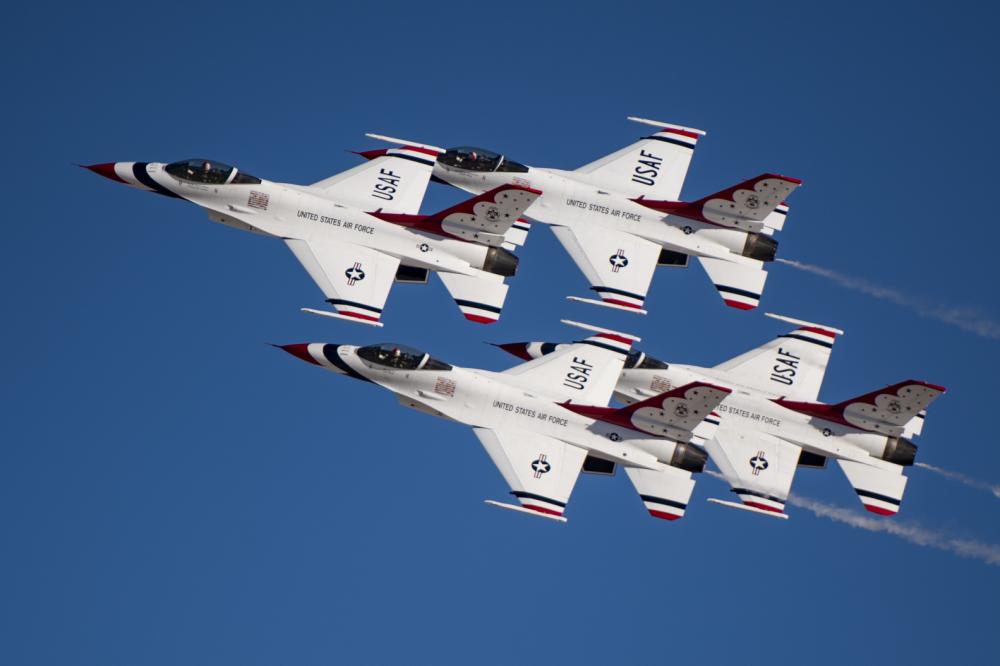
The United States Air Force Air Demonstration Squadron, known as the Thunderbirds, adopted the F 16A during the early 1980s.
The team later transitioned to the F-16C.
Thunderbirds aircraft are modified for demonstration flying but remain closely related to operational fighters.
Their performances display formation precision, rapid rolls, high-speed passes, and other manoeuvres illustrating the aircraft’s agility.
The team’s use of the F-16 introduced the aircraft to millions of spectators around the world.
It also reinforced the connection between the fighter and the public identity of the United States Air Force.
Global Operators
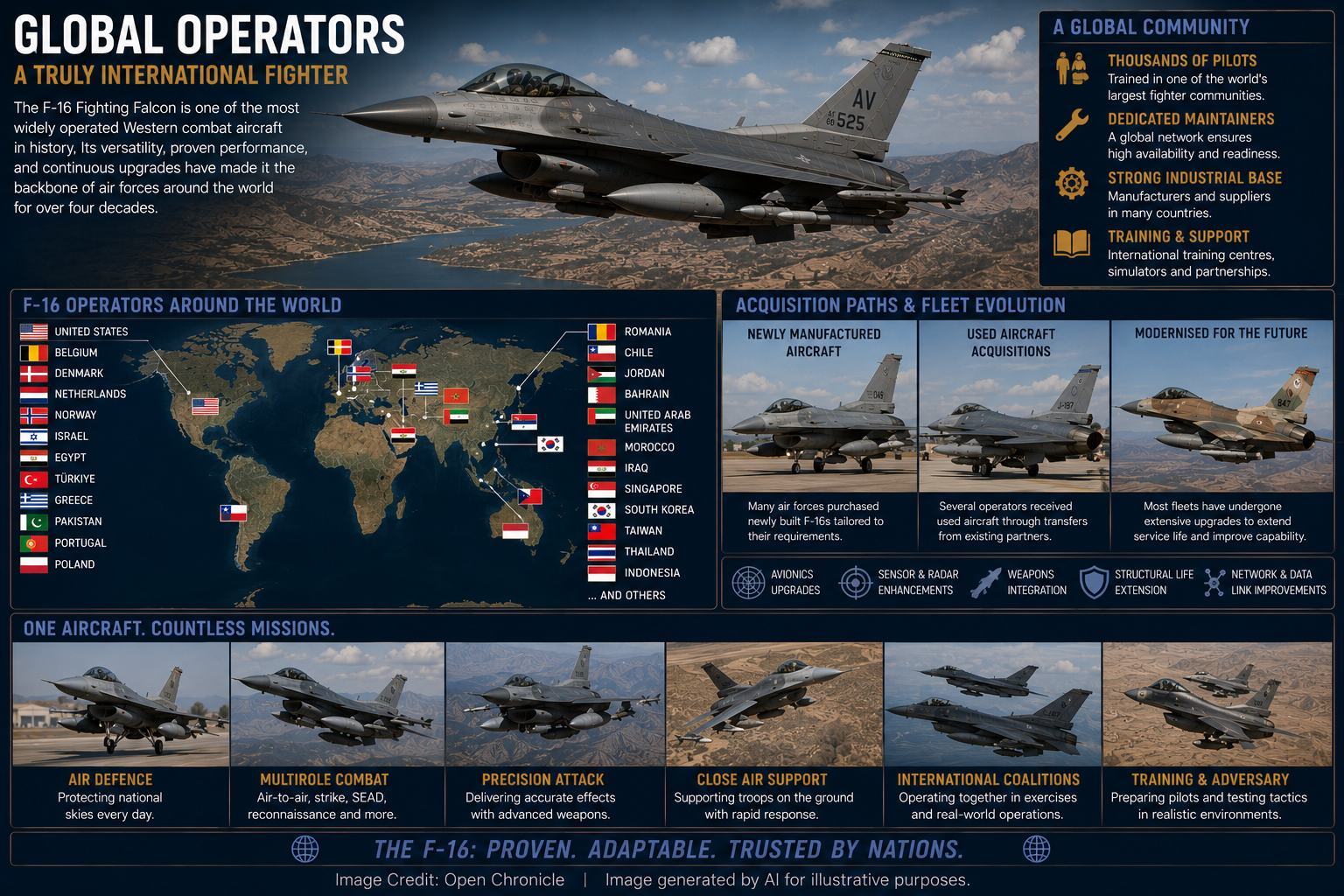
The F-16 became one of the most widely exported Western combat aircraft.
Operators have included the United States, Belgium, Denmark, the Netherlands, Norway, Israel, Egypt, Türkiye, Greece, Pakistan, Portugal, Poland, Romania, Chile, Jordan, Bahrain, the United Arab Emirates, Morocco, Iraq, Singapore, South Korea, Taiwan, Thailand, Indonesia, and several other countries.
The composition of this group changes as older fleets are retired, transferred, or replaced, and as new Block 70 and Block 72 customers receive aircraft.
Some air forces purchased newly manufactured fighters.
Others acquired used aircraft through transfers from existing operators.
Many fleets have undergone extensive modernisation to extend their operational lives.
The wide international distribution of the F-16 created a large community of pilots, maintainers, manufacturers, and training organisations.
Portugal and the F-16
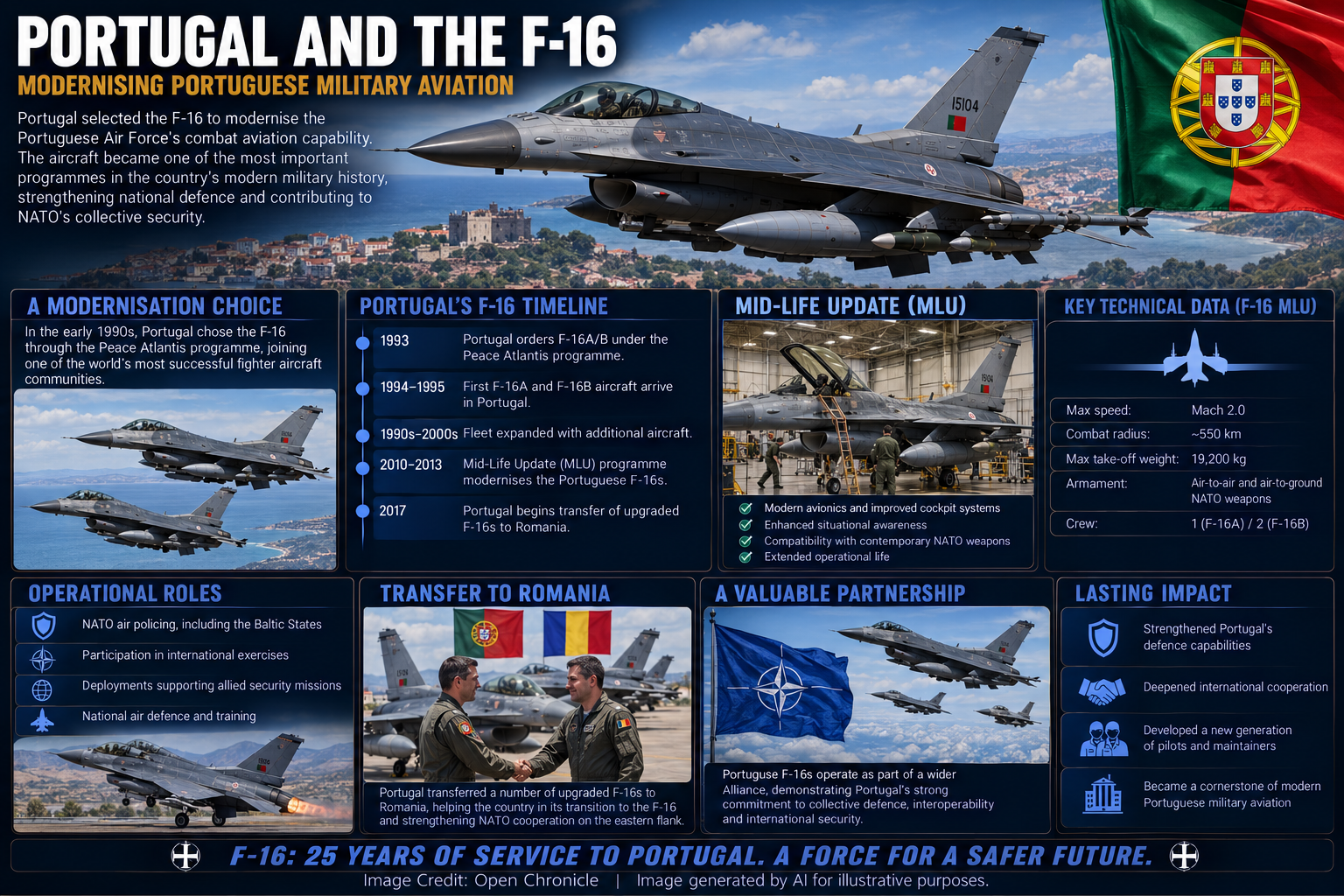
Portugal selected the F-16 to modernise the Portuguese Air Force’s combat aviation capability.
The aircraft entered Portuguese service during the 1990s through the Peace Atlantis programme.
Portugal initially received F-16A and F-16 B aircraft and later acquired additional examples.
The fleet underwent the Mid-Life Update programme, introducing modern avionics, improved cockpit systems, and compatibility with contemporary NATO weapons and procedures.
Portuguese F-16s have participated in NATO air policing, international exercises, and deployments supporting allied security missions.
Portugal also transferred upgraded aircraft to Romania, contributing to that country’s transition towards the F-16.
The programme became one of the most significant elements of modern Portuguese military aviation.
United States Air Force Service
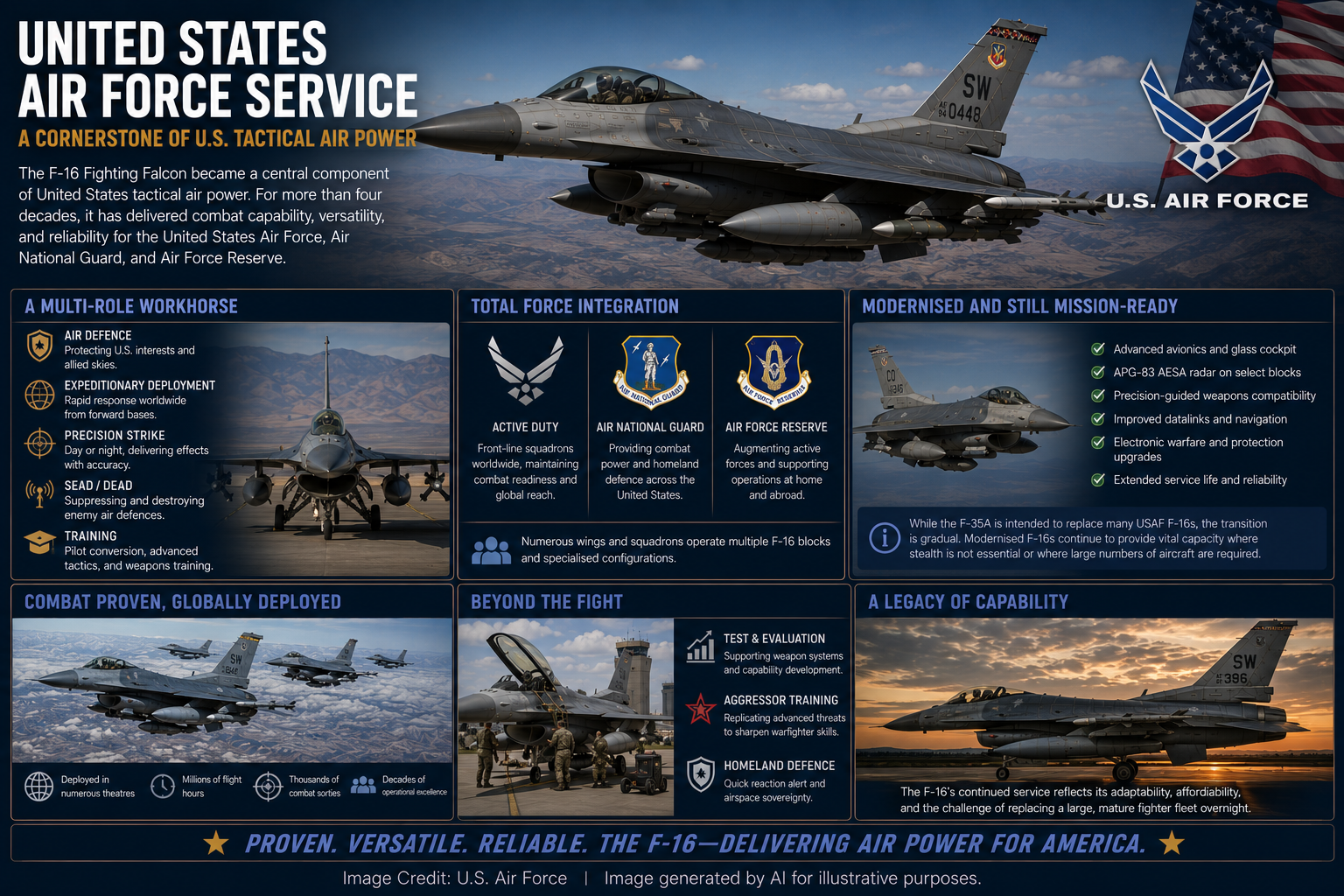
The F-16 became a central component of United States tactical air power.
Active duty, Air National Guard, and Air Force Reserve units have operated numerous blocks and specialised configurations.
The aircraft has performed air defence, expeditionary deployment, training, precision strike, and suppression of enemy air defences missions.
Although the F 35A is intended to replace many United States Air Force F 16s, the transition is gradual.
Modernised F-16s continue to provide important combat capacity, particularly where stealth is not essential or where large numbers of aircraft are required.
The type also supports testing, aggressor training, and homeland defence.
Its continued service reflects both its usefulness and the difficulty of replacing a large, mature fighter fleet quickly.
Maintenance and Operating Philosophy
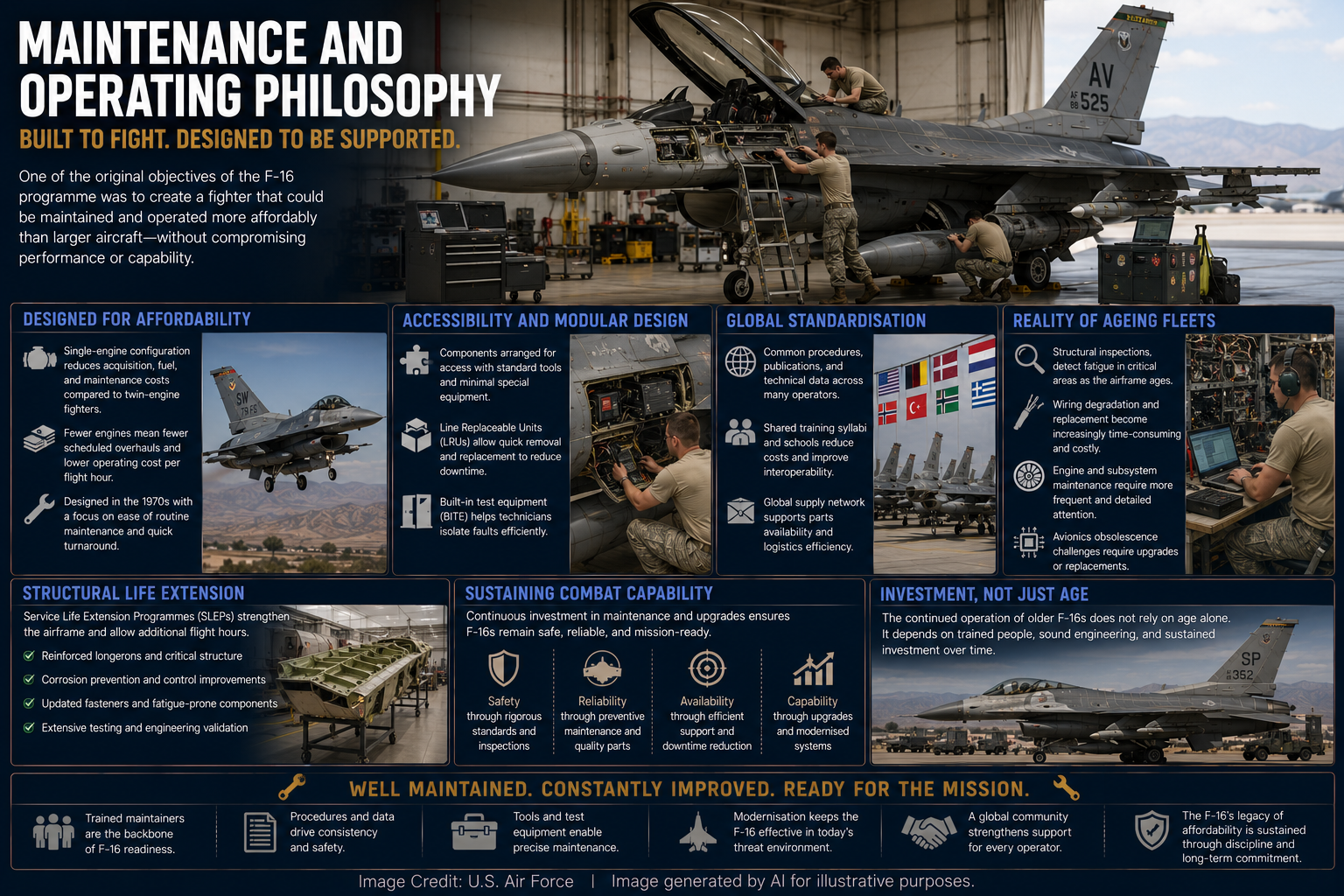
One of the original objectives of the F-16 programme was to create a fighter that could be maintained and operated more affordably than larger aircraft.
Its single-engine configuration reduced some forms of complexity, although advanced avionics and ageing structures create significant maintenance demands.
The aircraft was designed with accessible components and modular systems.
International standardisation created common training and supply networks.
As fleets aged, structural inspections, wiring replacement, engine maintenance, and avionics obsolescence became increasingly important.
Service life extension programmes strengthen the airframe and replace components to support additional flight hours.
The continued operation of older F-16s therefore depends on sustained investment rather than the aircraft’s age alone.
Production History
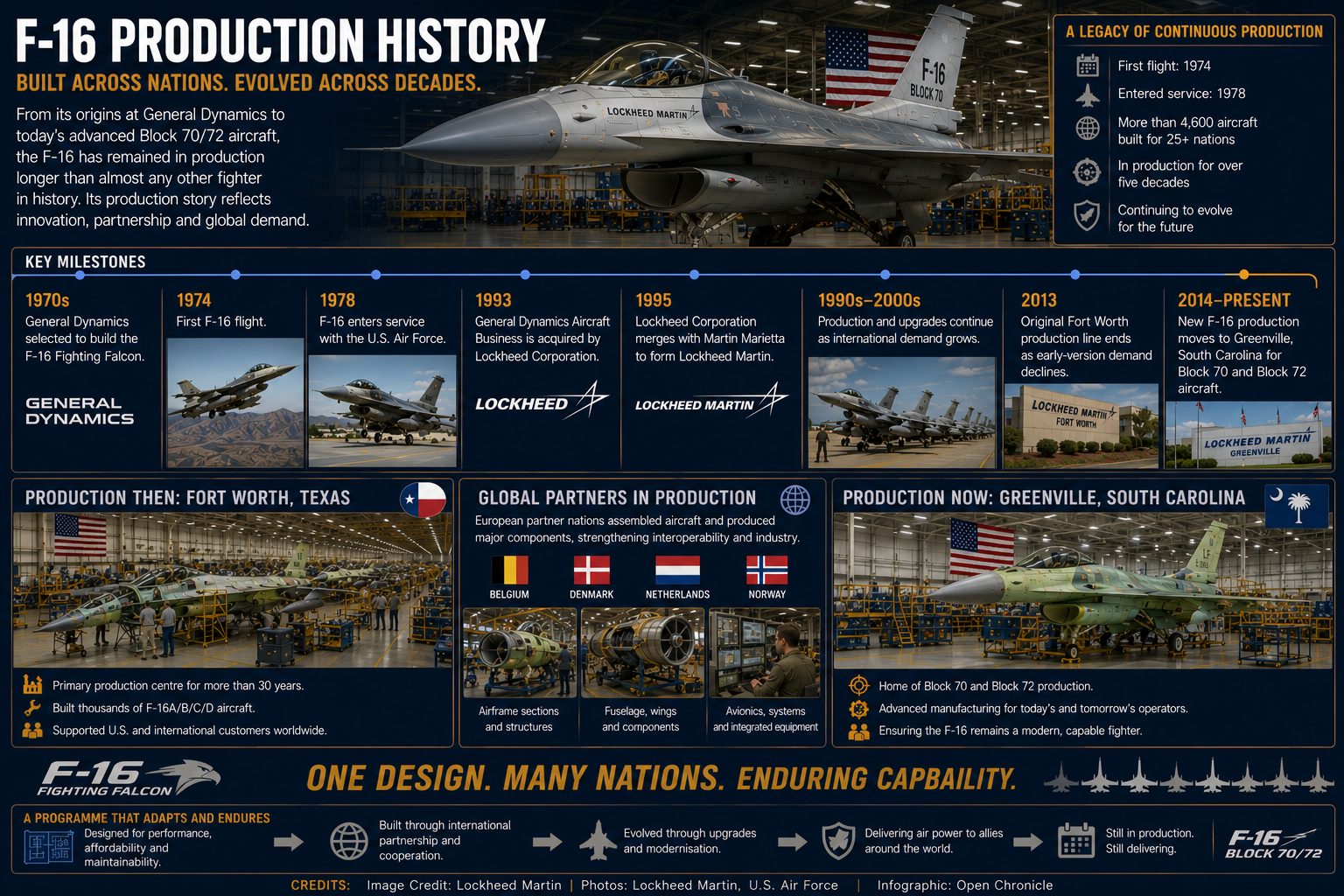
General Dynamics originally manufactured the F-16.
The company’s aircraft business later became part of Lockheed, which subsequently merged with Martin Marietta to form Lockheed Martin.
Large-scale production initially centred on Fort Worth, Texas.
European partner nations also assembled aircraft and produced components.
As demand for earlier versions declined, the original Fort Worth production line ended.
Lockheed Martin transferred new F-16 production to Greenville, South Carolina, where Block 70 and Block 72 aircraft are manufactured for international customers.
The movement of the production line represented a new stage rather than the end of the programme.
The F-16 remains one of the rare fighter designs to have remained in production, in evolving forms, across such a long period.
Technology Spotlight: Relaxed Static Stability
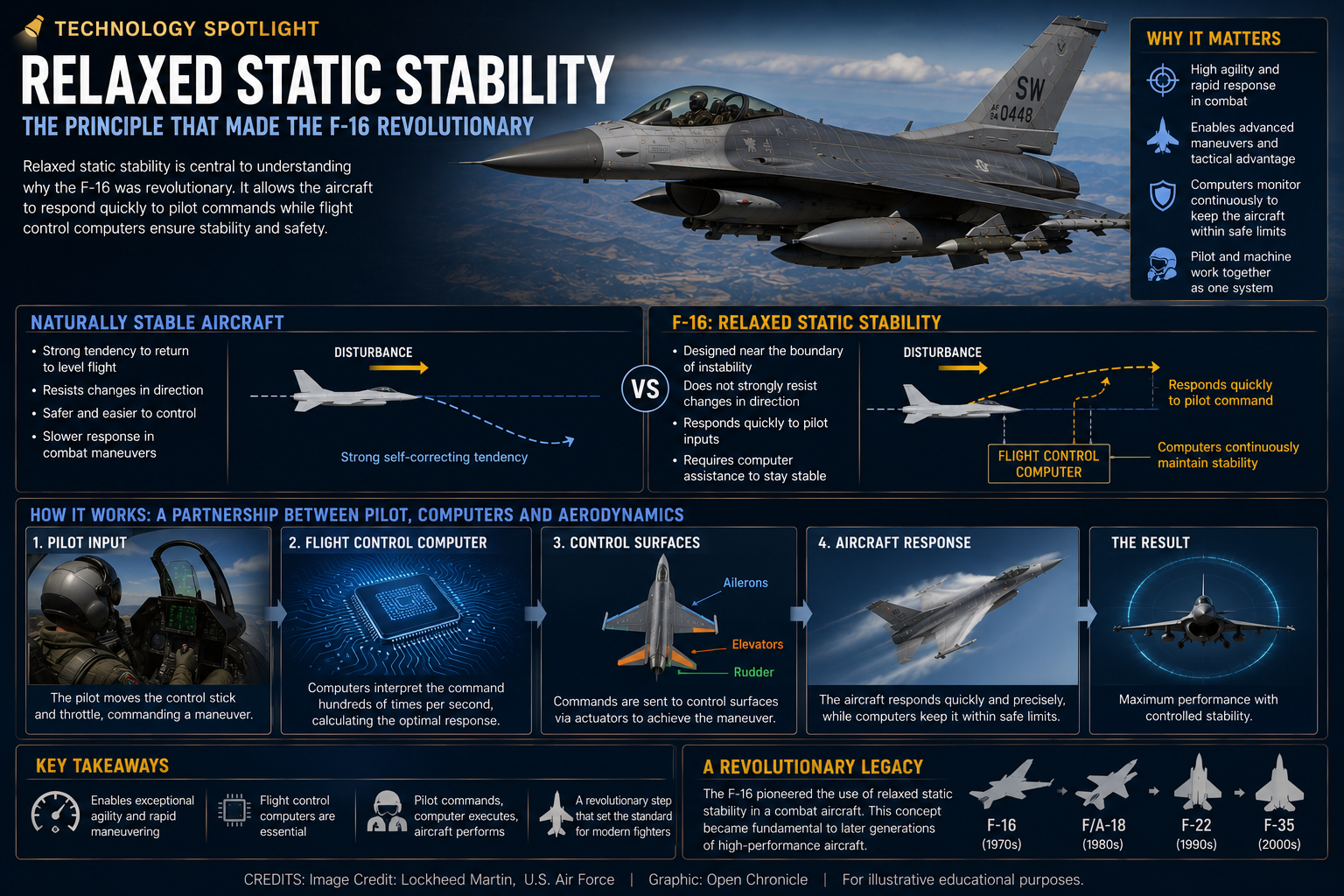
Relaxed static stability is central to understanding why the F-16 was revolutionary.
A naturally stable aircraft tends to resist changes in direction.
This is useful for safety and ease of control, but it can slow the response during combat manoeuvres.
The F-16 was designed closer to the boundary of instability.
When the pilot commands a turn, the aircraft can respond quickly because it does not strongly resist the change.
Flight control computers continuously prevent that responsiveness from becoming uncontrollable.
The result is a partnership between aerodynamics, computing, and pilot input.
The pilot does not directly move each control surface in a simple mechanical relationship.
Instead, the pilot communicates the desired manoeuvre to computers, which calculate how the aircraft should respond.
This concept became fundamental to later generations of high-performance aircraft.
Technology Spotlight: Modular Modernisation
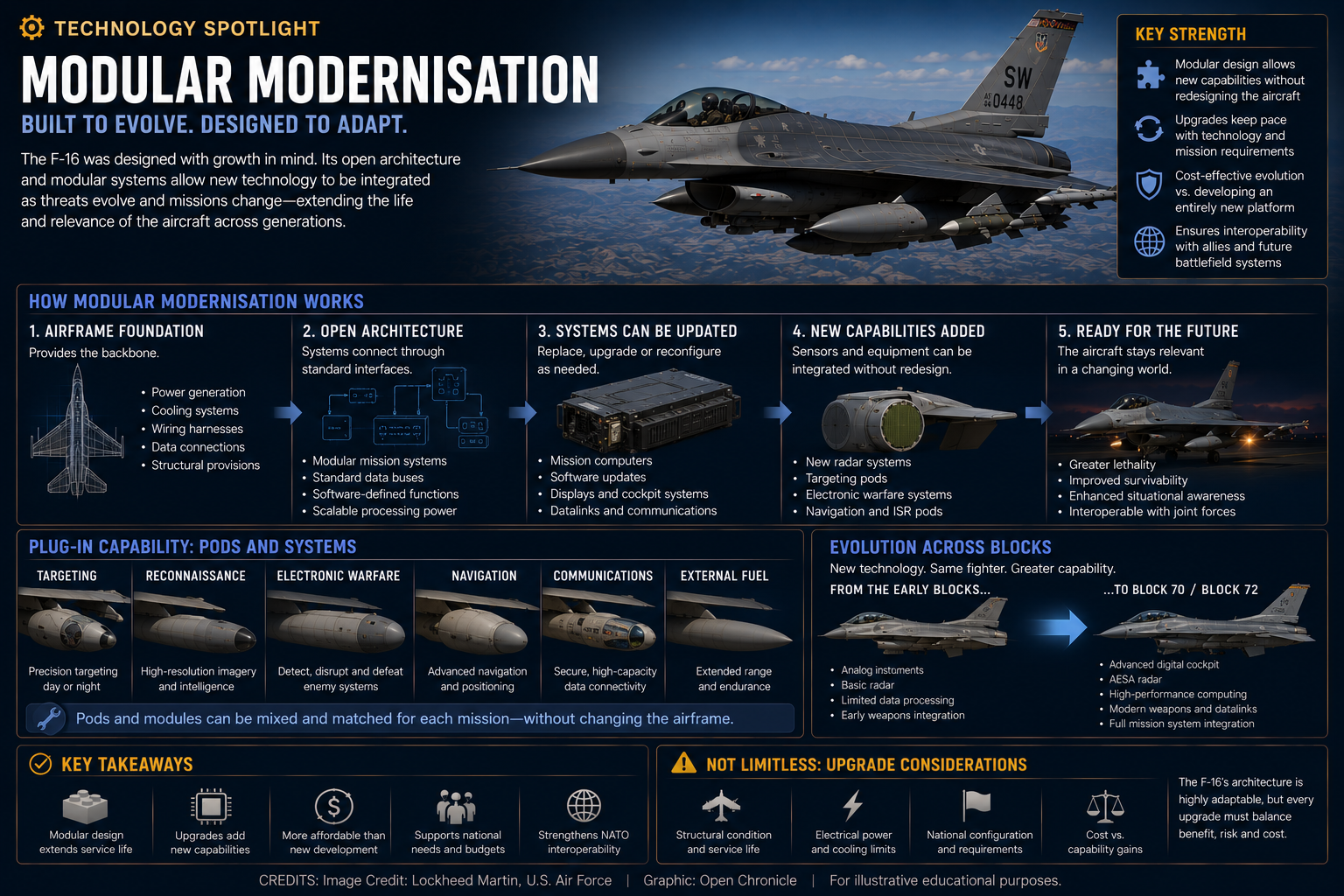
Another reason for the F-16’s longevity is its ability to accept new systems.
The airframe provides power, cooling, wiring, and data connections for changing equipment.
Mission computers can be replaced.
Software can be updated.
New radar systems can be installed.
External pods can add targeting, navigation, reconnaissance, or electronic warfare capabilities without requiring a completely new aircraft.
This does not mean every old F-16 can be upgraded indefinitely.
Structural condition, electrical capacity, national configuration, and cost impose limits.
Nevertheless, the basic architecture proved unusually adaptable.
The modern Block 70 and Block 72 retain the recognisable form of the original fighter while possessing sensors and computers that its first designers could not have imagined.
Comparison with the F-15
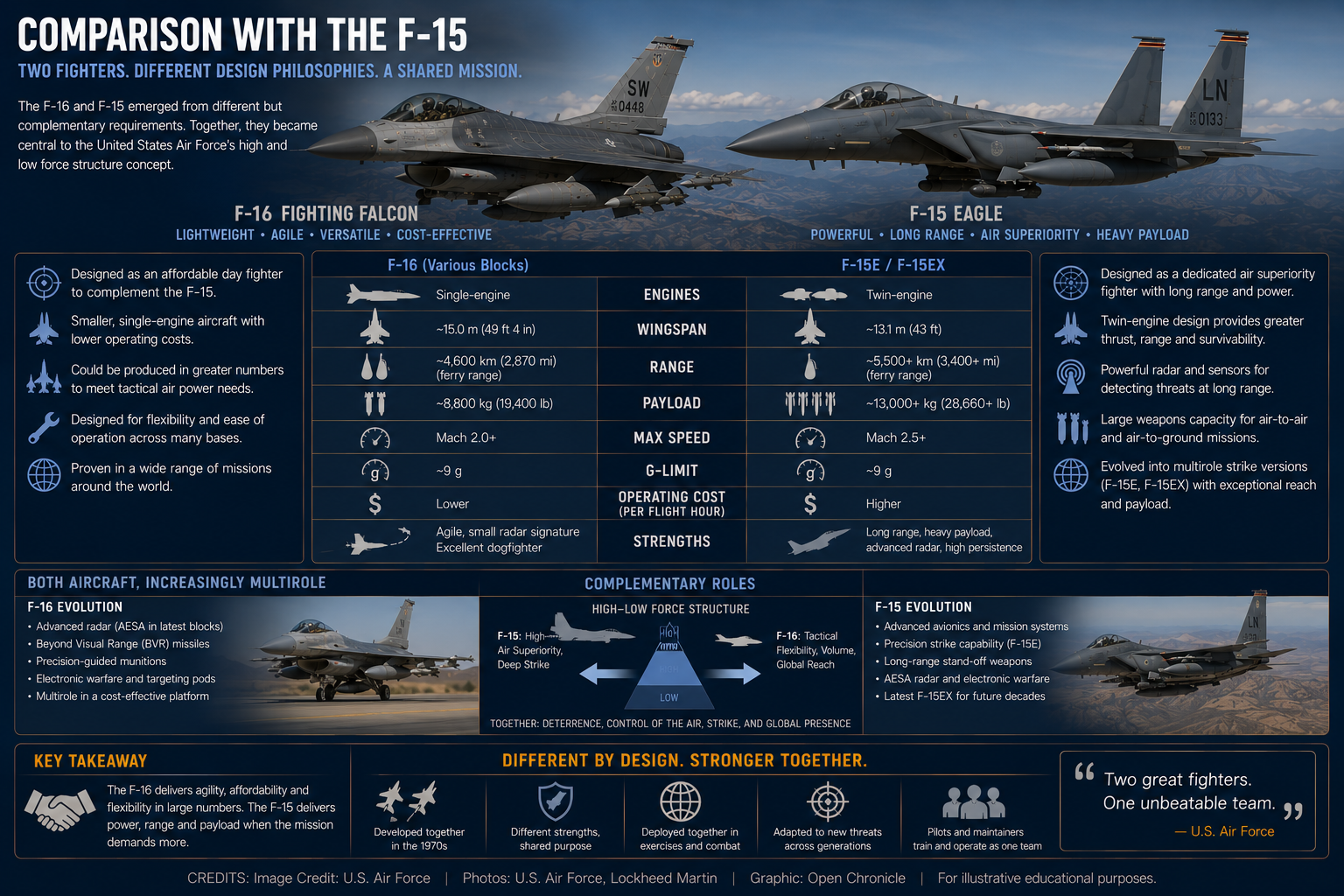
The F-16 and F 15 emerged from different but complementary requirements.
The F-15 was designed as a larger twin-engine air superiority fighter with powerful radar, long range, and substantial weapons capacity.
The F-16 was intended to provide a lighter and less expensive complement.
The smaller aircraft could be acquired in greater numbers and operated across a broad range of missions.
Over time, both aircraft became increasingly multirole.
The F 15 developed into advanced strike versions, while the F 16 gained improved radar, beyond visual range missiles, and precision attack systems.
Together, they became central to the United States Air Force’s high and low force structure concept.
Comparison with the F-A-18
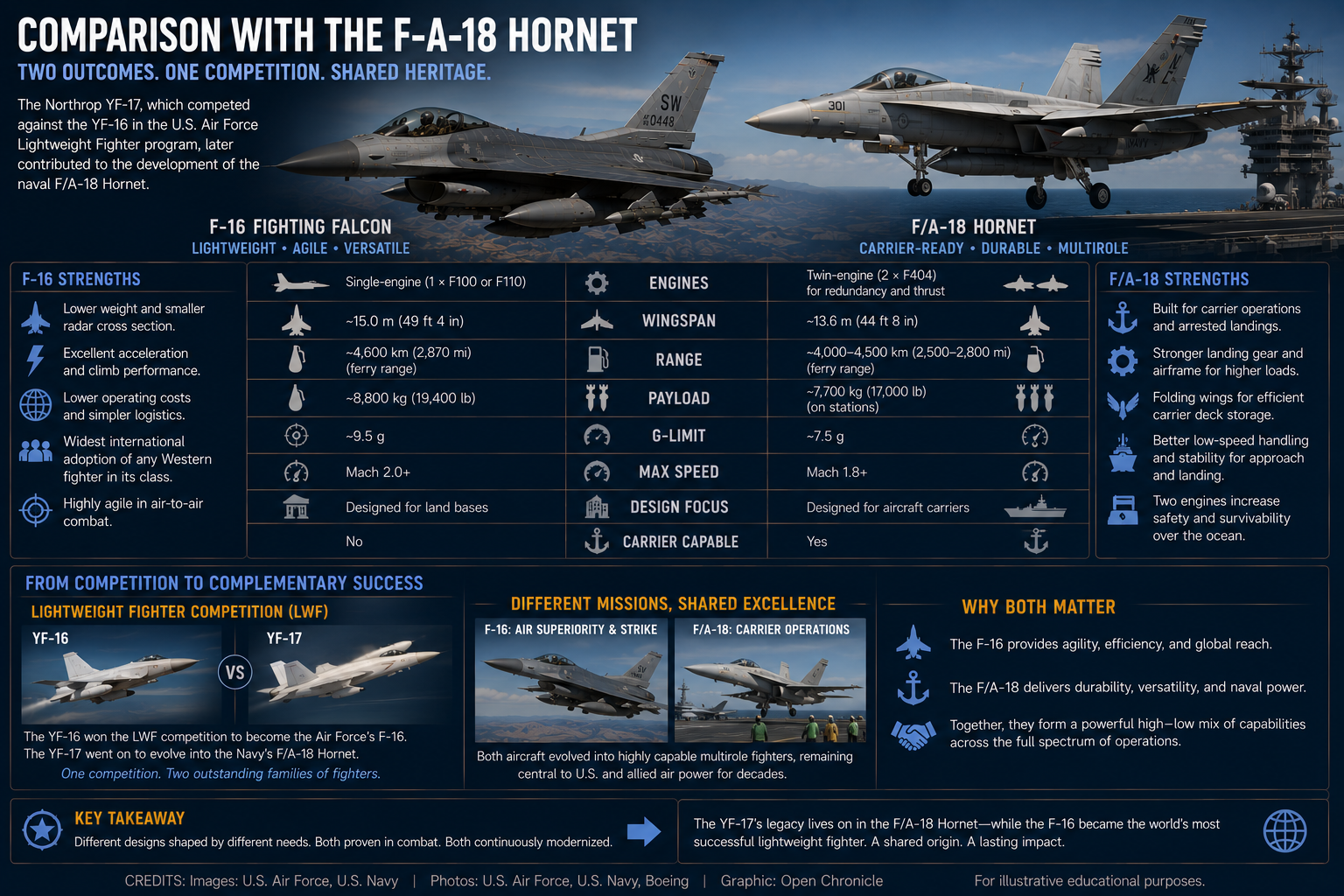
The Northrop YF-17, which competed against the YF-16, later contributed to the development of the naval F A 18 Hornet.
The F-A-18 uses two engines and was designed for aircraft carrier operations.
It has strengthened landing gear, folding wings, and naval equipment not required by the land-based F-16.
Both aircraft evolved into highly successful multirole fighters.
The F-16 achieved broader international adoption and generally emphasised lower weight and strong acceleration.
The F-A-18 provided the durability and low-speed handling required for carrier aviation.
Their shared competition origins illustrate how one experimental programme contributed to two major fighter families.
Comparison with Fifth Generation Fighters
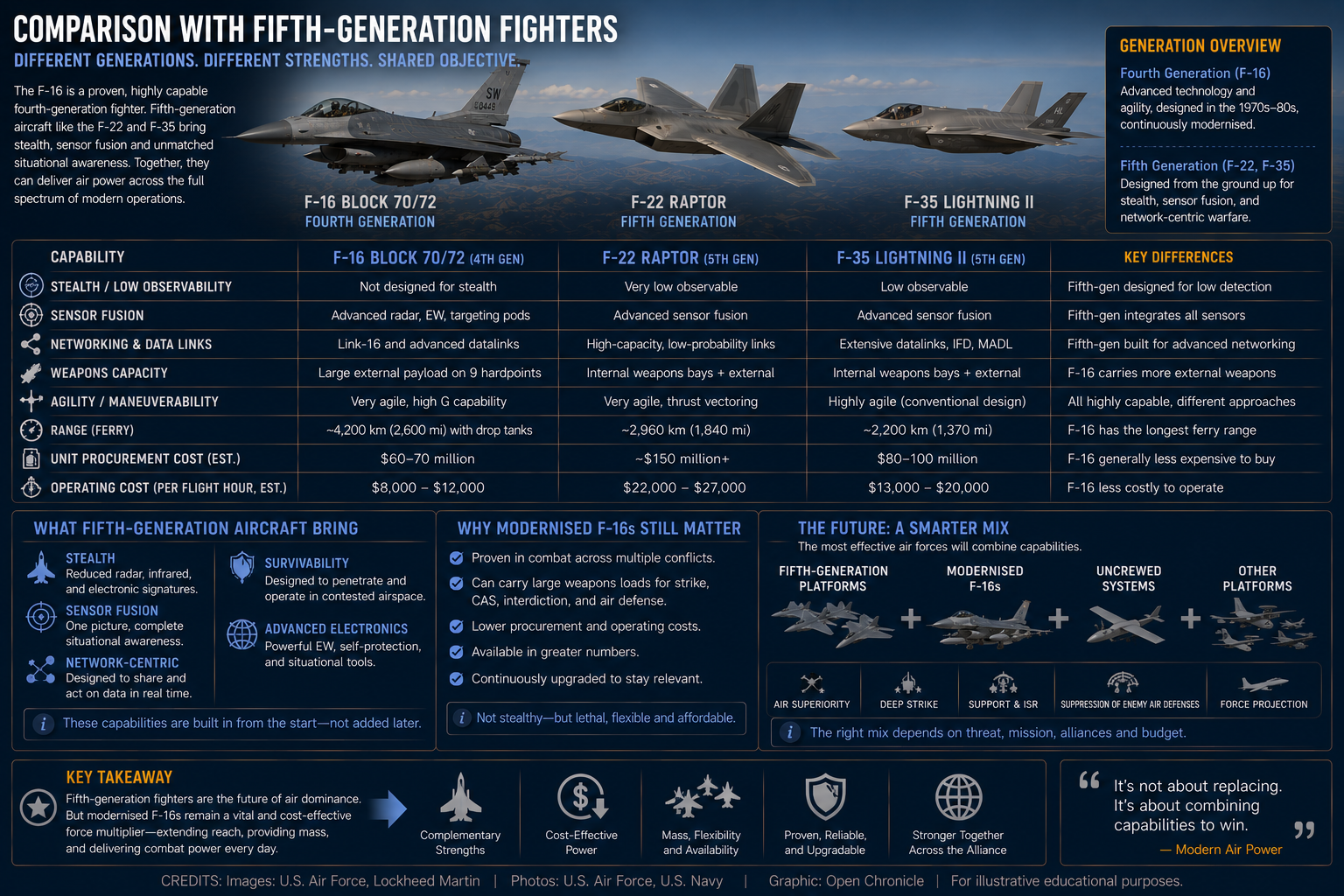
The F-16 belongs to the fourth generation of fighter aircraft.
Modern versions possess advanced radar, data links, guided weapons, and electronic warfare systems, but the aircraft was not originally designed for low radar visibility.
Fifth-generation fighters such as the F 22 and F 35 integrate stealth, sensor fusion, and advanced networked operations from the beginning of the design process.
An upgraded F-16 cannot fully reproduce those characteristics.
However, fourth-generation aircraft remain useful because they can carry substantial weapons, conduct many missions effectively, and often cost less to acquire and operate.
Future air forces may therefore combine fifth-generation aircraft with modernised F-16s, uncrewed systems and other platforms.
The appropriate mix depends on threat levels, budgets, alliances, and mission requirements.
Safety and Accident History
The F-16 is a high-performance combat aircraft operating in demanding environments.
Over decades of service, aircraft have been lost in combat, training accidents, mechanical failures, and pilot disorientation incidents.
The single-engine configuration means that some engine failures leave fewer recovery options than would exist in a twin-engine fighter.
However, the aircraft incorporates emergency systems, an ejection seat, and multiple flight control safeguards.
Accident investigations have produced changes to training, maintenance, and equipment.
More recent aircraft and upgrade programmes may include automatic ground collision avoidance technology.
Such systems can intervene when an aircraft is descending towards terrain, and the pilot is unable to respond.
The development of these protections reflects a broader effort to use automation not only for combat effectiveness but also to preserve aircraft and lives.
The F-16 as a Research Aircraft
The F-16’s electronic flight controls and adaptable structure made it valuable for experimental programmes.
Modified aircraft have tested advanced control laws, thrust vectoring, cockpit technologies, and autonomous systems.
The F-16XL explored alternative wing design.
The VISTA programme allowed researchers to simulate the handling characteristics of other aircraft.
The X 62A later supported artificial intelligence and autonomous flight experimentation.
VENOM extends this role by modifying F-16s to test autonomy with real fighter mission systems.
The aircraft that helped introduce digital flight control is therefore contributing to the development of a future in which software may perform increasingly complex flying and tactical tasks.
F 16 VENOM
The Viper Experimentation and Next-Gen Operations Model, Autonomy Flying Testbed, known as VENOM, uses specially modified F-16 aircraft to evaluate advanced autonomous technology.
The aircraft receives hardware, software, instrumentation, and automatic throttle modifications, allowing autonomous systems to control flight while a human test pilot remains aboard.
Testing progresses through simulation, software in the loop, hardware in the loop, ground evaluation, and eventual flight experimentation.
VENOM does not simply seek to produce an unmanned F-16.
Its wider purpose is to create knowledge applicable to future crewed and uncrewed combat aircraft, including Collaborative Combat Aircraft.
The programme demonstrates how the F-16 continues to serve as an experimental bridge between established aviation technology and future autonomous air power.
Strategic Significance
The strategic importance of the F-16 arises from scale as much as from individual capability.
Thousands of aircraft, dozens of operators, and decades of common training created a global combat aviation network.
Countries operating the F-16 can participate in multinational exercises and coalition operations using broadly compatible systems.
Shared logistics and weapons improve interoperability.
Transfers of used aircraft allow countries to modernise more quickly than would be possible through entirely new development programmes.
At the same time, dependence on American approval, supply chains, and software creates political and strategic constraints.
The F-16 is therefore both a military platform and an instrument of international security relationships.
Its distribution reflects alliances, regional balances, and foreign policy decisions.
Economic Significance
The F-16 programme supported aerospace industries across the United States, Europe, and other partner countries.
International production agreements distributed component manufacturing and assembly work.
Maintenance, engine support, software development, and weapons integration created long-term industrial activity beyond initial aircraft production.
The fighter’s large user community generated continuing demand for upgrades, spare parts, and training.
For Lockheed Martin and associated suppliers, the programme developed into a business ecosystem spanning several generations.
For operating countries, local participation could strengthen technical skills and aerospace capacity.
However, maintaining ageing aircraft and implementing complex upgrades can also impose significant financial burdens.
Political Significance
F 16 sales frequently carry political meaning.
Approval can signal a close security relationship with the United States.
Delays, restrictions, or refusal may reflect concerns about regional stability, technology transfer, human rights, or strategic alignment.
Because the aircraft is widely used, transfers can alter regional military balances without introducing an entirely unfamiliar platform.
Used F-16s may offer a relatively rapid path towards NATO-compatible air power.
New Block 70 and Block 72 aircraft provide more advanced capability but involve longer production and training processes.
The aircraft therefore remains a significant element of defence diplomacy.
Modern Relevance
The F-16 continues to occupy an important position between ageing Cold War aircraft and newer fifth-generation systems.
For some operators, it remains the principal frontline fighter.
For others, it serves alongside the F 35 or national aircraft types.
Modern radar, electronic warfare, precision weapons, and communications upgrades allow the F-16 to remain effective in many missions.
Its limitations become more serious in environments dominated by advanced integrated air defences and stealth aircraft.
Even there, the F-16 may contribute through stand-off weapons, electronic attack, defensive patrol, or cooperation with more survivable platforms.
Its future relevance will depend increasingly on networking, modern weapons and integration with uncrewed aircraft rather than manoeuvrability alone.
The Future of the F-16
The F-16 is likely to remain operational for decades.
New Block 70 and Block 72 aircraft are being manufactured with extended structural lives and advanced systems.
Existing fleets are receiving radar, cockpit, communications, and electronic warfare upgrades.
Other aircraft are being retired, transferred, or converted into training and target platforms.
The United States Air Force will gradually reduce its reliance on the type as more F 35As enter service, but the transition will not occur uniformly.
International operators may fly modernised F-16s well into the middle of the twenty-first century.
The aircraft’s future may also include increasing cooperation with autonomous systems.
An F-16 pilot could eventually operate as part of a network containing stealth fighters, surveillance aircraft, ground sensors, and Collaborative Combat Aircraft.
In this environment, the F-16 would remain recognisable, but its operational role would be transformed by information and automation.
Timeline
Late 1960s and early 1970s: Engineers, pilots and analysts debate the value of lightweight, highly manoeuvrable fighters.
1972: The United States Air Force initiates the Lightweight Fighter programme.
January 1974: The YF-16 becomes airborne during a high-speed ground test, producing an unexpected first flight.
1974: Planned flight testing of the YF-16 and competing YF-17 continues.
January 1975: The YF-16 is selected for development under the Air Combat Fighter programme.
1975: Belgium, Denmark, the Netherlands, and Norway join the multinational F-16 programme.
December 1976: The first production standard F-16A conducts its first flight.
January 1979: The first operational F 16A is delivered to the United States Air Force.
Early 1980s: The F-16 enters service with European partners and other international operators.
7 June 1981: Israeli F-16s conduct Operation Opera against Iraq’s Osirak reactor.
1982: Israeli F-16s participate extensively in operations over Lebanon.
1983: The United States Air Force Thunderbirds begin performing with the F-16.
Mid 1980s: The F 16C and F 16D enter production with improved radar and avionics.
1991: F-16s conduct extensive combat operations during Operation Desert Storm.
1994: United States Air Force F-16s participate in NATO’s first combat engagement over Bosnia and Herzegovina.
1999: F-16s conduct strike and suppression missions during the Kosovo campaign.
2001 onwards: F-16s support operations over Afghanistan.
2003 onwards: F-16s participate in the invasion of Iraq and subsequent operations.
2010s: Multiple operators begin major radar, avionics and structural modernisation programmes.
2015: The F-16V configuration is publicly presented as an advanced modernisation pathway.
2019: Lockheed Martin inaugurates the new F-16 production line in Greenville, South Carolina.
January 2023: The first newly manufactured Block 70 aircraft completes its first flight.
2024 onwards: Advanced F-16s continue to support autonomy research, training and multinational air operations.
2025: The F-16 remains in production and operational with air forces around the world.
Did You Know?
The F-16 is officially called the Fighting Falcon, but pilots and maintainers commonly call it the Viper.
The YF-16’s first flight was not originally planned. The prototype became airborne during a fast taxi test, and the pilot continued flying to avoid damaging the aircraft.
The F-16 was one of the first operational fighters designed with relaxed static stability and a digital fly-by-wire control system.
The pilot’s seat is reclined approximately 30 degrees to improve tolerance of high gravitational forces.
The original F-16 was conceived primarily as a lightweight daytime fighter, but it developed into an all-weather multi-role aircraft.
The F-16 and F A 18 can trace their origins to competing aircraft in the same Lightweight Fighter programme.
Some retired F-16s have been converted into QF-16 aerial targets capable of flying without a pilot aboard.
The experimental X 62A VISTA can use advanced software to reproduce different aircraft handling qualities and test autonomous flight technologies.
The latest Block 70 and Block 72 aircraft have a projected structural life of approximately 12,000 flight hours.
The F-16 production line remains active decades after the aircraft first entered operational service.
Open Chronicle Perspective
The F-16 Fighting Falcon demonstrates that the historical importance of a combat aircraft cannot be measured only by speed, weapons, or battlefield victories.
Its greatest achievement may be its capacity for transformation.
The aircraft began as an argument against the increasing weight and complexity of fighter design. It became an advanced multi-role platform carrying sophisticated radar, electronic warfare systems, and precision weapons.
It began as a United States programme and became the foundation of an international military aviation community.
It began as a human-controlled fighter dependent on revolutionary digital flight controls and later became a test platform for artificial intelligence and autonomous aviation.
This adaptability does not make the F-16 unlimited.
The aircraft lacks the inherent low-observable design and integrated sensor architecture of modern fifth-generation fighters. Older airframes require expensive structural and electronic modernisation. Operating effectively against advanced threats increasingly depends on stand-off weapons, networks, intelligence, and support from other platforms.
Nevertheless, the F-16 has repeatedly absorbed technologies that were not available when its designers created the original airframe.
Its continued relevance offers an important lesson in engineering.
A successful combat aircraft is not simply one that performs well when introduced. It provides enough structural, aerodynamic, and architectural potential to evolve through several generations of warfare.
The F-16’s future may no longer be defined by independent fighter operations. It may instead operate inside a connected force of crewed aircraft, autonomous platforms, satellites, ground systems, and artificial intelligence.
In that sense, the Fighting Falcon remains what it has been throughout much of its history: an aircraft positioned between established military aviation and the next technological transformation.
See Also
F 16 VENOM
YF 16
General Dynamics
Lockheed Martin
Lightweight Fighter Programme
Fighter Mafia
John Boyd
Energy Manoeuvrability Theory
F 15 Eagle
F-A-18 Hornet
F 16XL
F 16V
F 16 Block 70 and Block 72
Mitsubishi F-2
X 62A VISTA
Collaborative Combat Aircraft
Autonomous Aircraft
United States Air Force
Portuguese Air Force
NATO Air Power
References
United States Air Force, “F-16 Fighting Falcon”, official aircraft fact sheet.
National Museum of the United States Air Force, “General Dynamics F-16A Fighting Falcon”, museum aircraft fact sheet.
Lockheed Martin, “F-16 Fighting Falcon”, official programme information.
Lockheed Martin, “F-16 Fighting Falcon History”, historical overview of the Lightweight Fighter programme and aircraft development.
United States Government Accountability Office, “The Multinational F-16 Aircraft Program”, report concerning development, procurement, and multinational production.
United States Air Force historical materials concerning F-16 introduction, operational service, and modernisation.
Lockheed Martin documentation concerning the F-16V, Block 70, and Block 72 configurations.
Further Reading
United States Air Force publications on F-16 operations, training, and modernisation.
National Museum of the United States Air Force materials concerning the development of the F 16A.
Technical literature concerning digital fly-by-wire flight control and relaxed static stability.
Historical studies of the Lightweight Fighter programme.
Research concerning John Boyd and energy manoeuvrability theory.
Official documentation relating to NATO’s multinational F-16 programme.
Studies of F-16 combat operations in the Middle East, the Balkans, and Southwest Asia.
Lockheed Martin information concerning current F 16 production and international support.
Explore this subject
Continue exploring related Open Chronicle Encyclopedia entries through the categories associated with this article.

Staff Writers at Open Chronicle produce trusted journalism, strategic analysis and authoritative reference content across global affairs, geopolitics, defense, science, history, technology, business, culture and sport. Their work combines accurate reporting with historical perspective and analytical depth, helping readers understand not only what is happening, but why it matters. Beyond daily news coverage, Staff Writers contribute to the Open Chronicle Encyclopedia, investigative features, original research projects and long-form reports, building a comprehensive knowledge platform designed to inform, educate and preserve reliable information for a global audience.