
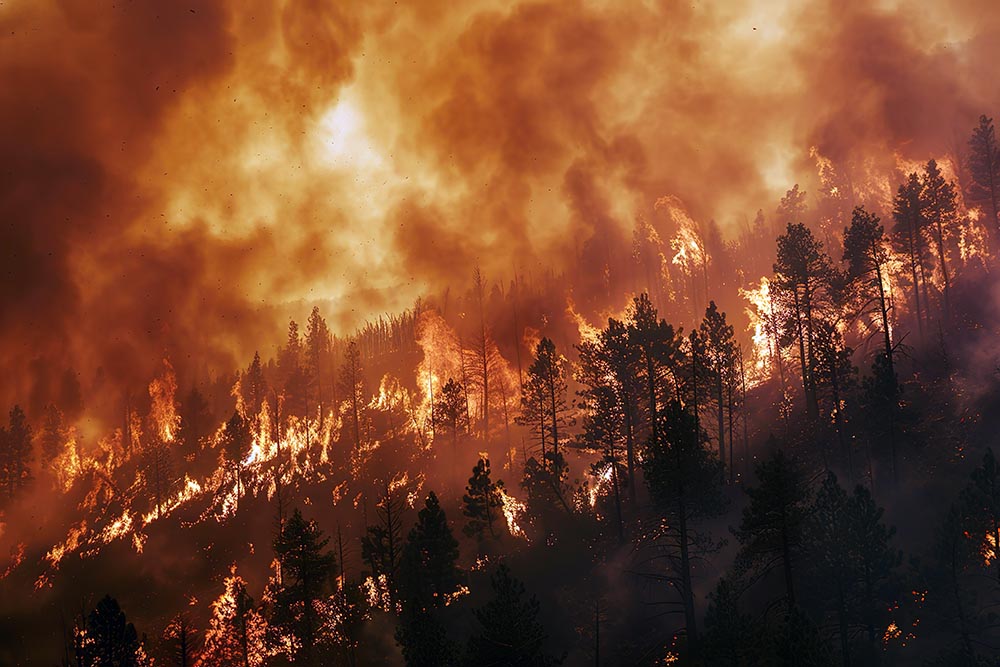
Image: from KSTV Uganda X @kstvug
By Open Chronicle News Desk with Agencies
Spain is battling its largest wildfire of the year after a major blaze in the northeastern province of Zaragoza burned approximately 12,000 hectares, forced more than 1,100 people from their homes and spread across a perimeter of around 60 kilometres.
The fire began on Wednesday in the Cinco Villas region and remained highly active on Friday, with authorities reporting significant overnight expansion. Five municipalities in Zaragoza and another community in neighbouring Navarre were evacuated as emergency crews attempted to protect residential areas and contain the advancing flames.
El incendio de las Cinco Villas supera las 12.000 hectáreas quemadas: “El riesgo de propagación continúa siendo muy alto” https://t.co/SibhH5mLzh pic.twitter.com/RhuE7nTvI7
— elDiario.es (@eldiarioes) July 17, 2026
Fire remains active across a wide perimeter
Emergency officials said the blaze continued to spread despite a large firefighting operation involving hundreds of personnel and aircraft.
Around 400 ground crew members and 19 aircraft were deployed on Thursday. During the night, teams concentrated their efforts on defending homes in Uncastillo, one of the communities most directly threatened by the fire.
Several roads remained closed as smoke, flames and emergency operations disrupted movement across the affected region. Parts of Cinco Villas also remained under lockdown.
Electricity was restored to all affected towns, although residents continued to face uncertainty over when they would be permitted to return home.
More than 1,100 people evacuated
Authorities ordered the evacuation of more than 1,100 residents as the fire approached settlements across Zaragoza and Navarre.
The evacuations were intended to give emergency crews greater freedom to defend buildings while reducing the danger to civilians in areas where the fire could change direction rapidly.
Strong winds and dry vegetation have made the blaze difficult to predict. The wide perimeter has also forced firefighting units to divide their resources between multiple fronts.
Other fires remain active
The Zaragoza fire is the largest of several wildfires currently burning across Spain.
In the northern province of Guadalajara, a fire near La Mierla remained active after destroying around 900 hectares. Nearby communities were placed under evacuation orders or lockdown restrictions as crews attempted to prevent further expansion.
The regional government requested support from Spain’s Military Emergency Unit, which deployed approximately 100 personnel to assist local firefighters.
A third fire near Lozoyuela, north of Madrid, had burned almost 70 hectares. Emergency services said conditions there were improving, although the blaze had not yet been fully contained or brought under control.
Police arrested a man suspected of starting the Madrid region fire. The regional government said it would participate in the legal proceedings as a civil party.
Dangerous combination of heat, wind, and vegetation
Officials and experts linked the current fire conditions to a combination of high temperatures, strong winds, low humidity, and abundant vegetation produced by a rainy spring.
Rainfall earlier in the year encouraged plant growth across rural areas. As temperatures rose and vegetation dried, that additional biomass became fuel capable of supporting fast-moving and highly intense fires.
Strong winds can then carry burning material over roads, firebreaks and areas already cleared by emergency crews, creating new ignition points far ahead of the main fire front.
Climate change increases wildfire risk
Experts have also pointed to climate change as an important factor behind the increasing severity of wildfire seasons across southern Europe.
Hotter summers, longer drought periods, and more frequent extreme weather events can create conditions in which fires ignite more easily and spread more rapidly.
Spain has experienced repeated episodes of severe heat and drought in recent years, placing growing pressure on forests, agricultural land and firefighting services.
The abandonment of rural areas has created another layer of risk. As populations decline in some countryside communities, fields and woodland are often left unmanaged, allowing combustible vegetation to accumulate.
Rural depopulation complicates prevention
The wildfire emergency has renewed debate over Spain’s long-term approach to rural land management.
Preventive measures such as controlled clearing, grazing, forest maintenance, and the creation of effective firebreaks require personnel, investment, and permanent activity in the countryside.
Where villages lose population and agricultural activity declines, landscapes can become increasingly vulnerable to large fires.
This means that wildfire prevention is not solely an emergency services issue. It is also linked to rural development, farming policy, environmental management, and the ability of local communities to remain economically viable.
Emergency resources face growing pressure
The deployment of hundreds of firefighters, military personnel, and aircraft demonstrates the scale of resources required to respond to a single major blaze.
During periods when several fires burn simultaneously, national and regional authorities may face difficult decisions over where to concentrate personnel and aviation assets.
Aircraft can slow the advance of flames and support crews on the ground, but they cannot replace sustained work by firefighters operating across difficult terrain.
High winds may also limit aerial operations precisely when communities face the greatest danger.
A continuing threat
The Zaragoza fire remains the most serious wildfire Spain has confronted in 2026.
Although emergency teams have restored electricity and continued defending communities, the size of the burned area and the active state of the fire mean that conditions could remain dangerous.
Authorities will continue monitoring wind direction, temperature and humidity while assessing whether further evacuations are required.
The disaster offers another warning that Europe’s wildfire season is becoming increasingly intense. It also highlights the need for stronger prevention, rural land management and long term adaptation to warmer and more volatile climatic conditions.