
Image: ARISE NEWS X @ARISEtv
By Open Chronicle News Desk with Agencies
Japan’s parliament has approved a historic revision of the law governing the imperial family, introducing measures designed to address the monarchy’s shrinking membership while preserving the country’s long-established system of male-only succession to the Chrysanthemum Throne.
The Diet approved amendments to the Imperial House Law on Friday, July 17, marking the first major revision of the legislation since it took effect in 1947. Despite growing concerns over the declining number of imperial family members and potential future succession difficulties, lawmakers stopped short of opening the throne to women or descendants through the female line.
Instead, the revised framework introduces two significant mechanisms intended to preserve the imperial household. It allows male members aged 15 and older from former collateral branches of the imperial family, descended from emperors through the male line, to be adopted into the current imperial family. It also permits female members of the imperial household to retain their status after marrying commoners.
Addressing Japan’s shrinking imperial family
Japan’s imperial family has steadily declined in size under succession rules that restrict eligibility for the throne to male descendants in the paternal imperial line.
The problem has been compounded by rules under which female members traditionally left the imperial household when marrying commoners. The combination has created growing concern about whether the monarchy will have enough members to carry out its ceremonial and public responsibilities in the decades ahead.
The imperial family now has fewer than 20 members, while the number of men eligible to succeed Emperor Naruhito remains extremely limited.
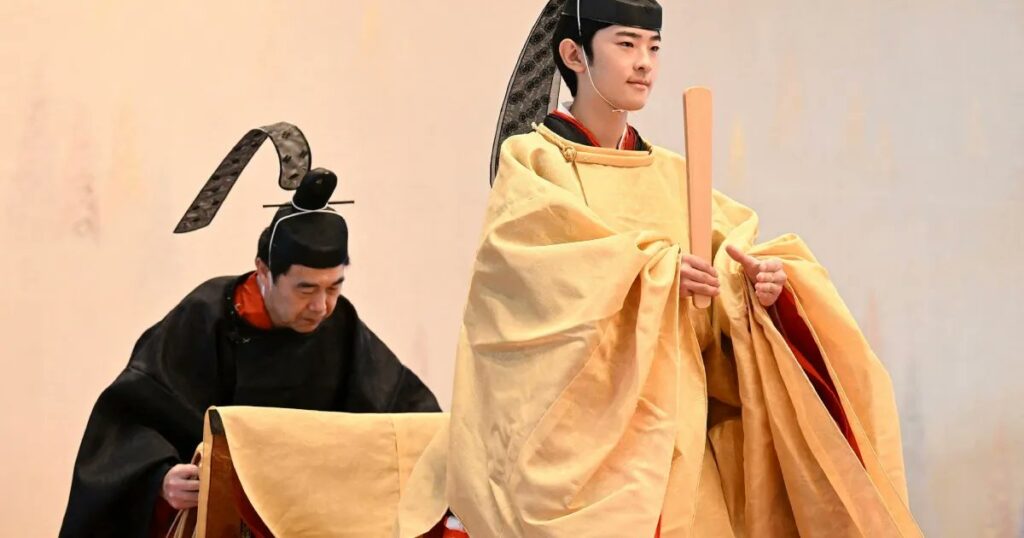
Under the current succession order, Crown Prince Akishino, Emperor Naruhito’s younger brother, is first in line. He is followed by his son, Prince Hisahito, who was born in 2006 and is the only male heir of his generation. Prince Hitachi, the emperor’s elderly uncle, is also in the succession line.
The shortage of younger male heirs has placed the future of the imperial succession at the center of a long-running political and social debate in Japan.
Former imperial branches could return
One of the most consequential elements of the revised law concerns the former collateral branches of the imperial family.
Japan removed 51 members belonging to 11 former branch families from the imperial household under the postwar legal framework. The new legislation creates a pathway for eligible males from families descended from emperors through the paternal line to be adopted into the imperial family.
Male descendants of individuals brought into the imperial household through this mechanism could eventually become eligible to ascend the Chrysanthemum Throne, potentially expanding the pool of future male heirs without abandoning the principle of paternal line succession.
The measure therefore represents a compromise between preserving Japan’s traditional succession system and confronting the demographic reality facing the monarchy.
Female royals gain greater ability to remain in the imperial family
The reform also changes the status of female members of the imperial family who marry outside the monarchy.
Under the revised system, women will be permitted to retain their imperial status after marrying commoners. The change could help maintain the number of working members available to perform official duties and represent the imperial household.
However, the reform does not establish new succession rights for these women. Their commoner husbands and children will also remain outside the imperial family, meaning the change does not create a female line through which the throne could be inherited.
As a result, the central principle of the 1947 Imperial House Law remains intact. Only males belonging to the paternal imperial line can inherit the throne.
Debate over tradition and succession continues
The decision is unlikely to end Japan’s debate over the future of the monarchy.
The conservative ruling coalition led by Prime Minister Sanae Takaichi has faced criticism from opposition lawmakers over what critics described as insufficient parliamentary deliberation and an apparent determination to preserve male and paternal line succession.
Supporters of maintaining the existing system argue that the paternal succession tradition is fundamental to the historical continuity of the Japanese monarchy. Those favoring broader reform have questioned whether the system remains sustainable given the extremely small number of potential male heirs.
Japan’s monarchy traces its traditional origins back more than 2,600 years and is widely regarded as the world’s oldest continuing hereditary monarchy. The modern legal framework governing the imperial household was established in 1947, during the postwar US occupation of Japan.
The new revision represents an attempt to strengthen the institution without fundamentally changing the succession principle established under that framework. The legislation also provides for the revised system and its implementation to be reviewed every 30 years if necessary.
For the immediate future, Japan has chosen institutional preservation over a fundamental transformation of imperial succession. The adoption mechanism and the decision to allow female royals to retain their status could stabilize the size of the imperial household, but the underlying question of succession may persist as Prince Hisahito remains the only eligible male heir of his generation.