
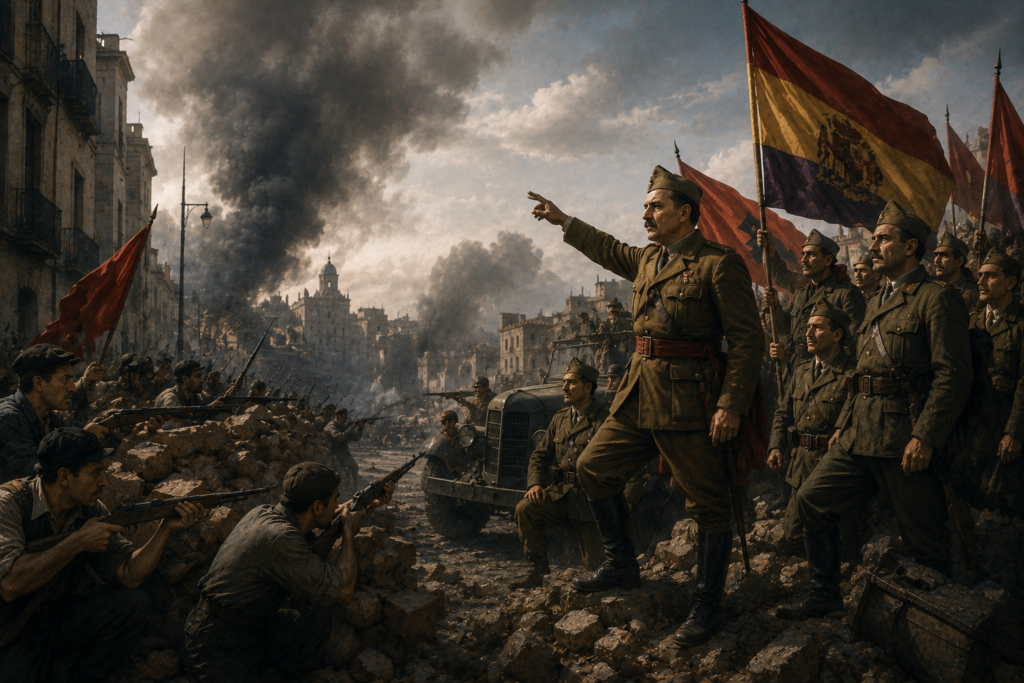
Image Credentials: Image Title: The Spanish Civil War Begins as Military Uprising Erupts Against the Republic. Source: (chatgpt.com) Date: July 2026. Attribution: This image was created using AI-generated imagery (chatgpt.com) by Open Chronicle and does not depict a real-world scene.
By Open Chronicle
17 July 1936
On 17 July 1936, a military uprising led by Spanish generals including Francisco Franco and Emilio Mola began in Spanish Morocco, marking the start of the Spanish Civil War. What was initially intended as a swift coup against the democratically elected Second Spanish Republic quickly evolved into a brutal conflict that lasted nearly three years, claimed hundreds of thousands of lives, and became a defining prelude to the Second World War.
The roots of the conflict lay in years of growing political instability, economic hardship, and deep ideological divisions within Spanish society. Following the establishment of the Second Republic in 1931, successive governments introduced reforms affecting land ownership, the military, education, and the relationship between church and state. While many welcomed these changes, others viewed them as a threat to Spain’s traditional institutions and social order.
Political violence intensified throughout the first half of the 1930s. Left-wing and right-wing groups clashed with increasing frequency, strikes and protests became common, and confidence in democratic institutions steadily eroded. The victory of the Popular Front coalition in the February 1936 general election further polarised the country, convincing many conservative military officers that armed intervention was necessary.
The conspiracy to overthrow the Republic had been organised for months under the leadership of General Emilio Mola, with support from a number of senior officers. The uprising officially began on 17 July among Spanish Army units stationed in Morocco, Spain’s most experienced military force. The following day, the rebellion spread rapidly to mainland Spain as military garrisons declared their support for the coup.
General Francisco Franco, then serving in the Canary Islands, quickly joined the rebellion after flying to Morocco aboard the British charter aircraft Dragon Rapide. He soon assumed command of the Army of Africa, whose seasoned troops became one of the Nationalist forces’ greatest military advantages during the early stages of the war.
Contrary to the conspirators’ expectations, the coup did not achieve an immediate victory. In many major cities, including Madrid, Barcelona, Valencia, and Bilbao, government forces, assisted by workers’ organisations and civilian militias, successfully resisted the uprising. Spain was effectively divided into territories controlled by the Republican government and those held by the Nationalists, transforming the failed coup into a prolonged civil war.
The conflict rapidly attracted international attention. Nazi Germany and Fascist Italy provided extensive military assistance to the Nationalists, supplying aircraft, tanks, weapons, and troops. The Soviet Union supported the Republican government with military equipment and advisers, while thousands of foreign volunteers travelled to Spain to join the International Brigades in defence of the Republic. The war thus became a testing ground for new military technologies and ideological struggles that would soon engulf Europe.
Over nearly three years, Spain witnessed devastating battles, aerial bombardments, political repression, and widespread civilian suffering. Events such as the bombing of Guernica in 1937 became enduring symbols of the horrors of modern warfare. The conflict also inspired artists, writers, and journalists, including Pablo Picasso, Ernest Hemingway, and George Orwell, whose works helped shape international understanding of the war.
The Spanish Civil War ended on 1 April 1939 with the victory of Franco’s Nationalists. Franco established an authoritarian dictatorship that lasted until he died in 1975, profoundly influencing Spain’s political, social, and cultural development throughout the twentieth century.
Today, the outbreak of the Spanish Civil War is remembered as one of modern Europe’s most consequential conflicts. It exposed the growing ideological divisions between fascism, communism, and liberal democracy, foreshadowed many of the military tactics employed during the Second World War, and left a legacy that continues to shape historical memory in Spain and beyond.