
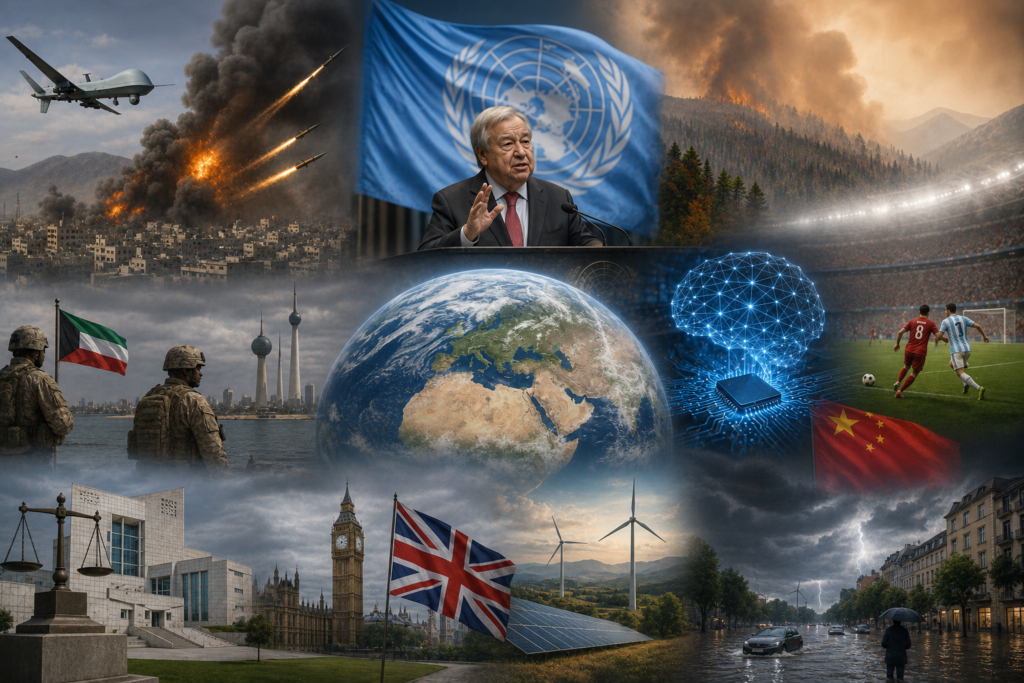
Image Credentials: Image Title: China’s Arctic Intelligence Strategy: How Scientific Access, Satellite Infrastructure and Commercial Presence Are Reshaping the High North. Source: (chatgpt.com) Date: July 2026. Attribution: This image was created using AI-generated imagery (chatgpt.com) by Open Chronicle and does not depict a real-world scene.
By Open Chronicle News Desk with Agencies
Escalating tensions in the Middle East, renewed diplomatic warnings, severe weather in Europe, artificial intelligence competition, and mounting legal concerns over international justice dominate the global agenda on July 18.
From continued United States military operations against Iran to destructive storms in France and China’s push for technological self-reliance, governments across the world are confronting an increasingly complex geopolitical and economic landscape.
US reissues Middle East travel warning
The United States has renewed its travel advisory for the Middle East as military tensions continue to rise across the region.
The updated warning comes amid ongoing exchanges between American and Iranian forces and follows a series of missile and drone attacks affecting several Gulf states. US authorities urged citizens to remain vigilant, monitor official guidance and reconsider travel to areas facing heightened security risks.
UN condemns attacks on civilian infrastructure
United Nations Secretary-General António Guterres has described attacks on civilian infrastructure during the US-Iran conflict as “unacceptable.”
The UN chief reiterated calls for all parties to respect international humanitarian law and avoid actions that place civilian populations, hospitals, energy facilities and essential public services at risk.
The organization continues to urge an immediate reduction in hostilities while encouraging renewed diplomatic efforts to prevent a wider regional war.
Canadian wildfire smoke reaches Europe
Smoke from massive wildfires burning in Canada has drifted across the Atlantic, affecting air quality in parts of Europe and casting a visible haze over Spain ahead of the FIFA World Cup final against Argentina.
Meteorological agencies have confirmed that upper atmospheric winds carried smoke thousands of kilometres from North America, a phenomenon that has become increasingly common during intense wildfire seasons.
Although most of the smoke remains at high altitude, experts continue to monitor potential impacts on visibility and air quality.
Kuwaiti soldiers injured in Iranian drone attacks
Several members of Kuwait’s armed forces were injured after Iranian drone strikes targeted military facilities in the country, according to Kuwaiti authorities.
The attacks form part of the expanding regional confrontation between Iran and the United States, with Gulf states increasingly affected by military operations involving drones and missiles.
The incident underscores growing concerns that neighbouring countries hosting American military assets are becoming increasingly exposed to the conflict.
International Criminal Court faces growing pressure
On International Justice Day, legal experts warned that the International Criminal Court is experiencing one of the most serious crises in its 24-year history.
Analysts point to increasing political pressure, funding challenges, and difficulties enforcing arrest warrants in major international conflicts.
The concerns come as the court continues to investigate alleged war crimes and crimes against humanity in several active conflict zones around the world.
Andy Burnham sets vision for UK Labour
British Prime Minister Andy Burnham has pledged that the Labour Party will succeed by remaining “boldly, confidently, authentically Labour.”
His remarks come as the new government begins implementing its domestic agenda while addressing economic challenges, public services, and Britain’s international commitments.
Burnham has emphasized investment, economic growth, and public sector reform as central priorities for his administration.
Climate cooperation highlighted at D-8
The president of COP31 said the Developing Eight (D-8) organization could play a transformative role in advancing the global climate agenda.
The comments stressed greater cooperation among developing economies in renewable energy, climate finance and sustainable development while encouraging stronger partnerships ahead of future international climate negotiations.
Severe storms disrupt France
Powerful storms and heavy rainfall swept across parts of France, leaving at least two people dead and cutting electricity to approximately 53,000 households.
Emergency services responded to flooding, fallen trees and widespread infrastructure damage as utility companies worked to restore power.
Meteorological authorities warned that additional unstable weather could affect parts of the country.
China pushes for secure artificial intelligence
Chinese President Xi Jinping called for the development of “secure” and “controllable” artificial intelligence as competition with the United States intensifies.
The remarks reflect Beijing’s continued focus on strengthening domestic technological capabilities while reducing dependence on foreign technologies.
Artificial intelligence has become one of the principal areas of strategic competition between the world’s two largest economies, alongside semiconductors, quantum computing and advanced manufacturing.
Iran rejects Trump’s claim
Iran denied a claim by US President Donald Trump that Tehran had released an American woman.
Iranian officials dismissed the assertion and said the information presented by Washington was inaccurate, adding another point of disagreement during a period of heightened military and diplomatic confrontation.
Global uncertainty continues
The day’s developments illustrate how security, climate, technology, and diplomacy have become increasingly interconnected.
The continuing US-Iran confrontation is influencing travel advisories, military deployments, energy markets and international diplomacy, while severe weather and environmental challenges continue to affect populations far beyond their points of origin.
At the same time, competition over emerging technologies such as artificial intelligence is reshaping global strategic priorities, reinforcing the growing overlap between economic policy and national security.
As governments respond to simultaneous geopolitical, environmental and technological challenges, international cooperation remains under increasing strain, making diplomacy and crisis management more important than ever.