
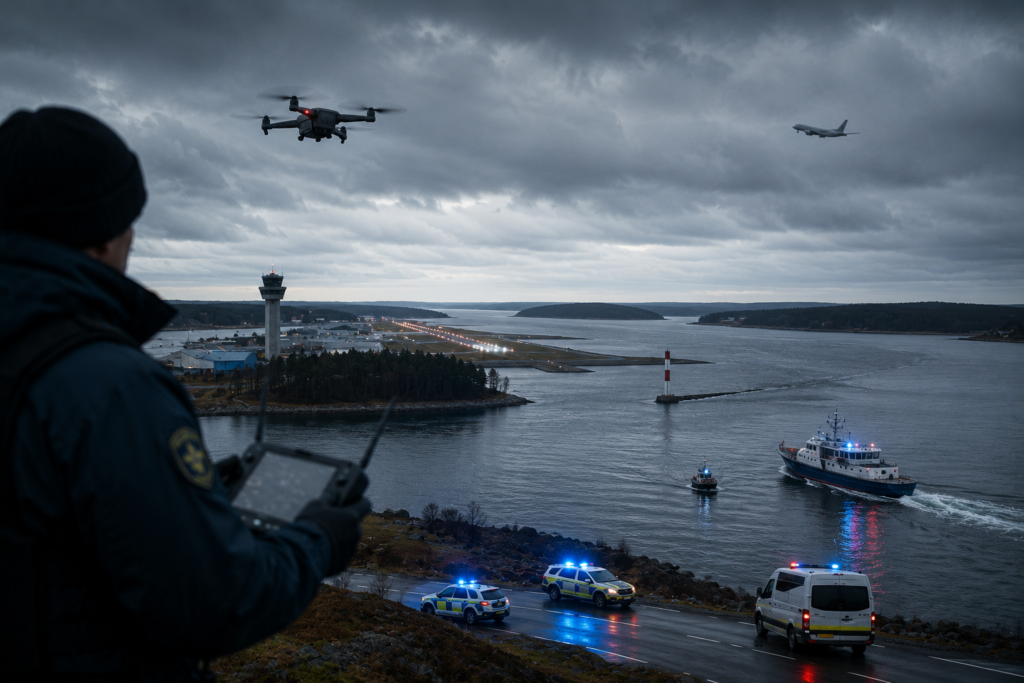
Image Credentials: Image Title: Finland Temporarily Restricts Air and Maritime Traffic Over Suspected Drone Threat. Source: (chatgpt.com) Date: July 2026. Attribution: This image was created using AI-generated imagery (chatgpt.com) by Open Chronicle and does not depict a real-world scene.
By Open Chronicle News Desk with Agencies
Finnish authorities temporarily restricted both air and maritime traffic on Friday after identifying a potential drone threat in the vicinity of a strategically important area in southern Finland.
The precautionary measures affected civilian aviation and shipping while security agencies assessed the situation. Officials later lifted the restrictions after determining that there was no immediate danger to the public, but an investigation into the incident remains underway.
Temporary restrictions imposed as a precaution
Finnish authorities announced the temporary closure of sections of airspace and nearby maritime routes following reports of a possible unmanned aerial vehicle operating in a restricted area.
The restrictions were introduced as a preventive security measure to allow law enforcement and defence authorities to assess the potential threat without interference from civilian traffic.
Officials stressed that the decision was taken out of caution and formed part of established security procedures for dealing with unidentified aerial activity.
Security agencies respond to suspected drone activity
Police, border authorities and defence officials coordinated their response after receiving information about the suspected drone.
Authorities monitored the situation while examining whether the object represented a genuine security threat, an unauthorized civilian drone, or another type of aerial activity.
Although details about the drone’s origin, operator, and exact flight path were not immediately disclosed, investigators continue to gather evidence to determine what occurred.
No arrests or injuries were reported in connection with the incident.
Air and maritime operations resume
Following security assessments, Finnish authorities reopened the affected airspace and restored maritime traffic.
Officials said there was no continuing threat requiring extended restrictions, allowing commercial flights and shipping operations to resume normal activity.
The temporary interruption nevertheless demonstrated how rapidly authorities can implement coordinated measures when unidentified drones are detected near sensitive infrastructure.
The investigation remains active, and authorities have not ruled out further action should new evidence emerge.
Growing concern over drone activity
The incident comes amid increasing concern across Northern Europe regarding the use of drones near critical infrastructure, military facilities and transportation hubs.
Since Russia’s full-scale invasion of Ukraine in 2022, several Nordic and Baltic countries have strengthened surveillance of their airspace and maritime environments amid reports of suspected espionage, sabotage and unauthorized drone flights.
Governments throughout the region have expanded counter-drone capabilities and increased cooperation between military, police, and border security agencies.
Finland, which joined NATO in 2023, has placed particular emphasis on protecting strategic infrastructure, especially given its 1,340-kilometre border with Russia and its location on the Baltic Sea.
Baltic Sea security remains under scrutiny
The Baltic region has witnessed a series of security incidents involving undersea cables, energy infrastructure, GPS interference and suspected drone activity over the past two years.
Authorities across Finland, Sweden, Estonia and other neighbouring states have increased monitoring of ports, airports, power facilities and telecommunications networks.
While many drone sightings ultimately prove harmless or remain unexplained, officials say every incident requires careful evaluation because commercially available drones can be adapted for surveillance, intelligence gathering or attacks on critical infrastructure.
Recent geopolitical tensions have reinforced the need for rapid responses whenever unidentified aerial systems are detected near sensitive locations.
Counter-drone capabilities are becoming increasingly important
The Finnish incident highlights the growing challenge posed by unmanned aerial systems to civilian and military security.
Small drones are relatively inexpensive, difficult to detect, and capable of carrying cameras, sensors, or even explosive payloads. Their widespread availability has forced governments to develop new procedures for protecting airports, ports, military installations and other critical sites.
Modern counter-drone operations typically combine radar, radio frequency monitoring, optical sensors, and electronic warfare systems capable of detecting, tracking, and, where legally permitted, neutralizing unauthorized aircraft.
As drone technology continues to evolve, European governments are investing heavily in integrated detection networks and faster decision-making processes to minimize disruptions while maintaining public safety.
Although Friday’s restrictions proved temporary, the incident underscores how unmanned aerial systems have become an increasingly significant security concern across Europe, particularly in strategically important regions such as the Baltic Sea.