
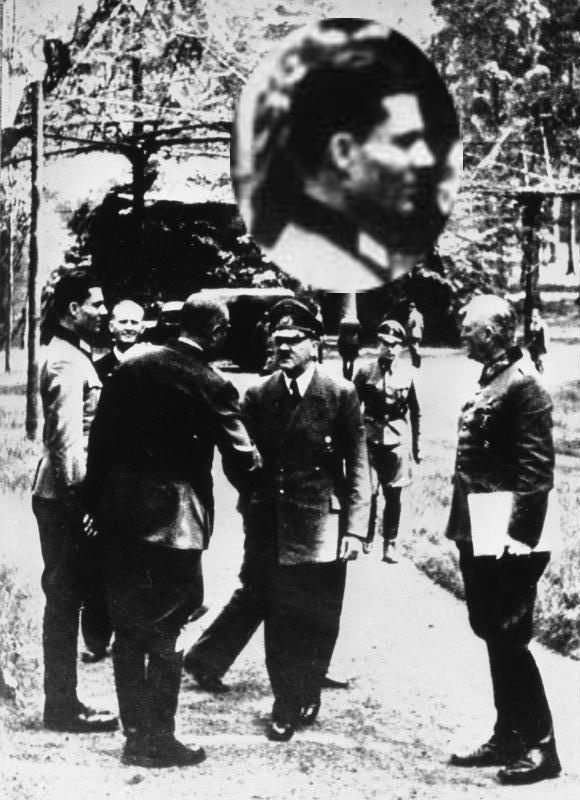
Image: Graf von Stauffenberg, left, with Hitler (centre) and Generalfeldmarschall Wilhelm Keitel, right, in an aborted assassination attempt at Rastenburg on 15 July 1944 (Wikimedia)
By Open Chronicle
20 July 1944
On 20 July 1944, German Army officer Colonel Claus Schenk Graf von Stauffenberg carried out an assassination attempt against Adolf Hitler at the Wolf’s Lair military headquarters in East Prussia. The failed bombing, known as the July 20 Plot, represented the most serious attempt by German military officers to overthrow the Nazi regime during the Second World War. Although the explosion injured Hitler, he survived, allowing the Nazi government to crush the conspiracy and execute thousands of suspected opponents.
By the summer of 1944, Germany’s military situation had deteriorated dramatically. Allied forces had landed in Normandy on 6 June, while the Soviet Union was advancing rapidly on the Eastern Front. Many senior German officers concluded that the war was unwinnable and feared that Hitler’s leadership would bring destruction upon Germany.
Opposition to Hitler had existed within parts of the German military for years, but repeated plans to remove him had failed. Stauffenberg, a decorated officer who had been severely wounded in North Africa, became convinced that only Hitler’s death could end the dictatorship and allow Germany to negotiate peace with the Allies.
The conspiracy involved senior officers, civil servants, and political figures who intended not only to assassinate Hitler but also to seize control of the German government through Operation Valkyrie. Originally designed as an emergency plan to maintain order in the event of internal unrest, the operation was secretly modified so that reserve army units could occupy key government buildings, arrest Nazi leaders, and establish a new administration once Hitler was confirmed dead.
On the morning of 20 July, Stauffenberg attended a military conference at the Wolf’s Lair, Hitler’s heavily fortified headquarters near Rastenburg. Carrying a briefcase containing explosives, he placed it beneath the conference table close to Hitler before leaving the room under the pretext of making a telephone call.
At approximately 12:42 p.m., the bomb exploded, devastating the meeting room. Four people were killed and several others seriously injured. Hitler survived with relatively minor wounds after another officer had unknowingly moved the briefcase behind a heavy oak table support, which deflected much of the blast away from him.
Believing that Hitler had been killed, Stauffenberg returned to Berlin and initiated Operation Valkyrie. However, confusion quickly spread as reports confirmed that Hitler was alive. Without proof of the dictator’s death, many military commanders refused to support the coup, and the conspiracy rapidly collapsed.
That evening, loyal Nazi forces regained control of Berlin. Stauffenberg, General Friedrich Olbricht, Colonel Albrecht Mertz von Quirnheim, and Lieutenant Werner von Haeften were arrested and executed by firing squad during the night. In the weeks that followed, the Gestapo launched an extensive investigation that uncovered much of the conspiracy.
More than 7,000 people were arrested in connection with the plot, and nearly 5,000 were executed or died as a result of persecution. Many of those convicted were subjected to public show trials before the People’s Court under Judge Roland Freisler, with executions often carried out in particularly brutal fashion to intimidate potential opposition.
The failure of the July 20 Plot strengthened Hitler’s control over Germany during the final months of the war. Distrustful of the military leadership, he imposed even tighter political control over the armed forces while continuing a conflict that ultimately ended with Germany’s unconditional surrender in May 1945.
Today, the July 20 assassination attempt is remembered as one of the most significant acts of resistance against the Nazi regime. Although historians continue to debate the political motivations of some conspirators, the plot has become an enduring symbol of moral courage among those Germans who chose to oppose dictatorship despite the overwhelming personal risks.
The events of 20 July 1944 remain a powerful reminder of the difficult choices faced by individuals living under totalitarian rule and of the profound consequences that a single failed act of resistance can have on the course of history.