
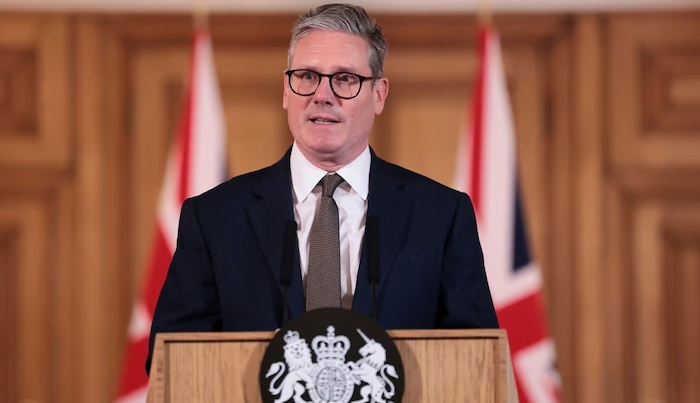
Image Credentials: Image Title: Keir Starmer Formally Resigns as UK Prime Minister, Andy Burnham Takes Office. Source: (chatgpt.com) Date: July 2026. Attribution: This image was created using AI-generated imagery (chatgpt.com) by Open Chronicle and does not depict a real-world scene.
By Open Chronicle News Desk with Agencies
Keir Starmer formally resigned as Prime Minister of the United Kingdom on Monday, bringing his two-year premiership to an official close as Andy Burnham was invited by King Charles III to form a new government.
The constitutional transition followed Burnham’s election as leader of the governing Labour Party after Starmer stepped down amid mounting political pressure and disappointing electoral performances.
🚨 BREAKING: Andy Burnham is now the UK's new Prime Minister following Keir Starmer's resignation speech.
"My work is done." pic.twitter.com/XLbhwrAjjY
— The Mercian (@TheMercianNews) July 20, 2026
Formal transfer of power at Buckingham Palace
Starmer travelled from 10 Downing Street to Buckingham Palace, where he formally tendered his resignation to King Charles III.
Following long-standing British constitutional tradition, the King accepted Starmer’s resignation before inviting Andy Burnham to form a government. Burnham accepted the invitation during the ceremonial audience known as “kissing hands,” officially becoming the United Kingdom’s new prime minister.
The peaceful transfer of power once again demonstrated the constitutional conventions that underpin Britain’s parliamentary democracy, allowing a governing party to change its leader without holding a general election.
Starmer’s premiership comes to an end
Before leaving Downing Street, Starmer reflected on his time in office, stating that his “work is done” and arguing that Britain had become stronger and fairer during his tenure.
His resignation followed weeks of intense pressure within the Labour Party after disappointing local election results and growing concerns among MPs about the party’s prospects at the next general election.
Starmer had announced his intention to resign in June, remaining as caretaker prime minister while Labour completed its leadership contest.
Andy Burnham begins a new chapter
Burnham, the former Mayor of Greater Manchester, has now become Britain’s seventh prime minister in a decade.
After formally accepting the King’s invitation, he returned to Downing Street to begin assembling his Cabinet and setting out the priorities for his new administration.
Burnham has pledged to focus on reviving economic growth, devolving more powers to local communities, improving housing, strengthening public services and addressing homelessness. He has also reaffirmed Britain’s continued support for Ukraine and its international allies.
Cabinet appointments are closely watched
Attention now turns to Burnham’s ministerial appointments, with political observers viewing his Cabinet selections as an early indication of the direction his government intends to take.
Key positions, including Chancellor of the Exchequer, are expected to play a central role as the new administration confronts sluggish economic growth, pressure on public finances and ongoing geopolitical challenges.
A pivotal moment for British politics
The leadership transition represents another significant moment in a period of political instability that has seen frequent changes at the top of the British government over the past decade.
Unlike presidential systems, the UK’s parliamentary model allows the governing party to replace its leader during a parliamentary term without automatically triggering a general election. The next nationwide election is not required until 2029 unless Burnham decides to call one earlier.
As Burnham begins his premiership, he inherits an agenda dominated by economic challenges, public service reform, international security concerns, and the task of rebuilding public confidence in government.
The coming weeks are expected to define the tone of the new administration as Britain enters another chapter in its evolving political landscape.