
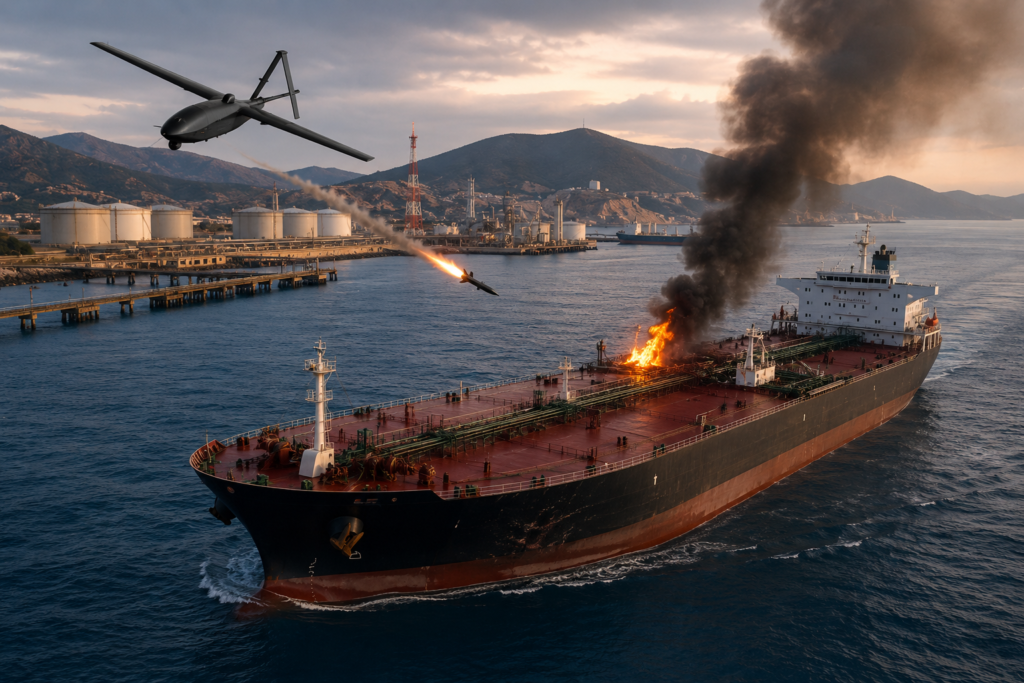
Image Credentials: Image Title: Oil Tanker Attacked by Drones Near Black Sea Export Terminal, Caspian Pipeline Consortium Says. Source: (chatgpt.com) Date: July 2026. Attribution: This image was created using AI-generated imagery (chatgpt.com) by Open Chronicle and does not depict a real-world scene.
By Open Chronicle News Desk with Agencies
A commercial oil tanker was struck by drones while approaching the Caspian Pipeline Consortium’s (CPC) export terminal on Russia’s Black Sea coast, the consortium announced, raising fresh concerns about the security of one of the region’s most important energy export routes.
The incident occurred near the CPC marine terminal close to Novorossiysk, a critical hub for transporting crude oil from Kazakhstan to international markets. Despite the attack, consortium officials said oil loading operations continued without interruption, although security measures were strengthened.
Videos of Russian Geran-3, Geran-4, and Gerbera Seeker strikes on ships and a fuel and lubricants depot. https://t.co/5nBJWI5yX3https://t.co/WTimZ1nQHHhttps://t.co/qqrq1pR2UQhttps://t.co/tg5npEyNn5 https://t.co/rl78Sij0Vu pic.twitter.com/mseTF3jCVB
— Rob Lee (@RALee85) July 20, 2026
Drone strike targets tanker
According to the Caspian Pipeline Consortium, the tanker came under attack from unmanned aerial vehicles while operating near the offshore loading facilities.
The consortium stated that emergency procedures were immediately activated and that the vessel’s crew remained safe. Initial assessments indicated that the tanker sustained damage, but no casualties or major oil spill were reported.
Authorities launched an investigation into the attack as specialists evaluated the extent of the damage.
Strategic energy infrastructure
The CPC pipeline system is one of the world’s most significant crude oil export networks, transporting oil primarily from Kazakhstan’s major fields through southern Russia to the Black Sea.
The Novorossiysk terminal handles millions of tonnes of crude annually, making it a key gateway for global energy supplies.
Any disruption to operations at the terminal has the potential to affect international oil markets, particularly given ongoing geopolitical tensions across the Black Sea region.
Operations continue despite the attack
The consortium emphasized that loading activities at the terminal continued following the incident.
Officials said the terminal’s infrastructure had not suffered significant damage and that export operations remained stable.
Additional security protocols were implemented to protect personnel, vessels, and offshore facilities while authorities monitored the surrounding maritime area.
The consortium did not indicate whether shipping schedules would be affected in the coming days.
Growing security concerns in the Black Sea
The attack highlights the increasing risks facing commercial shipping operating in the Black Sea.
Since the escalation of regional hostilities, both military and civilian vessels have encountered heightened security threats, including drone attacks, missile strikes, and naval incidents.
Energy infrastructure has increasingly become a target during the conflict, prompting operators to reinforce protective measures around pipelines, ports and export terminals.
Potential impact on global energy markets
Although exports continued after the incident, analysts noted that repeated attacks on strategic energy infrastructure could increase uncertainty in global oil markets.
The CPC pipeline is responsible for transporting a substantial share of Kazakhstan’s crude exports, making it an essential component of international energy supply chains.
Any prolonged disruption could influence oil prices, shipping insurance costs, and maritime traffic across the Black Sea.
Energy traders and governments are expected to closely monitor developments surrounding the terminal as investigations continue.
Investigation underway
The Caspian Pipeline Consortium said it is cooperating with relevant authorities to determine the circumstances of the attack and assess any additional security requirements.
No group immediately claimed responsibility for the drone strike, and officials have not publicly identified those believed to be behind the incident.
As regional tensions remain high, governments and energy companies continue to face growing challenges in safeguarding critical infrastructure against increasingly sophisticated aerial attacks.