
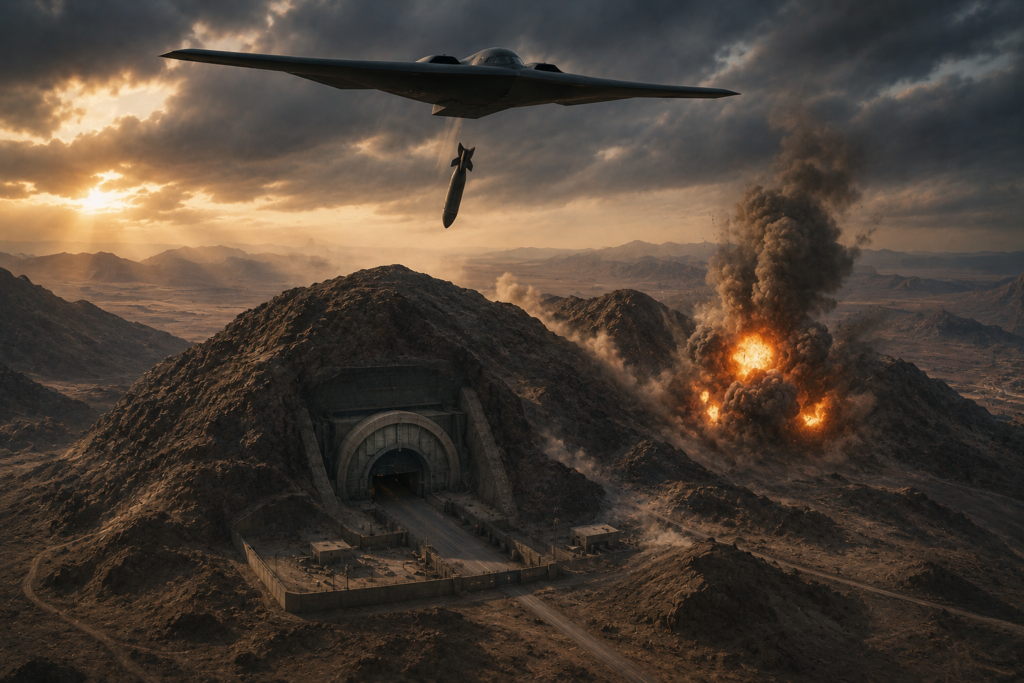
Image Credentials: Image Title: Trump Says U.S. Will Strike Iran’s Pickaxe Mountain Nuclear Site. Source: (chatgpt.com) Date: July 2026. Attribution: This image was created using AI-generated imagery (chatgpt.com) by Open Chronicle and does not depict a real-world scene.
By Open Chronicle News Desk with Agencies
U.S. President Donald Trump has said the United States intends to bomb Pickaxe Mountain, a heavily fortified underground complex near Iran’s damaged Natanz nuclear facility that American and Israeli officials suspect could become a centre of renewed nuclear activity.
Speaking at the White House during a meeting with Lebanese President Joseph Aoun, Trump indicated that an attack could take place soon and warned that any Iranian site believed to be connected to nuclear development would face a powerful military response.
The comments signalled that Washington may be preparing to intensify its campaign against Iran rather than move immediately towards a ceasefire or renewed diplomatic negotiations.
President Trump effectively announces today that the U.S. will be hitting Pickaxe Mountain in #Iran. pic.twitter.com/IZxJTSz41y
— Jason Brodsky (@JasonMBrodsky) July 21, 2026
A site buried deep beneath the mountains
Pickaxe Mountain lies near the Natanz nuclear complex, approximately 220 kilometres south of Tehran. The facility consists of deeply buried tunnel systems protected by rock and reinforced entrances.
Satellite imagery and assessments by nuclear experts suggest that construction began after a 2020 sabotage incident at Natanz. Iranian officials previously said the underground complex would be used for producing advanced centrifuges, although there remains uncertainty over its present function and whether it is already operational.
The facility is believed to extend more than 100 metres beneath the surface. Its depth has led analysts to question whether even the most powerful conventional bunker-busting weapons in the American arsenal could destroy the complex.
Trump promises a powerful attack
Trump has repeatedly warned Iran about Pickaxe Mountain in recent days. He previously said the United States would “take out” the site and told Tehran to prepare for further military action.
During his latest remarks, the president said the United States was closely monitoring the movement of nuclear materials and equipment inside Iran. He insisted that Washington would not allow Tehran to restore facilities capable of supporting a nuclear weapons programme.
Trump also suggested that Iran had not yet experienced the full force of what the United States could deploy if the confrontation continued.
Iran maintains that its nuclear programme is intended for peaceful purposes and has repeatedly denied seeking an atomic weapon.
Questions over centrifuges and underground activity
Concerns surrounding Pickaxe Mountain have increased following reports that Iran may have transferred centrifuges or other sensitive equipment into the tunnel complex.
Israeli officials reportedly believe that machinery linked to uranium enrichment may have been moved underground, although the evidence has not been independently verified. The facility’s size and extreme depth could potentially allow Iran to protect nuclear-related infrastructure from conventional air attacks.
Satellite imagery has also indicated continued construction or repair work at several Iranian nuclear locations, including Pickaxe Mountain, following earlier U.S. and Israeli strikes.
A difficult military target
Military analysts say destroying the underground complex would present a far greater challenge than striking conventional buildings above ground.
Aerial bombing could collapse entrances, damage ventilation systems and disrupt access to the tunnels. However, eliminating equipment stored deep inside the mountain might require repeated attacks or other military options.
Some experts have suggested that the facility may lie beyond the effective penetration depth of existing U.S. bunker-busting bombs. That raises the possibility that a strike could delay activity at the site without permanently destroying the underground chambers.
The uncertainty surrounding the facility’s purpose also complicates decisions over military action. While Western officials regard the site as a potential future centre for nuclear activity, publicly available evidence has not established that it currently enriches uranium.
Conflict spreads across the Middle East
Trump’s warning comes as hostilities between the United States and Iran continue to spread across the region.
Iranian attacks have targeted American interests and U.S.-allied states, while Washington has conducted further strikes against Iranian military and strategic infrastructure. Fighting has also disrupted shipping through the Strait of Hormuz, one of the world’s most important energy routes.
Efforts by Pakistan and other governments to preserve diplomatic contacts have so far failed to produce a lasting halt to the conflict. Iran has warned that an attack on additional nuclear facilities would trigger further retaliation.
The escalating confrontation has pushed oil prices higher and increased fears that the conflict could draw more countries into direct military action.
Diplomacy remains uncertain
Senior American officials have continued to describe diplomacy as an option, but Trump’s latest comments appeared to place greater emphasis on military pressure.
The president has argued that repeated strikes are necessary to prevent Iran from rebuilding its nuclear infrastructure. Critics, however, warn that attacks on deeply buried facilities could expand the war without permanently ending Iran’s nuclear capabilities.
Any strike on Pickaxe Mountain would represent one of the most consequential operations of the current conflict. It would also test whether air power can meaningfully damage one of the most heavily protected underground sites associated with Iran’s nuclear programme.
For now, the timing and precise form of any American attack remain unclear. Trump’s public warning, however, has placed Pickaxe Mountain at the centre of the latest phase of the U.S.-Iran confrontation.