
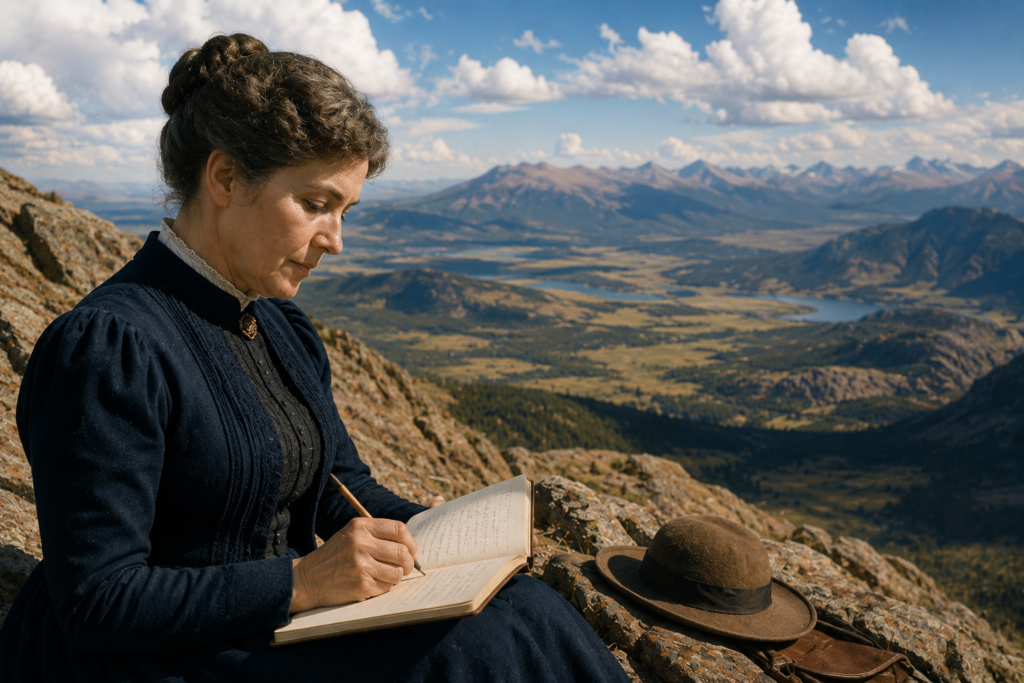
Image Credentials: Image Title: Today in History, July 22: Katharine Lee Bates Writes the Poem That Becomes America the Beautiful. Source: (chatgpt.com) Date: July 2026. Attribution: This image was created using AI-generated imagery (chatgpt.com) by Open Chronicle and does not depict a real-world scene.
By Open Chronicle
22 July 1893
On 22 July 1893, American writer and professor Katharine Lee Bates was inspired to compose the poem that would later become “America the Beautiful,” one of the most beloved patriotic songs in the United States. Written after a journey across the American West, the poem celebrated the country’s natural beauty, democratic ideals and hopes for national unity, eventually becoming an enduring symbol of American identity.
In the summer of 1893, Bates, an English professor at Wellesley College in Massachusetts, travelled west to teach at Colorado College. During her stay, she joined a group of fellow educators on an excursion to the summit of Pikes Peak, a mountain rising more than 4,300 metres (14,000 feet) above sea level in Colorado.
Reaching the summit was no easy task. Part of the journey was completed by prairie wagon before the final ascent on muleback. The demanding climb rewarded visitors with sweeping views of the Rocky Mountains, the Great Plains and seemingly endless landscapes stretching toward the horizon.
Bates later recalled being deeply moved by the panoramic scenery. The vast plains, distant mountains and open skies inspired reflections not only on the country’s remarkable geography but also on its promise as a nation. She reportedly began writing lines of the poem shortly after descending from the mountain, drawing upon the emotions stirred by the experience.
The opening verse famously begins:
“O beautiful for spacious skies,
For amber waves of grain…”
These words evoke the wide-open landscapes of the American continent while expressing admiration for both its natural beauty and agricultural abundance. Unlike many patriotic works of the period, Bates’s poem combined praise of the country’s physical landscape with moral aspirations for justice, liberty and civic responsibility.
Rather than celebrating military victories or political power, the poem calls upon Americans to pursue higher ideals. Bates repeatedly asks that God “shed His grace” upon the nation and encourage citizens to value brotherhood, generosity and integrity. These themes gave the work a distinctive tone that appealed across generations.
The poem was first published in the church newspaper The Congregationalist on 4 July 1895, coinciding with Independence Day celebrations. It quickly attracted attention and was reprinted widely throughout the United States.
Bates later revised the poem several times, producing updated versions in 1904 and 1913. The final version reflected her evolving vision of America’s democratic ideals while preserving the imagery that had originally inspired her on Pikes Peak.
The words were eventually paired with a melody composed by church organist and composer Samuel A. Ward. Ward had written the tune, known as “Materna,” in 1882, several years before Bates composed her poem. The combination of Bates’s lyrics and Ward’s music proved remarkably successful, creating one of the best-known patriotic songs in American history.
Throughout the twentieth century, America the Beautiful became a familiar feature of national celebrations, school ceremonies, sporting events and public commemorations. Many Americans came to regard it as an unofficial national hymn, and on several occasions lawmakers proposed replacing “The Star-Spangled Banner” with Bates’s composition as the official national anthem. Although those proposals were never adopted, the song remains one of the country’s most cherished patriotic works.
Katharine Lee Bates continued a distinguished career as an educator, poet and social reformer. Beyond America the Beautiful, she wrote numerous books, essays and poems while advocating for education, social justice and international peace. Nevertheless, the poem inspired by her journey to Pikes Peak remains her most enduring legacy.
Today, America the Beautiful continues to be performed across the United States during national holidays, presidential inaugurations and moments of public remembrance. Its enduring popularity reflects the universal themes that Bates expressed in 1893: admiration for the nation’s landscapes, hope for its future and the belief that true greatness depends not only on natural beauty but also on the character and ideals of its people.