
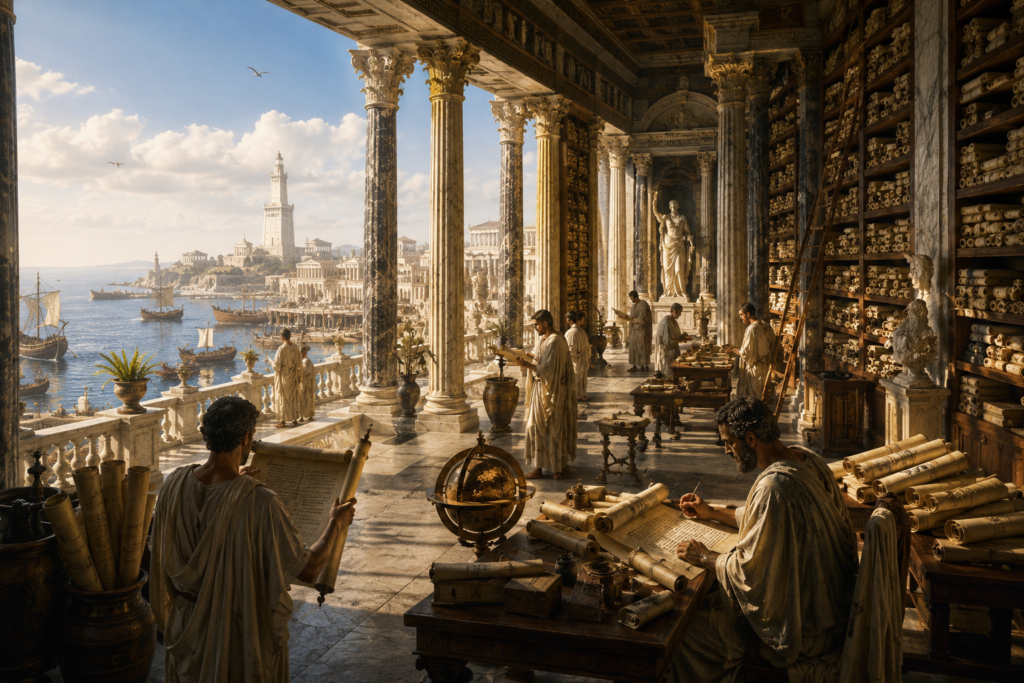
Image Credentials: Image Title: What If the Library of Alexandria Had Never Been Lost?. Source: (chatgpt.com) Date: July 2026. Attribution: This image was created using AI-generated imagery (chatgpt.com) by Open Chronicle and does not depict a real-world scene.
By Open Chronicle
For more than two thousand years, the Library of Alexandria has captured the imagination like few places in history.
It has become a symbol of lost knowledge, a monument to human curiosity and, perhaps more than anything else, a reminder of how fragile civilization can be.
Many people imagine a single catastrophic fire reducing hundreds of thousands of scrolls to ashes overnight. The reality, however, is more complicated. Historians believe the library declined over centuries, suffering repeated damage during wars, political upheaval and changing imperial priorities before eventually disappearing altogether.
But one question continues to fascinate historians and scientists alike.
What if the Library of Alexandria had survived?
Could the course of human history have been dramatically different?
The World’s Greatest Knowledge Centre
Founded during the reign of Ptolemy I in the early third century BC, the Library of Alexandria was far more than a building filled with books.
It formed part of the Mouseion, an institution dedicated to scholarship, research and intellectual exchange. Scholars from across the Mediterranean gathered there to study mathematics, astronomy, medicine, geography, philosophy and literature.
Ancient sources suggest the library may have housed hundreds of thousands of scrolls, although modern historians debate the exact number.
Its ambition was extraordinary.
The Ptolemaic rulers sought to collect every significant written work they could obtain. Ships entering Alexandria were reportedly searched for manuscripts, which were copied before the originals were sometimes retained for the royal collection.
Never before had so much knowledge been assembled in one place.
More Than a Library
The Library of Alexandria functioned much like a modern research university.
Its scholars translated foreign texts, debated scientific theories, conducted observations and produced original research.
Among those associated with Alexandria were Euclid, whose Elements became one of history’s most influential mathematical works, Eratosthenes, who calculated the Earth’s circumference with remarkable accuracy, and Herophilus, whose anatomical studies transformed ancient medicine.
Knowledge was not simply preserved.
It was actively expanded.
The Myth of One Great Fire
Popular culture often portrays Julius Caesar’s campaign in Alexandria in 48 BC as the moment when the library vanished forever.
The historical evidence is less certain.
While some ancient writers describe fires during Caesar’s campaign that damaged parts of the city, there is little evidence that the entire library disappeared at that moment.
Instead, historians believe the institution gradually declined over several centuries. Political instability, economic difficulties, religious conflict and reduced royal patronage all contributed to its eventual disappearance.
In many ways, the loss of Alexandria was not a single tragedy.
It was a long process of neglect.
Could Science Have Advanced Earlier?
This is where history becomes speculation.
If the Library of Alexandria had continued operating for centuries, it might have preserved countless works that are now lost forever.
Only a fraction of ancient Greek literature survives today.
Many scientific treatises, philosophical works, historical accounts and engineering manuals disappeared completely.
A continuously functioning centre of scholarship could have accelerated scientific development by preserving ideas, encouraging collaboration and transmitting discoveries across generations.
Fields such as astronomy, engineering, medicine and mathematics might have developed more rapidly.
The transition between the classical world and the medieval period may also have looked very different.
Would There Have Been an Earlier Scientific Revolution?
Probably not.
This is one of the most common misconceptions surrounding Alexandria.
Scientific progress depends on far more than access to books.
Technological innovation also requires stable political institutions, economic investment, widespread literacy, manufacturing capabilities and practical experimentation.
Even if every scroll had survived, many inventions would still have required centuries of technological development before becoming possible.
Steam power, for example, was understood in principle during antiquity through Hero of Alexandria’s aeolipile, but ancient societies lacked the industrial economy necessary to transform that curiosity into practical machinery.
Knowledge alone rarely changes history.
The surrounding society must be ready to apply it.
A Bridge Between Civilizations
Perhaps the library’s greatest potential lay in its ability to connect cultures.
Alexandria stood at the crossroads of Africa, Europe and Asia.
Greek, Egyptian, Persian, Jewish and later Roman traditions all intersected within the city.
Had the institution endured, it might have continued serving as one of the world’s great centres for preserving and exchanging knowledge across civilizations.
Instead of knowledge being repeatedly fragmented by political upheaval, scholars from different cultures might have collaborated more continuously over many centuries.
What Humanity Truly Lost
The greatest loss may not have been specific books.
It was continuity.
Throughout history, civilizations have repeatedly rediscovered ideas that earlier cultures already understood.
Mathematical methods, astronomical observations, engineering principles and philosophical debates often had to be reconstructed because earlier records had disappeared.
A surviving Library of Alexandria might have provided an uninterrupted chain of scholarship stretching from classical antiquity into the modern world.
That continuity could have saved generations of scholars from rebuilding knowledge that had already existed.
A Symbol That Still Matters
Whether or not the Library of Alexandria could have changed the course of history, its legacy remains powerful.
It represents humanity’s determination to collect, preserve and share knowledge across borders and generations.
Modern libraries, universities, museums and digital archives all continue the mission that Alexandria began more than two thousand years ago.
The lesson is not simply that knowledge can be destroyed.
It is that preserving knowledge requires constant effort.
Civilizations are remembered not only for the monuments they build or the wars they fight, but also for the ideas they choose to protect.
The Library of Alexandria may no longer stand on the Mediterranean coast, but its greatest legacy survives wherever people believe that understanding the past is essential to shaping the future.
References
- Canfora, L. The Vanished Library: A Wonder of the Ancient World.
- Casson, L. Libraries in the Ancient World.
- El-Abbadi, M. The Life and Fate of the Ancient Library of Alexandria.
- MacLeod, R. (Ed.). The Library of Alexandria: Centre of Learning in the Ancient World.
- Barnes, R. Mysticism and the Library of Alexandria.
- Mostafa El-Abbadi. “The Library of Alexandria and the Daughter Library in the Serapeum.”
- Britannica, Library of Alexandria.
- UNESCO, Bibliotheca Alexandrina.