
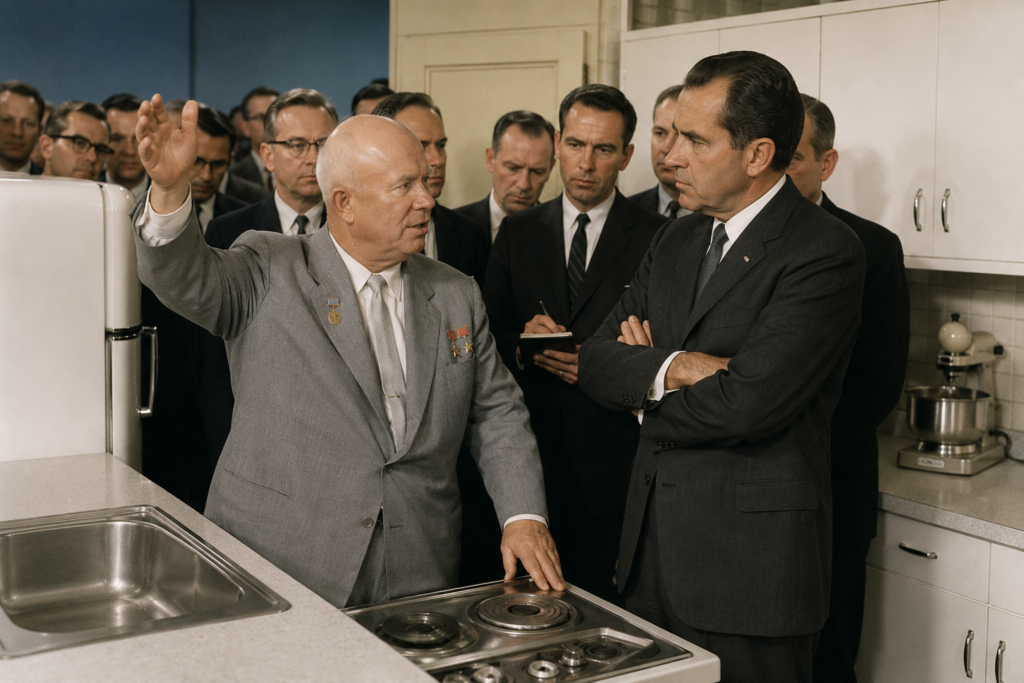
Image Credentials: Image Title: Today in History, July 24: Nikita Khrushchev and Richard Nixon Hold the Famous Kitchen Debate in Moscow. Source: (chatgpt.com) Date: July 2026. Attribution: This image was created using AI-generated imagery (chatgpt.com) by Open Chronicle and does not depict a real-world scene.
By Open Chronicle
24 July 1959
On 24 July 1959, Soviet Premier Nikita Khrushchev and United States Vice President Richard Nixon engaged in an unscripted public exchange that became known as the Kitchen Debate, one of the most memorable confrontations of the Cold War. Held inside a model American suburban home at the American National Exhibition in Moscow, the debate symbolised the ideological rivalry between capitalism and communism at a time when the two superpowers competed not only in military strength but also in economics, technology and standards of living.
The debate took place during a brief period of easing tensions between the United States and the Soviet Union. Following the death of Joseph Stalin in 1953, Khrushchev had introduced a policy of limited reform and sought greater engagement with the West, even as the Cold War remained deeply entrenched. Cultural exchanges between the two nations became an important part of this strategy, allowing each country to showcase its achievements to the other.
The American National Exhibition, which opened in Moscow in July 1959, was organised to present everyday American life to Soviet citizens. Visitors explored displays featuring household appliances, automobiles, consumer products, colour televisions and examples of suburban homes. Rather than focusing on military or industrial power, the exhibition highlighted the comforts available to ordinary American families.
One of the exhibition’s centrepieces was a fully furnished model house equipped with the latest household technology. It was inside this kitchen that Nixon and Khrushchev unexpectedly began discussing the merits of their respective political and economic systems.
Standing beside modern appliances, Nixon argued that the strength of the United States lay in its ability to provide consumer goods, personal freedom, and rising living standards for ordinary citizens. He suggested that technological innovation should improve daily life rather than simply demonstrate national power.
Khrushchev responded by defending the Soviet economic model, insisting that socialism would eventually surpass capitalism in both production and scientific achievement. He argued that the Soviet Union was rapidly closing the technological gap with the United States and dismissed the emphasis on consumer appliances as superficial when compared with broader social progress.
As the discussion continued, both men interrupted one another repeatedly while journalists and television cameras recorded the exchange. They debated housing, economic systems, freedom of expression, technological competition and the future of global politics. Although neither side persuaded the other, the conversation remained largely civil despite moments of visible frustration.
The debate attracted worldwide attention because it offered an unusually confrontational exchange between senior leaders of the rival superpowers. Instead of formal diplomatic speeches, audiences witnessed an energetic exchange in which each participant defended his nation’s political system before an international audience.
Television played a crucial role in amplifying the event. The debate was broadcast in both countries, although each government presented edited versions that emphasised the strengths of its own representative. Nevertheless, many viewers appreciated the rare opportunity to see leaders from opposing ideological camps speaking openly rather than through official statements.
The Kitchen Debate also reflected the changing nature of Cold War competition. By the late 1950s, the rivalry between the United States and the Soviet Union increasingly extended beyond military power and nuclear weapons to include consumer prosperity, technological innovation, education, scientific research and quality of life. The discussion over refrigerators, washing machines and modern kitchens became a symbolic argument about which political system could best serve its people.
Only two months after the debate, Khrushchev travelled to the United States for a historic state visit, becoming the first Soviet leader to do so. Although relations remained tense, these exchanges demonstrated that dialogue between the superpowers remained possible despite profound ideological differences.
Richard Nixon would later become President of the United States in 1969, while Khrushchev remained Soviet leader until his removal from office in 1964. Their encounter in Moscow endured as one of the defining public moments of both political careers.
Today, the Kitchen Debate is remembered as one of the most iconic episodes of the Cold War. It illustrated how the ideological contest between East and West extended into everyday life, with kitchens, household appliances and consumer products becoming unexpected symbols of global political competition. More than six decades later, the debate continues to represent an era when diplomacy, propaganda and public opinion were as significant as military strength in shaping international relations.