
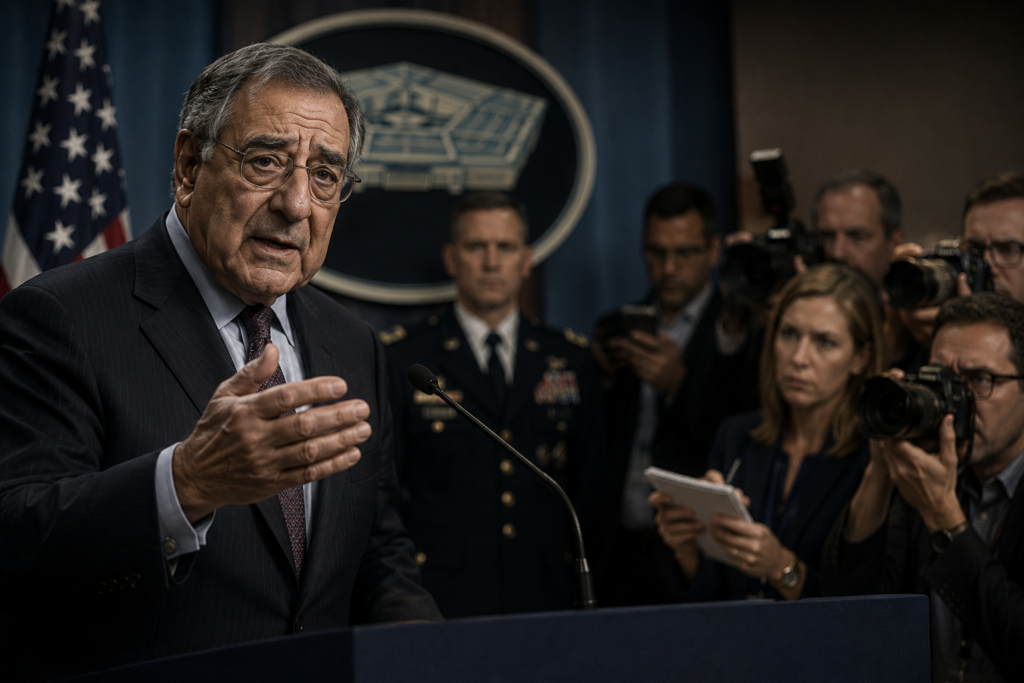
Image Credentials: Image Title: New Mossad Chief Meets CIA Director in Washington for High-Level Iran Talks. Source: (chatgpt.com) Date: July 2026. Attribution: This image was created using AI-generated imagery (chatgpt.com) by Open Chronicle and does not depict a real-world scene.
By Open Chronicle News Desk with Agencies
Former CIA Director and US Defense Secretary Leon Panetta has sharply criticized the Trump administration over what he described as a deliberate effort to limit public access to information about the ongoing conflict with Iran, arguing that attempts to restrict transparency will ultimately fail.
In an interview with The Guardian, Panetta accused Pentagon officials of withholding information from both the American public and the media, warning that excessive secrecy undermines democratic accountability during wartime.
Panetta accuses Pentagon of withholding information
Panetta said the Department of Defense had adopted an unusually restrictive approach to public communication during the current conflict.
“There’s a deliberate effort here to withhold information from the American people basically,” he said.
“And I think it represents in many ways a shameful approach to sharing the responsibility that we all have when it comes to fighting a war.”
According to The Guardian, the Pentagon has not held a formal press briefing in approximately two and a half months despite continued US military operations in the Middle East.
Contrast with previous wars
Panetta compared the current communications strategy to his tenure as US Defense Secretary during the wars in Afghanistan and Iraq.
He noted that regular weekly Pentagon briefings were held during those conflicts, providing journalists with opportunities to question military leaders and receive updates on ongoing operations.
In his view, maintaining regular communication with the public is an essential part of democratic oversight during times of war.
“Trying to tiptoe past the graveyard”
Panetta argued that the Pentagon appears to believe that limiting public statements will reduce political controversy surrounding military operations.
“They’re trying to tiptoe past the graveyard,” he said.
“They’re hoping that the less they say, the less controversy they’ll be involved in.”
However, he suggested that such a strategy is unlikely to succeed, arguing that reduced official communication typically encourages journalists to pursue information more aggressively through independent reporting.
Media access restrictions
The criticism comes amid reports that the Pentagon has tightened access rules for journalists covering the Department of Defense.
According to The Guardian, new measures require reporters to be escorted while on Pentagon grounds, while some journalists have reportedly had their credentials revoked or restricted.
Press freedom advocates have expressed concern that such measures could make independent reporting on defense and national security matters more difficult.
The Pentagon has said changes to access procedures are intended to strengthen security and protect sensitive information.
“The truth comes out”
Despite his criticism, Panetta expressed confidence that investigative journalism would continue to uncover developments surrounding US military operations.
“In essence, what they’re doing is challenging the press to find what’s really happening, and they will,” he said.
“They can dodge, bob and weave, they can hide it, but my experience is that no matter how much you try to hide it, in the end, the truth comes out.”
His remarks reflect a long-standing debate in the United States over balancing operational security with the public’s right to know about military actions conducted in its name.
Transparency during wartime
Questions surrounding government transparency often become more prominent during periods of armed conflict, when military authorities must weigh the protection of operational information against demands for public accountability.
Successive US administrations have faced criticism from journalists, lawmakers and civil liberties organizations over access to information during overseas military campaigns.
Supporters of greater transparency argue that regular briefings help maintain public trust and democratic oversight, while defense officials frequently contend that operational security sometimes requires limiting the release of sensitive information.
As the conflict involving Iran continues, the relationship between the Pentagon and the press is likely to remain under close scrutiny, particularly if military operations expand or result in significant casualties or strategic developments.