
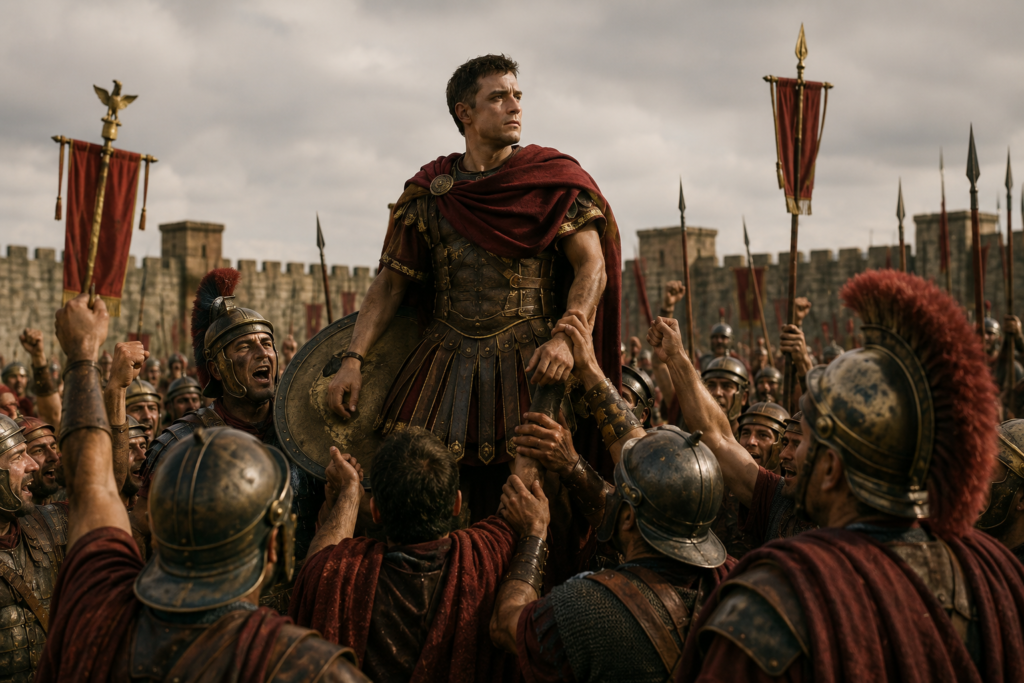
Image Credentials: Image Title: Constantine the Great Is Proclaimed Roman Emperor by His Troops at York. Source: (chatgpt.com) Date: July 2026. Attribution: This image was created using AI-generated imagery (chatgpt.com) by Open Chronicle and does not depict a real-world scene.
By Open Chronicle
25 July 306
On 25 July 306, Constantine the Great was proclaimed Roman emperor by his troops at Eboracum, modern-day York in northern England, following the death of his father, Emperor Constantius I Chlorus. This decisive moment marked the beginning of Constantine’s rise to power and ultimately transformed the Roman Empire through sweeping political, military and religious reforms that reshaped European history.
At the beginning of the fourth century, the Roman Empire was governed under the Tetrarchy, a system introduced by Emperor Diocletian in 293 to improve imperial administration and military defence. Instead of a single ruler, the empire was divided among two senior emperors, known as Augusti, and two junior emperors, or Caesars. Although intended to provide stability, the arrangement created rivalries and uncertainty over succession.
Constantius I served as one of the Western Augusti and was responsible for governing Britain, Gaul and parts of Hispania. His son, Constantine, had spent much of his early life at the imperial court in the East, where he gained military experience and observed the complexities of imperial politics. Despite his abilities, Constantine had not been formally designated as his father’s successor within the Tetrarchic system.
In the summer of 306, Constantius campaigned in northern Britain against the Picts beyond Hadrian’s Wall. After completing the expedition, he returned to Eboracum but soon fell seriously ill.
On 25 July 306, Constantius died in York. Immediately afterward, the assembled Roman legions proclaimed Constantine as the new emperor. According to ancient sources, the soldiers raised him upon a shield in the traditional military fashion and hailed him as Augustus.
The proclamation challenged the carefully designed succession established by Diocletian. In theory, the next Western emperor should have been Severus, another senior member of the imperial administration. However, Constantine’s popularity among the army and his close association with his father made opposition difficult.
Rather than provoking immediate civil war, the senior Eastern emperor Galerius reluctantly recognised Constantine, although only with the lower title of Caesar rather than Augustus. Constantine accepted the compromise temporarily while gradually consolidating his authority in the western provinces.
During the following years, the Roman Empire became engulfed in a series of civil wars as several claimants competed for imperial power. Constantine steadily expanded his influence through military victories and political alliances.
His most famous triumph came in 312, when he defeated his rival Maxentius at the Battle of the Milvian Bridge outside Rome. Ancient historians later connected this victory with Constantine’s reported vision of the Christian symbol known as the Chi-Rho and the words often translated as “In this sign, conquer.”
The following year, Constantine and his co-emperor Licinius issued the Edict of Milan, granting religious toleration throughout the empire and ending the official persecution of Christians. Although Christianity had previously existed as a minority religion, Constantine’s policies dramatically accelerated its growth and influence.
By 324, Constantine had defeated Licinius and reunited the Roman Empire under a single ruler for the first time in decades. He introduced major administrative reforms, reorganised the army, strengthened the imperial government and established a new eastern capital at Constantinople, dedicated in 330 on the site of the ancient city of Byzantium.
Constantine’s reign profoundly influenced the development of both the Roman Empire and European civilisation. His support for Christianity culminated in the First Council of Nicaea in 325, which sought to resolve theological disputes and establish greater unity within the Church. Although he was baptised only shortly before his death in 337, later Christian tradition honoured him as a pivotal figure in the faith’s expansion.
The events in York on 25 July 306 therefore marked far more than a military succession. They began the career of one of history’s most consequential emperors, whose decisions shaped the political, religious and cultural landscape of Europe and the Mediterranean for centuries.
Today, Constantine’s proclamation at York remains one of the defining moments of Late Antiquity. The city proudly commemorates its connection with the emperor, whose rise to power transformed both the Roman Empire and the course of Western history.