
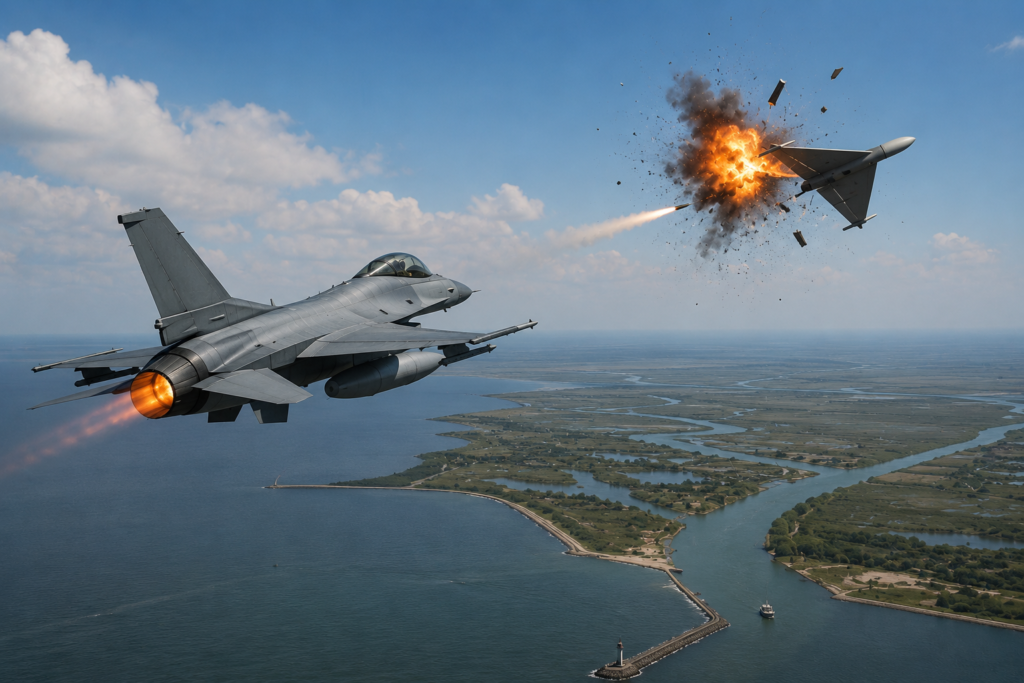
Image Credentials: Image Title: Romanian F-16 Shoots Down Third Drone in Three Days Over Black Sea. Source: (chatgpt.com) Date: July 2026. Attribution: This image was created using AI-generated imagery (chatgpt.com) by Open Chronicle and does not depict a real-world scene.
By Open Chronicle News Desk with Agencies
A Romanian Air Force F-16 fighter jet has shot down an unauthorized drone over the Black Sea, marking the third such interception by Romania in three consecutive days and intensifying concerns about repeated airspace violations along NATO’s eastern flank.
Romania’s Ministry of National Defence said the unmanned aerial vehicle was intercepted and destroyed approximately 12 kilometres northeast of the port city of Sulina, over Romanian territorial waters. Officials said the operation was conducted safely and did not endanger civilians or maritime traffic.
The latest incident comes amid intensified Russian attacks on Ukrainian infrastructure near the Danube Delta and the Black Sea coast, where drones have repeatedly approached or crossed Romanian territory.
🇷🇴 This morning, a Romanian F-16 fighter jet shot down the third drone in the last few days, according to President Dan. https://t.co/6W1Cdo9nfa
— Vijesti (@Vijesti11111) July 26, 2026
Drone intercepted over Romanian territorial waters
According to the Romanian Defence Ministry, the drone entered national airspace without authorization before being identified and engaged by an F-16 assigned to air-policing duties.
The aircraft was brought down over the Black Sea in the Sulina-Chilia area, away from populated communities. Romanian authorities are expected to recover and examine the wreckage to determine the drone’s precise type, origin and intended target.
Romanian President Nicușor Dan said the drone was destroyed at approximately 10:13 a.m. local time and described the operation as a necessary response to the continuing violations of the country’s sovereignty.
Third shootdown in as many days
The latest interception followed two similar incidents on Friday and Saturday.
On Friday, a Romanian F-16 shot down a drone after it entered the country’s airspace, representing the first time Romania had destroyed an intruding drone following dozens of previous violations linked to the war in neighbouring Ukraine. Investigators later identified the wreckage as Russian.
A second drone was destroyed on Saturday approximately 10 kilometres west of Sfântu Gheorghe in the Danube Delta. Two F-16 fighters were scrambled after the object appeared on radar, and the drone was shot down several minutes later.
Sunday’s incident therefore became the third successful interception in three days, reflecting a more assertive Romanian response to unauthorized aircraft entering its national airspace.
Romanian president condemns repeated breaches
President Dan described the incursions as “inadmissible and intolerable,” stressing that they represented violations not only of Romanian sovereignty but also of NATO and European Union airspace.
Romania’s Foreign Ministry summoned the Russian ambassador in Bucharest following the latest incidents, while senior officials warned that repeated drone incursions created an unacceptable danger to civilians, military personnel and commercial activity near the Black Sea and Danube Delta.
Prime Minister Ilie Bolojan also condemned the violations, while Defence Minister Radu Miruță said Romania would continue protecting its airspace and territorial integrity.
Drone believed to be linked to Russian operations
Romanian and allied authorities believe the series of incursions is connected to Russian drone attacks against Ukrainian ports and logistics infrastructure near Romania’s border.
The drones are suspected to be variants of the Iranian-designed Shahed system used extensively by Russia against Ukraine. However, officials said investigations into the two most recent incidents were still underway, and the exact origin of each aircraft had not yet been formally confirmed.
Romania shares a long border with Ukraine and lies directly across the Danube from Ukrainian port facilities that have repeatedly been targeted by Russian forces.
NATO eastern flank under growing pressure
The incidents have renewed concerns about the vulnerability of NATO airspace to drones operating close to the alliance’s borders.
Since Russia launched its full-scale invasion of Ukraine, Romanian authorities have recorded more than 30 drone incursions into national airspace. Until July 2026, Romania generally scrambled fighter aircraft to track the objects but avoided direct engagement unless there was an immediate danger to civilians or infrastructure.
Recent legislative and operational changes have given Romanian pilots greater authority to engage unauthorized drones when necessary.
NATO is examining the latest incidents and coordinating with Romania and other eastern member states to reinforce air-defence coverage, radar surveillance and counter-drone capabilities.
Security risks near the Danube Delta
The Danube Delta and the waters surrounding Sulina have become increasingly sensitive security areas because of their proximity to the Ukrainian border and strategic Black Sea shipping routes.
Russian attacks on Ukrainian ports such as Izmail and Reni have repeatedly sent drones close to Romanian territory. Fragments from earlier attacks have been recovered inside Romania, while residents in the border counties of Tulcea, Galați and Brăila have periodically received emergency warnings.
In May, a Russian-made drone struck a residential building in Galați, injuring civilians and increasing pressure on the government to adopt a more forceful interception policy.
Romania signals tougher air-defence posture
The destruction of three drones in three days represents a significant shift in Romania’s response to airspace violations.
Bucharest now appears prepared to engage unauthorized aircraft more rapidly, particularly when they approach inhabited areas, territorial waters or critical infrastructure.
Romanian officials insist that the measures are defensive and intended solely to protect the country’s population, territory and NATO commitments.
However, the repeated incidents also demonstrate how the war in Ukraine continues to create direct security risks for neighbouring alliance members, increasing the possibility of accidents, escalation or further confrontations along NATO’s eastern frontier.