
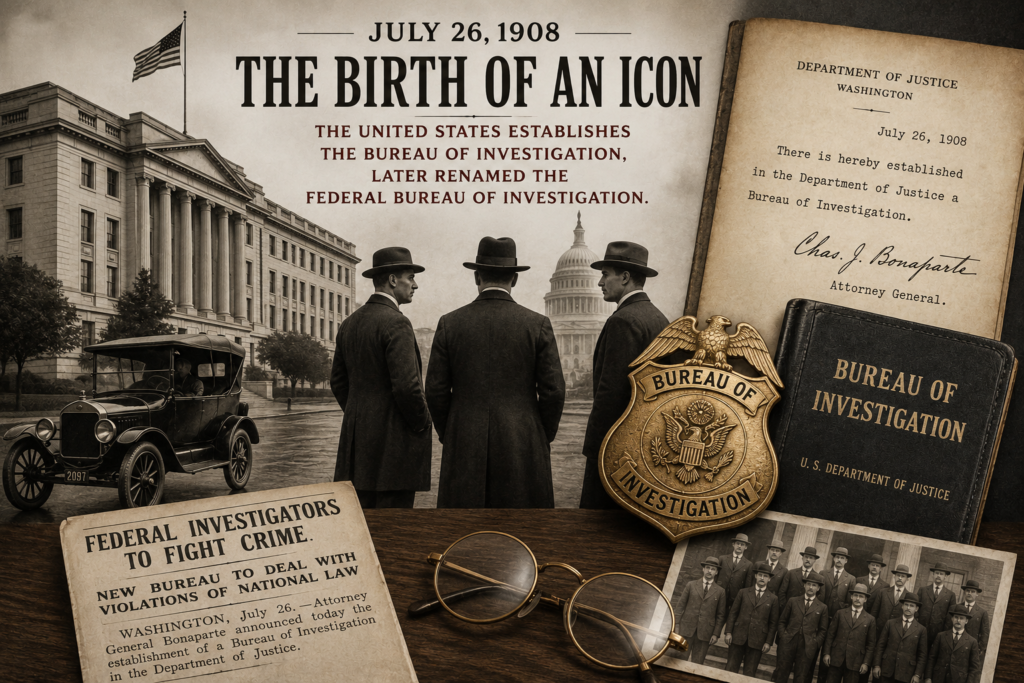
Image Credentials: Image Title: The Birth of the Bureau of Investigation That Became the FBI. Source: (chatgpt.com) Date: July 2026. Attribution: This image was created using AI-generated imagery (chatgpt.com) by Open Chronicle and does not depict a real-world scene.
By Open Chronicle History Desk
July 26, 1908
On July 26, 1908, the United States government quietly created a new federal law enforcement agency that would eventually become one of the world’s most recognizable investigative organizations. Known at the time as the Bureau of Investigation (BOI), the agency was established under the leadership of Attorney General Charles Joseph Bonaparte, laying the foundation for what would later become the Federal Bureau of Investigation (FBI).
The creation of the Bureau reflected the growing challenges facing the United States at the beginning of the twentieth century. Rapid industrialization, westward expansion, interstate commerce, and the emergence of organized criminal networks exposed the limitations of local law enforcement. Crimes increasingly crossed state lines, making it difficult for individual police departments to investigate cases that extended beyond their jurisdictions.
Until 1908, the Department of Justice relied heavily on investigators borrowed from the United States Secret Service. Concerned about maintaining greater independence and accountability, Attorney General Bonaparte authorized the formation of a dedicated team of federal investigators. Initially composed of just a few dozen special agents, the Bureau’s primary mission was to investigate violations of federal law and assist federal prosecutors.
The Bureau’s responsibilities expanded steadily over the following decades. It investigated land fraud, banking crimes, antitrust violations and other federal offences at a time when the federal government’s role in law enforcement was rapidly increasing. The agency also developed more structured investigative techniques, helping to professionalize criminal investigations across the country.
A major transformation came in 1935, when the Bureau of Investigation was officially renamed the Federal Bureau of Investigation. Under the leadership of J. Edgar Hoover, who served as director for nearly five decades, the FBI evolved into a highly centralized national investigative agency. Hoover introduced standardized training, expanded forensic science, created one of the world’s largest fingerprint databases, and established the FBI Laboratory, which became a model for modern forensic investigation.
During the twentieth century, the FBI played central roles in some of the most significant criminal investigations in American history. The agency pursued notorious gangsters during the Prohibition era, investigated espionage during World War II and the Cold War, and later expanded its work into organized crime, public corruption, terrorism, cybercrime and counterintelligence.
The Bureau’s history has also been marked by controversy. Historians have documented periods in which the agency conducted extensive surveillance of political activists, civil rights leaders and anti-war organizations. Programs such as COINTELPRO remain the subject of ongoing historical debate, raising important questions about the balance between national security and civil liberties.
Following the terrorist attacks of September 11, 2001, the FBI underwent another significant transformation. Counterterrorism and intelligence gathering became central priorities, while the agency also strengthened its capabilities in cybersecurity and the investigation of transnational criminal organizations.
More than a century after its founding, the FBI remains the principal federal investigative agency of the United States. Its origins in the small Bureau of Investigation created in 1908 illustrate how a modest government office evolved into one of the most influential law enforcement institutions in the world.
The establishment of the Bureau of Investigation marked a turning point in American legal history, reflecting the federal government’s growing responsibility for combating crime that extended beyond local and state borders. What began with a handful of investigators would ultimately shape the future of criminal justice, forensic science, and national security for generations.