
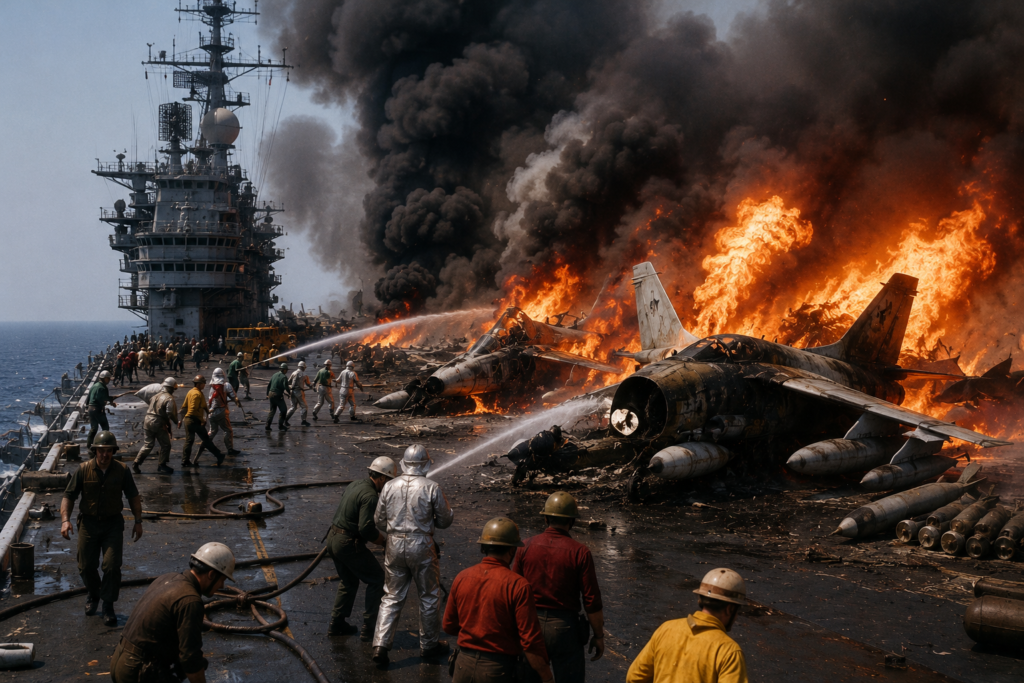
Image Credits: Today in History, July 29: Fire Aboard USS Forrestal Kills 134 Sailors in One of the U.S. Navy’s Worst Peacetime Disasters. AI-generated illustration created by Open Chronicle using ChatGPT (OpenAI). July 2026. This image is illustrative and does not depict a real-world scene.
By Open Chronicle
29 July 1967
On 29 July 1967, a catastrophic fire erupted aboard the American aircraft carrier USS Forrestal while it was operating in the Gulf of Tonkin during the Vietnam War. The disaster claimed the lives of 134 sailors, injured 161 others, and destroyed or severely damaged dozens of aircraft, making it one of the deadliest accidents in the history of the United States Navy.
Commissioned in 1955, USS Forrestal was the lead ship of a new class of supercarriers designed to operate large numbers of high-performance jet aircraft. By the summer of 1967, the carrier was participating in combat operations against North Vietnam, launching frequent air strikes from the waters off the Vietnamese coast.
On the morning of 29 July, the flight deck was crowded with armed aircraft preparing for another series of missions. Pilots and deck crews carried out routine pre-flight procedures while fuel lines, bombs and rockets were positioned for the day’s operations.
At approximately 10:50 a.m., tragedy struck when an unintentionally fired Zuni rocket shot across the flight deck. The rocket struck an A-4E Skyhawk attack aircraft piloted by Lieutenant Commander John McCain, who would later become a U.S. senator and the Republican presidential nominee in 2008.
The impact ruptured the aircraft’s external fuel tank, releasing thousands of litres of jet fuel across the flight deck. McCain escaped from his aircraft moments before flames rapidly spread among nearby planes.
Within seconds, intense fires engulfed multiple aircraft carrying fully armed bombs and rockets. The extreme heat quickly exceeded the limits of the ordnance. Approximately ninety seconds after the initial fire began, one of the ageing 1,000-pound bombs detonated unexpectedly.
The explosion tore a massive hole through the armoured flight deck, instantly killing many firefighters and flight deck personnel who had rushed toward the blaze. Burning fuel cascaded into lower compartments, igniting additional fires throughout the ship.
As further bombs exploded over the next several minutes, the situation became increasingly desperate. Thick smoke filled internal spaces while fragments of aircraft and munitions were thrown across the carrier. Damage-control teams continued fighting the fire despite repeated explosions and intense heat.
The crew’s determination proved decisive. Sailors formed firefighting teams, flooded burning areas with foam, rescued trapped personnel and jettisoned live ammunition whenever possible. Many continued working despite severe injuries, preventing the disaster from becoming even more catastrophic.
The fire burned for hours before it was finally brought under control. In total, 134 crew members lost their lives, while 161 others were injured. More than 20 aircraft were destroyed, including A-4 Skyhawks, F-4 Phantom IIs and other carrier-based aircraft, causing damage valued at approximately 72 million U.S. dollars at the time.
The disaster had a profound impact on the U.S. Navy. A comprehensive investigation identified several contributing factors, including the accidental rocket launch, the instability of older bomb designs exposed to intense heat and shortcomings in firefighting procedures and training.
As a direct consequence, the Navy introduced sweeping improvements to carrier safety. New damage-control training programmes were established, firefighting equipment was upgraded, improved fire-resistant clothing was issued and more stable modern munitions gradually replaced older ordnance. The famous Advanced Damage Control School incorporated many lessons learned from the Forrestal tragedy.
Despite the extensive damage, USS Forrestal was repaired and returned to active service in 1968. The carrier continued serving for more than two decades before being decommissioned in 1993.
The heroism displayed by the crew remains one of the defining aspects of the disaster. Numerous sailors received military decorations for extraordinary courage while attempting to rescue shipmates and contain the fire under conditions of extreme danger.
Today, the USS Forrestal fire is remembered as a turning point in modern naval safety. The lessons learned from the tragedy fundamentally changed firefighting procedures aboard aircraft carriers around the world, improving the survivability of future crews. The sacrifice of the 134 sailors who lost their lives continues to be honoured as a lasting reminder of the risks faced by those serving at sea, even outside direct combat.