
Image: from WAR X @warsurv
By Open Chronicle News Desk with Agencies
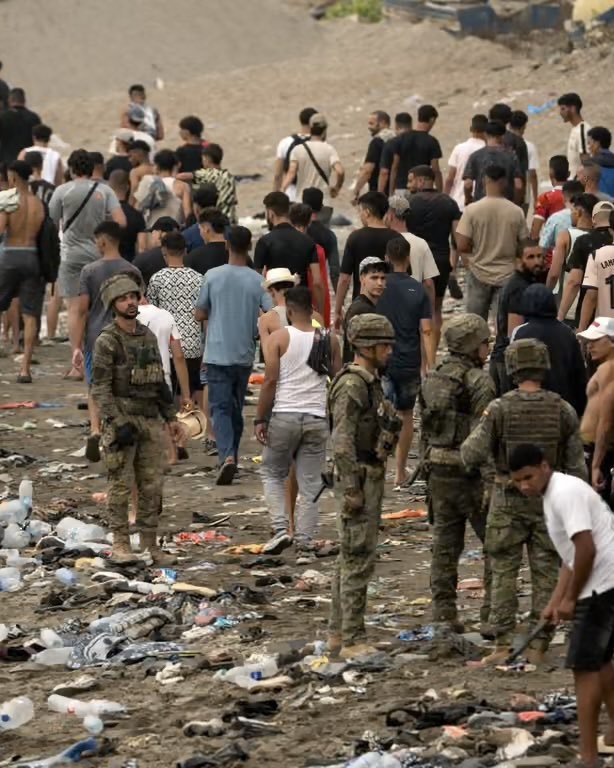
Spanish authorities say more than 48,300 migrants have returned to Morocco after an unprecedented mass crossing into the North African enclave of Ceuta, as security forces continue efforts to prevent new arrivals by sea.
According to Spain’s Interior Ministry, approximately 50,000 people entered Ceuta after the border crisis began early on Thursday. By Friday afternoon, the vast majority had already crossed back into Morocco under a coordinated repatriation effort between the two countries.
Officials said returns were taking place at a pace of around 150 people per minute, highlighting the scale of one of the largest migration movements ever recorded at the European Union’s only land border with Africa.
In the past few hours, large numbers of migrants who arrived in the Spanish city of Ceuta have begun returning to Morocco.
The latest official figures currently indicate that approximately 35,000 newly arrived migrants remain in Ceuta.
According to official data, around 60,000… pic.twitter.com/wq5LzE3dcL
— 𝕊𝕡𝕣𝕚𝕟𝕥𝕖𝕣 𝕻𝕣𝕖𝕤𝕤 (@SprinterPress) July 31, 2026
Thousands remain in Ceuta
Despite the rapid repatriation process, several thousand migrants were still scattered across different areas of Ceuta by Friday afternoon, with many uncertain about their next destination.
Spanish officials said hundreds of migrants voluntarily made their way back toward the border after finding few resources available inside the enclave.
Most shops, supermarkets and restaurants remained closed because of security concerns following the sudden influx, leaving many migrants without access to food, accommodation or other essential services.
The lack of basic supplies, combined with the implementation of the bilateral return agreement between Spain and Morocco, encouraged many to leave voluntarily.
BREAKING: 🇪🇸🇲🇦 Spain deploys army to deal with Moroccan invasion of Ceuta pic.twitter.com/SOc2kbVjwv
— Megatron (@Megatron_ron) July 30, 2026
Security reinforced along the coast
Spanish authorities have significantly strengthened security around Ceuta in an effort to prevent further crossings.
The Civil Guard and the Regulares Group No. 54, one of Spain’s elite military units based in Ceuta, have been deployed along the Tarajal coastline, where many migrants attempted to enter by swimming around the border barriers.
Officials reported that security forces intercepted a group of around 40 migrants who reached the shoreline by sea and directed them back toward Morocco before they could enter the city.
Military patrols remain in place as authorities monitor the coastline for additional crossing attempts.
Humanitarian toll rises
The migration crisis has also taken a heavy human cost.
Spanish authorities confirmed that at least 57 people have died during the mass migration emergency, making it one of the deadliest border incidents ever recorded at Ceuta.
Although officials have not released detailed information about all of the fatalities, many deaths are believed to have occurred during dangerous attempts to swim around the coastal border barriers separating Morocco from Spanish territory.
Emergency services have continued search and recovery operations while humanitarian organisations have expressed concern over the conditions faced by migrants during the crisis.
Cooperation between Spain and Morocco
The rapid reduction in migrant numbers reflects close operational cooperation between Madrid and Rabat.
Spanish officials praised Moroccan authorities for assisting in border management and facilitating the return of migrants under existing bilateral agreements.
The two governments have pledged to continue working together to prevent further irregular crossings while maintaining security along one of Europe’s most sensitive external frontiers.
Questions remain
Although the immediate crisis appears to be easing, authorities have not yet fully explained what triggered the sudden movement of tens of thousands of people toward Ceuta in such a short period.
Analysts expect the events to renew debate across Europe over migration policy, border security and cooperation with North African countries as governments seek long-term solutions to irregular migration across the Mediterranean region.