
Image Credits: Air France-KLM and Lufthansa submit binding bids for stake in TAP Air Portugal. AI-generated illustration created by Open Chronicle using ChatGPT (OpenAI). July 2026. This image is illustrative and does not depict a real-world scene.
By Open Chronicle News Desk with Agencies
U.S. President Donald Trump said on Friday that there is no indication the International Criminal Court (ICC) intends to investigate or prosecute him, emphasizing that the United States’ campaign against the court is focused on protecting American sovereignty and opposing cases brought against Israeli leaders.
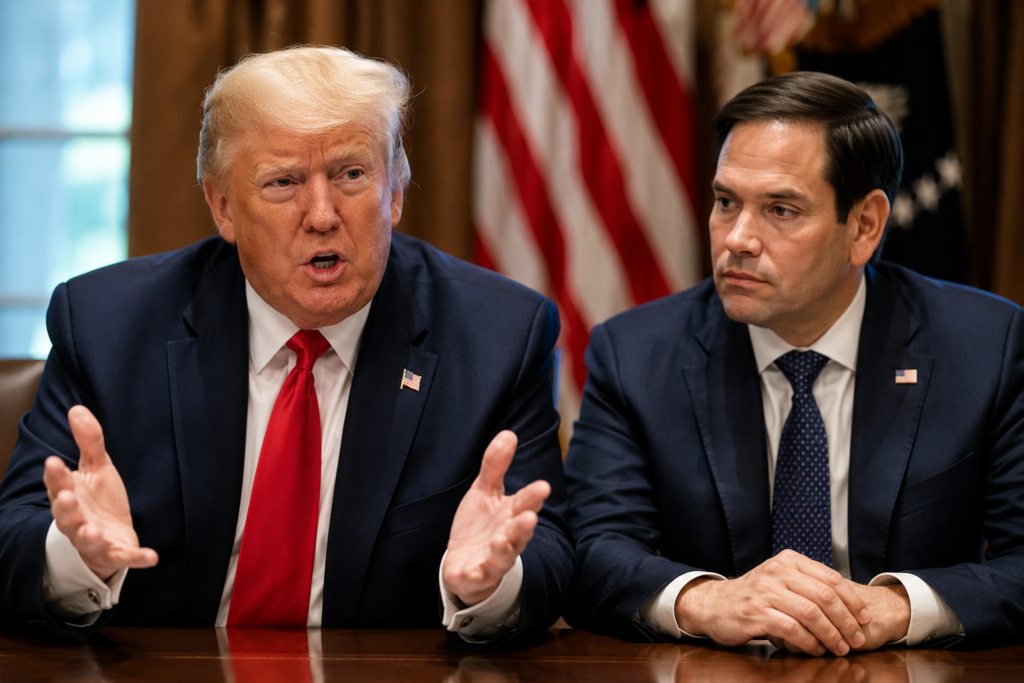
Speaking during the first televised Cabinet meeting held at Camp David, Trump dismissed suggestions that he could personally become a target of the Hague-based court.
“There’s no information that they’re after me,” Trump said.
He acknowledged that such a scenario could theoretically arise but stressed that current U.S. policy toward the ICC is not driven by concerns over his own legal exposure.
“It could happen, but just so you know. He (Marco Rubio) is not trying to defend me. He’s trying to defend Bibi (Benjamin Netanyahu) and various other people. But many people shouldn’t be looked at that way.”
“But there is no indication that I’m one of them at this moment,” he added.
Rubio defends campaign against the ICC
During the meeting, Secretary of State Marco Rubio argued that the International Criminal Court has exceeded its legal authority by claiming jurisdiction over citizens of countries that are not members of the court.
Rubio said the administration’s campaign against the ICC is intended to protect American military personnel, government officials and allied leaders from what Washington considers politically motivated prosecutions.
“The International Criminal Court is an illegitimate international organization,” Rubio said.
“They’ve made themselves illegitimate because they claim that even if you’re not a member of that court, they can come after you.”
He warned that accepting such claims of jurisdiction could eventually expose American service members and political leaders to prosecution despite the United States never having joined the court.
Dispute over Israel
The Trump administration has sharply increased its criticism of the ICC following the court’s decision to issue arrest warrants for Israeli officials, including Prime Minister Benjamin Netanyahu, over allegations of war crimes and crimes against humanity linked to the conflict in Gaza.
Washington has consistently rejected the court’s jurisdiction over Israeli and American nationals, noting that neither country is a party to the Rome Statute, the treaty that established the International Criminal Court.
Trump reiterated that the current diplomatic campaign is intended to defend Israel and other U.S. allies rather than to address any personal legal concerns.
Countries withdraw from the court
Rubio also noted that several countries have recently begun withdrawing from the ICC following increased international debate over the court’s role.
According to the administration, Chad has become the latest country to initiate formal withdrawal procedures after similar moves by Venezuela, Burkina Faso, Mali and Niger.
The withdrawals come amid broader discussions over the court’s jurisdiction and its role in international justice.
Leadership changes at the ICC
The debate has also coincided with changes inside the International Criminal Court itself.
Former ICC Prosecutor Karim Khan, who authorised the arrest warrant for Israeli Prime Minister Benjamin Netanyahu in 2024, was recently dismissed following misconduct allegations.
His departure has added another layer of uncertainty as the court continues to face political pressure from several governments over its investigations and jurisdiction.
The latest remarks from Trump and Rubio underscore the continuing tensions between Washington and the ICC, with the United States maintaining that the court should not exercise authority over citizens of countries that have not accepted its jurisdiction.