
Image: from Domestique X @Domestique___
By Open Chronicle Cycling
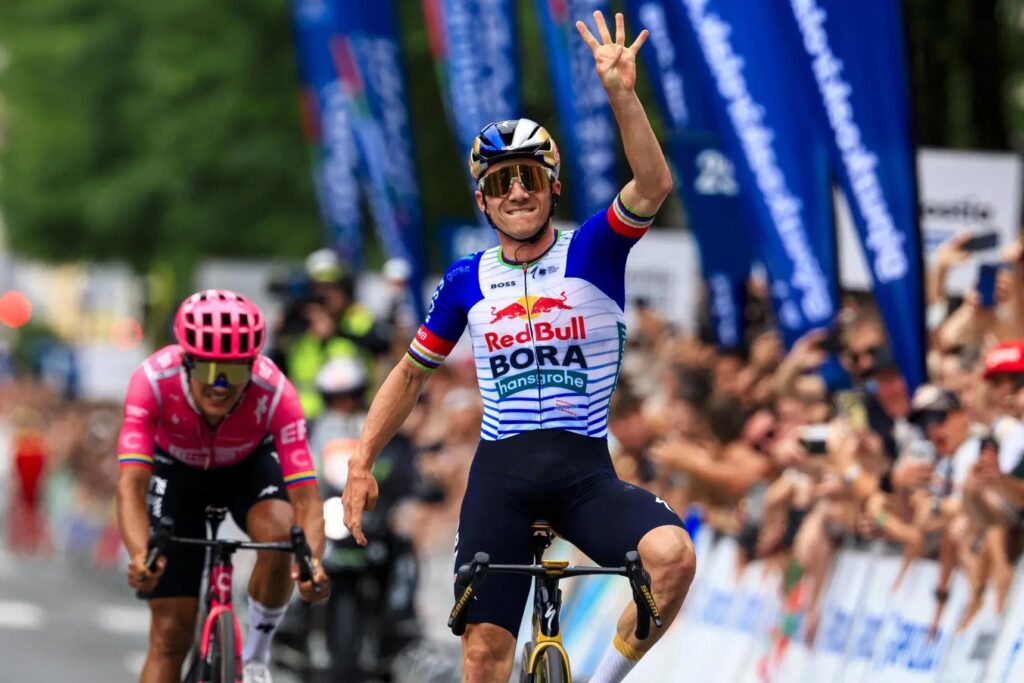
Remco Evenepoel made history in the Basque Country on 1 August, winning the 2026 Clásica San Sebastián after defeating Richard Carapaz in a two rider sprint following a decisive attack on the steep slopes of Murgil.
The victory was far more than another major one-day success for the Belgian.
It was Evenepoel’s fourth triumph in San Sebastián, following his victories in 2019, 2022 and 2023, making him the most successful rider in the history of the race.
Until this edition, Evenepoel had shared the record of three victories with Basque legend Marino Lejarreta.
Now the record belongs to him alone.
And he achieved it only six days after completing the Tour de France in second place overall.
🔥 This climb is always a MUST SEE! 👀
🚩 DONOSTIA – SAN SEBASTIÁN 🏁
🇪🇸 Clásica San Sebastián 2026
🗓️ Saturday, Aug.1st
📏 220km@dklasikoa #Donostia #SanSebastian #Clasica #Klasikoa #Jaizkibel #Erlaitz #Spain #ClasicaSanSebastian #BasqueCountry pic.twitter.com/de9gMaGU7T— Kingdom of Cycling (@Cycling_Kingdom) August 1, 2026
A Basque Classic Built for Attacking
The 45th edition of the Donostia San Sebastián Klasikoa covered 221.1 kilometres, starting and finishing in San Sebastián.
As usual, the race offered very little protection for riders hoping simply to survive until the finale.
Seven classified climbs and approximately 4,150 metres of accumulated elevation made it one of the most demanding one day races of the summer.
The famous Jaizkibel again formed part of the route, followed by the much steeper Erlaitz before the decisive final ascent of Murgil Tontorra.
At approximately 2.1 kilometres with an average gradient around 10 percent, Murgil offered exactly the type of terrain capable of breaking apart an already reduced group.
The summit came less than ten kilometres from the finish.
For Evenepoel, it would become the launching point for history.
The Breakaway Opens the Race
As expected, an early breakaway established itself during the opening phase.
The situation remained relatively controlled until the race approached the sequence of more demanding Basque climbs.
That was where the composition at the front began changing rapidly.
As the kilometres accumulated, stronger riders started moving from the peloton.
The Jaizkibel produced another important selection.
Bart Lemmen, Maxim Van Gils, Michael Leonard and Jay Vine were among those who moved forward, eventually connecting with survivors from the earlier breakaway.
The race was becoming increasingly tactical.
And increasingly difficult to control.
Erlaitz Reshapes the Front
The steep Erlaitz provided another major selection.
Maxim Van Gils, an important teammate for Evenepoel at Red Bull BORA hansgrohe, spent time at the front as a new collection of contenders began emerging.
Giulio Ciccone, Matteo Jorgenson, Louis Barré, Richard Carapaz, Paul Double, Felix Gall, Léo Bisiaux, Mathys Rondel and Enric Mas were among the riders involved as the race reorganised.
Behind them was one conspicuous name.
Evenepoel.
The Belgian had suffered a mechanical problem at a particularly inconvenient moment and was forced into a chase.
In a race this selective, such a setback could easily have ended his chances.
Instead, it became part of the story of his victory.
Evenepoel Has to Chase Back
Evenepoel’s route towards his fourth San Sebastián victory was considerably less straightforward than the final result suggests.
A flat tyre forced him to expend valuable energy chasing back towards the decisive part of the race.
His Red Bull BORA hansgrohe teammates played an important role in helping him return.
Evenepoel eventually joined a chase containing riders including Darren Rafferty, Jan Christen, Kevin Vermaerke, Jhonatan Narváez, Pello Bilbao and others.
The groups gradually came back together before the final circuit.
The mechanical problem had cost Evenepoel energy.
It had not removed him from contention.
When the race reached Murgil, he was exactly where he needed to be.
Everything Comes Down to Murgil
UAE Team Emirates XRG helped lead the reduced group towards the lower slopes of the final climb.
The decisive moment arrived with approximately 8.7 kilometres remaining.
Evenepoel accelerated.
It was the move everyone had been anticipating.
Knowing it was coming did not make following it any easier.
Only one rider could stay with him.
Richard Carapaz.
The Ecuadorian from EF Education EasyPost locked onto Evenepoel’s wheel while the rest of the contenders began losing contact.
Within moments, the race had been reduced to two riders.
Evenepoel and Carapaz Escape
The combination was formidable.
Evenepoel brought extraordinary sustained power.
Carapaz brought the climbing aggression and tactical instinct that have made him one of the most dangerous riders in major races.
Behind them, Ciccone, Barré and the other chasers attempted to close the difference.
But the two leaders maintained their advantage over the summit.
The descent then created another challenge.
Evenepoel and Carapaz had to cooperate enough to prevent the chase from returning, while simultaneously preparing for the inevitable battle between themselves.
Neither could afford to stop working completely.
Neither wanted to provide the other with an easy route to victory.
The chasers remained close enough to keep the pressure alive.
But not close enough.
San Sebastián would be decided between two riders.
A Sprint for History
Carapaz led as the pair entered the final kilometre.
Evenepoel then moved through and took his turn at the front.
The tactical contest continued.
Carapaz regained the lead with several hundred metres remaining.
For a moment, the Ecuadorian appeared perfectly positioned.
Then Evenepoel accelerated.
The Belgian came around Carapaz in the sprint and crossed the line first.
After 221.1 kilometres and more than four thousand metres of climbing, the difference between victory and defeat came down to the final seconds on the streets of San Sebastián.
Evenepoel had won again.
A Record Fourth Victory
The historical significance was immediate.
Before the 2026 edition, Evenepoel and Marino Lejarreta shared the record with three victories each.
Lejarreta had won in 1981, 1982 and 1987.
Evenepoel had won in 2019, 2022 and 2023.
His fourth victory moves him ahead of everyone.
2019
2022
2023
2026
Four appearances ending in victory across seven years have created an extraordinary relationship between one rider and one race.
Few modern riders have dominated a major WorldTour classic so consistently.
From Tour de France Podium to San Sebastián Victory
The timing makes the achievement even more remarkable.
Only six days earlier, Evenepoel had completed the Tour de France in Paris.
He finished second overall behind Tadej Pogačar, producing the best Tour de France General Classification result of his career.
Most riders would consider that sufficient reason for a period of recovery.
Evenepoel instead returned almost immediately to competition.
There were legitimate questions about whether he could recover sufficiently from three weeks of Grand Tour racing to challenge riders arriving in San Sebastián with fresher legs.
The answer came on Murgil.
He could.
Carapaz Comes Close
Richard Carapaz deserves significant credit for making the finale so competitive.
When Evenepoel attacked on Murgil, Carapaz was the only rider capable of following.
That alone demonstrated his strength.
The Ecuadorian then contributed to keeping the chasing group behind during the descent and run towards San Sebastián.
His tactical positioning approaching the sprint also allowed him to win.
But Evenepoel had enough remaining power to come around him.
Second place nevertheless represented another major performance from Carapaz during a strong summer campaign.
Tulett Completes the Podium
Behind the leading pair, the chasing group continued fighting for the final podium position.
Ben Tulett of Team Visma | Lease a Bike emerged as the strongest from that contest and secured third place.
His result completed a podium containing three riders from three different teams.
Remco Evenepoel
Richard Carapaz
Ben Tulett
The race had started with a large WorldTour peloton.
More than 220 kilometres later, those were the three names left on the podium.
Red Bull’s Tactical Contribution
Evenepoel delivered the decisive attack and the winning sprint.
But his victory also demonstrated the importance of team support in a one day classic.
The mechanical problem could have changed everything.
Maxim Van Gils and the Red Bull BORA hansgrohe structure helped ensure that their leader remained connected to the race.
Van Gils had already been active further forward during the decisive middle section.
That gave the team tactical flexibility while Evenepoel worked his way back.
Once their leader returned, the objective became clear.
Get him to Murgil with the strongest riders.
From there, Evenepoel could take responsibility himself.
He did.
The Murgil Formula Works Again
San Sebastián occupies a distinctive place among the WorldTour classics because its decisive terrain arrives after an already exhausting day of climbing.
Murgil is short enough to encourage explosive attacks.
It is steep enough to create meaningful gaps.
And it is close enough to the finish that a rider crossing the summit with an advantage has a realistic chance of surviving.
Evenepoel understood that equation perfectly.
Rather than waiting for a larger group to reach San Sebastián, he used the climb to reduce the race to the smallest possible selection.
Carapaz survived.
Everyone else was eliminated from the battle for victory.
That tactical simplicity was the foundation of the win.
Race at a Glance
Race: Clásica San Sebastián / Donostia San Sebastián Klasikoa
Date: 1 August 2026
Edition: 45th
Country: Spain
Start: San Sebastián
Finish: San Sebastián
Distance: 221.1 km
UCI Classification: 1.UWT
Race Type: One Day WorldTour Classic
Winner: Remco Evenepoel
Winning Team: Red Bull BORA hansgrohe
Second: Richard Carapaz
Third: Ben Tulett
Decisive Climb: Murgil Tontorra
A Victory Built on More Than Strength
Evenepoel’s fourth San Sebastián victory will naturally be remembered for the record.
But the manner of the victory deserves equal attention.
He had completed the Tour de France less than a week earlier.
He suffered a mechanical problem during the race.
He had to chase.
He returned to the decisive group.
Then, when Murgil arrived, he still possessed enough power to make the strongest attack of the race.
Only Carapaz could follow.
Even after that effort, Evenepoel still had enough speed to win the sprint.
It was not a perfect race.
It was arguably more impressive because it was not.
Evenepoel Now Stands Alone
The Clásica San Sebastián has been raced since 1981.
Its list of winners contains some of the greatest riders of several generations.
Marino Lejarreta.
Miguel Indurain.
Lance Armstrong.
Laurent Jalabert.
Paolo Bettini.
Alejandro Valverde.
Philippe Gilbert.
Julian Alaphilippe.
But nobody has now won the race as many times as Remco Evenepoel.
His first victory came in 2019 when, still only 19, he announced himself spectacularly to the WorldTour.
Seven years later, San Sebastián has become one of the defining races of his career.
Four victories.
One record.
And another demonstration of why the steep roads surrounding the Basque city seem almost designed for his abilities.
On 1 August 2026, Remco Evenepoel became the undisputed king of the Clásica San Sebastián.